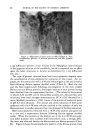
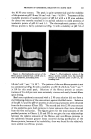
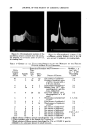
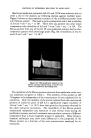
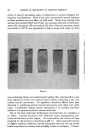
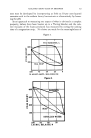
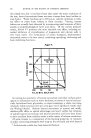
EFFECT OF BILATERAL STRUCTURE ON KERATIN FIBERS 369 ferentiation. Based on cystine content and alkali solubility, the B. A. fleece wool appears to show ortho-para differentiation. However, the B. A. fleece wool does not indicate such differentiation by either dye staining or tendency to curl in alkali. A possible explanation for this apparent anomaly is that each cortical cell or spindle cell of a keratin fiber is either ortho or para in nature. In the 64's wool the ortho spindle cells appear to be concentrated on one side of the fiber and the para spindle cells on the other, leading to ortho-para differentiation. In the B. A. fleece wool it may be that the ortho and para spindle cells are so inter- mingled across the whole fiber cross section that no effective fiber asym- merry is observed. This might explain the lack of dye staining differentia- tion and the lack of a curling tendency in alkali, as well as the much lower crimp level. Both kid mohair and human hair appear to be rather straight- forward in their behavior kid mohair appears to be "pure" ortho and human hair appears to be "pure" para. ?lcknowledgments: The work reported herein was carried out at Textile Research Institute as part of the Wool Research Project, under the spon- sorship of the International Wool Secretariat and a group of American wool manufacturers. Thanks are due A. B. Coe and Miss D. F. O'Reilly for the photomicrography. REFERENCES (1) Bell, P. H., )e. Arm. Chem. Soc., 76, 5565 (1954). (:2) Dusenbury, J. H., and Coe, A. B., Textile Research )e., 25, 354 (1955). (3) Dusenbury, J. H., Mercer. E. H., and Wakelin, J. H., Ibid., 24, 890 (19.54). (4) Freney, M. R., Nature, 160, 799(1947). (5) Golden, R. L., Whitwell, J. C., and Mercer, E. H., Textile Research St., 25, 334 (1955). (6) Harris, M., private communication. (7) Horio, M., and Kondo, T., Textile Research )e., 23, 373 (1953). (8) Mercer, E. H., Ibid., 23, 388 (1953). (9) Mercer, E. H., Golden, R. L., and Jeffries, E. B., Ibid., 24, 615 (1954). (10) Ohara, K., Melliand Textilber., 19, 407 (1938). (11) Ohara, K., Ibid., 20, 3:26 (1939). DIGEST OF DISCUSSION After the paper was presented on September 24, 1954, questions were asked by the audience. What follows is not a verbatim transcript, but rather an attempt to set down the gist of both questions and answers. QuEsxIoN: Could the kinky nature of negroid hair be attributed to its having an ortho-para differentiation? ztnswer: We really don't know. Some very preliminary work was done by Mercer to answer this question when he was at Textile Research Institute. He came to the tentative conclusion that kinky human hair might have an ortho-para character. The problem is complicated by the great amount of pigmentation found in most negroid hair, if preferential dyeing behavior is to be used as an experimental tool. A really complete investigation of all the ortho-para aspects would require a large amount

370 JOURNAL OF THE SOCIETY OF COSMETIC CHEMISTS (about 100 grams) of white or albino negroid hair that is highly kinked, and, preferably, it should be from a single human head. QU•.STION: What relationship does this work have to the recent studies of Pauling and Corey, which show that many proteins have an a-helical configuration that is, the protein molecule is a rather tightly packed coil? /lnswer: Perhaps none, since the ortho-para behavior appears to be related to an assembly of protein molecules rather than to single molecules. A major difference between the two cortex fractions is the cystine content. If the cystinc disulfide bonds serve to cross-link a-helices of the type pro- proposed by Pauling and Corey, it may be that the cystinc difference would affect the way the a-helices are twisted together. Pauling envisions that a-helices (single molecules) to be twisted together to form a still larger, and still helical, assembly of molecules. In this connection, it would be useful to make structural studies with kid mohair (ortho) and human hair (para), if possible, of the sort that Pauling and Corey have made. QUESTION: Wouldn't it be a good idea to make amino acid analyses of your kid mohair and human hair samples to check on the amino acid analysis work of Golden, et al.? alnswer: It certainly would, and we would be delighted to have another graduate student (Golden was one) sent to us who would be interested in doing such work. If he can gain admission to Princeton's Graduate School, please send us his name and address. (Laughter.) J. H. DUSENBU•¾ FOAM TRANSITIONS AND FOAM PERSISTENCE* By M. B. EPSTEIN Onyx Oil & Chemical Co., .Tersey City, N. yt. THE COSMETIC INDUSTRY has a special interest in the persistence of foam. In the development of shampoos, shaving preparations, bubble baths and other toilet articles considerable effort has been expended in finding materials and formulations which can produce long lasting foams. The requirements of the cosmetic industry in these respects differ from other important applications of surface-active agents. Thus with respect to detergents for laundering, high sudsing is not at the moment regarded in some circles as essential for technical or marketing purposes and in some situations is unnecessary and undesirable. * Presented at the May 13, 1955, Meeting, New York City.
Purchased for the exclusive use of nofirst nolast (unknown)
From: SCC Media Library & Resource Center (library.scconline.org)