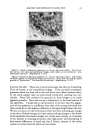
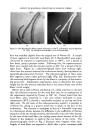
ANATOMY AND HISTOLOGY OF AGING SKIN 301 tissue are due to the fact that this was being studied in regions of the body which were exposed. Ejiri (8, 9, 10) made an extensive study of the human skin using 718 speci- mens from 50 autopsy subjects. He found degeneration of connective tis.- sue, particularly of the elastic connective tissue. Dick (6) studied the skin from many regions of the body including the sole and the dotsurn of the foot, the leg, the thigh, the forearm, the arm, the abdomen and chest in each of 32 autopsy subjects. Of these subjects eight were over sixty-five years old. He prevented shrinkage of these specimens by inserting a number of needles in a circular conformation and then cutting the specimen with an outline one centimeter from the edge of these needles. Beginning with the thirty- to forty-year age group he found in the deeper layers of the dermis a slight irregularity in size of the elastic fibers. Of the subjects over sixty- five years of age he says (page 204) "in the elastic fibers degenerative changes are prominent." The changes consist of rough thickenings of fibers, of variability in their length and of irregular fragmentation of their ends. There seems also to be a tendency for condensation and aggregation of the fibers into irregular masses. In the fibers immediately beneath the epidermis he finds usually a thickening, but occasionally no change, in older people. Ma and Cowdry (19) described the elastic tissue of biopsy specimens from a group of 19 adult males, 11 young, ranging from nineteen to thirty- two years of age, and eight senile, ranging from seventy-eight to ninety- four years of age. In the older group a decrease in the elastic tissue was evident. This change was even more apparent in the plexus just beneath the epidermis than it was in the deep fiber layer. In this plexus the split- ting of the elastic fibers into their component fibrils was observed in senile skin. These workers however, did not find in their specimens the hyaline degeneration, or clumping, observed by Ejiri, and even transverse fragmen- tation seemed to be rare. They do not mention particularly the collagen fibers. They note a definite decrease in elastic tissue in old age which may account for the loss of elasticity. On the other hand, it should be noted that Ceresa (3) found an increase both in the number and thickness of elas- tic fibers occurring up to an advanced age. He attributes frank degenera- tive changes of fibers seen by other authors not to physiological aging but rather to extrinsic factors. The whole question of"elasticity" of the skin is a complicated one. Tun- bridge and his associates (27) indeed believe that this property is dependent not so much upon the presence of the relatively scanty number of elastic fibers as on the netlike arrangement of the collagenous fibers. They find in senile skin from exposed areas a degeneration of some of the collagen fibers whereby they acquire a capacity for taking up the elastic connective tissue .stain and a susceptibility to action of trypsin.

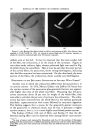
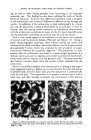
302 JOURNAL OF THE SOCIETY OF COSMETIC CHEMISTS As we can see from the above descriptions a number of authors have noted changes in the fibers of the dermis with old age but there is consider- able disagreement still in relation to the details of the changes which occur and also as to whether or not they are due to actual aging or to other factors that operate from outside of the body. There may be differences in the rather mysterious ground substance or "background" material which lies between the fibers and which determines certain important physiological characteristics such as the permeability of the skin. This is suggested by Ma and Cowdry (19). They say that in the sections of skin from older individuals there was a sort of a cloudiness or lack of clarity apparent as compared with the same material in the skin of young individuals. Their material was from living subjects and promptly and uniformly fixed, and one must give considerable credence to the evidence of a difference in this material at different ages. A great field lies open at the present time in work with 'the electron microscope on the changes in fibers of this connec- tive tissue layer of the skin. In the epidermis we have a tissue which is growing old and "dying" con- stantly in order to serve the function of providing a cellular layer or cover- ing of dead cells for the entire organism and thus to protect it from its environment. Ejiri (9) studied the epidermis in his extensive series of 718 specimens of human skin from 50 autopsies. He describes a decrease in the thickness of one of the layers, namely, the spinous layer of the epidermis over the face and head but an increase with age in this same layer on the upper arm, the hand and the back of the foot. He does not seem to have noticed any changes other than these in thickness, for he says that the basal cell layer shows no change and that there is not a senile atrophy of the granular layer. Ejiri noted no special changes in the cornified layer, the layer of dead cells. Ceresa (3) did not find any definite change in the thickness of the epider- mis in old age. He says that the individual variations in thickness are so great that it is impossible to make conclusions concerning any general tendencies. On the other hand, Evans, Cowdry and Neilson (11) did find differences in the appearance of the epidermis of young and senile human skin in their biopsy material. In the young adult subjects the epidermis had an average thickness of 33.8 micra while in the senile ones the average thickness was 27.3 micra. They believe, however, that a good deal of the difference in the appearance of the epidermis at different ages is due to the much greater tendency of the young skin with its marked elastic quality to shrink on being removed from the body and that this tends to make the epidermis appear thicker than it probably is. In separating away the epidermis from the dermis by special methods they found much less difference in the epi-
Purchased for the exclusive use of nofirst nolast (unknown)
From: SCC Media Library & Resource Center (library.scconline.org)