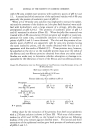
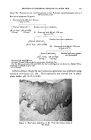
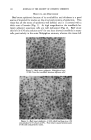
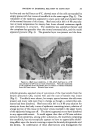
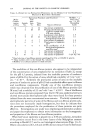
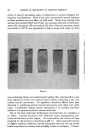
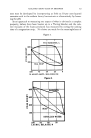
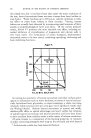
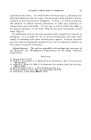
340 JOURNAL OF THE SOCIETY OF COSMETIC CHEMISTS into the disorganized B form in water at 90-95øC., Mercer postulates that this fibrous protein is held together weakly by hydrogen bonds and salt linkages. The pre-keratin zone is dissolved by a saturated solution of urea, while in the area of keratinization this solution causes swelling, the degree of which decreases as the hardening becomes more complete. In the zone of keratinization the formation of disulfide linkages between the protein chains occurs since solution of these proteins by urea follows reduction of the --SINS -- bonds by zinc and hydrochloric acid. Finally stabilization or formation of the true keratin appears to be brought about by the estab- lishment of covalent links, probably cystine bridges, between the protein components in the direction of the fiber (14). Sedimentation analysis by Mercer and Olofsson of the urea extractable proteins from cow lip and snout (epidermis plus dermis) indicates that the synthesis of keratin is brought about by an ascending (lower to upper strata of epidermis) series of molecules produced by aggregation through cystine bridges (23). From the sedimentation rate and diffusion coefficient of the component present in the highest concentration in the urea extract, a molecu- lar weight of 60,000 was calculated, and Mercer and Olofsson considered this protein to be the monomer, the association of which through disulfide bonds generates the increasingly complex proteins in the upper epidermal strata. In line with this concept the observations of Rudall on the thermal contraction of the various layers of cow snout epidermis as a function of temperature are revealing (17). He showed that the stratum corneum was stable in water to a temperature of about 80øC., whereas the outer Mal- pighian layer showed contraction at about 65øC., and the inner level at an even lower temperature. These differences in contraction were ascribed to variations in the internal stability of the proteins in the various strata of the epidermis. The increase in stability from the Malpighian layers to the corneum was attributed to changes from the zone of free sulfhydryl groups to that of disulfide groups. The results reported in this paper demonstrate that concentrated urea solutions (6 and 10 M) extracted from the epidermis proteins which formed clots following dialysis of the urea extracts against distilled water. The complexity of this clot-forming material suggests that it arose from the upper strata of the epidermis. Less concentrated urea solutions (0.5, 1 and 2 M) did not extract from the epidermis proteins which had clot forming properties and the fibrous and non-fibrous proteins obtained are probably extracted from the lower levels of this tissue. Regardless of the source of the fibrous protein, only the one which was obtained from the insoluble proteins of isoelectric point of pH 6.3 had a mobility which was significantly different from the other fibrous protein preparations. However, the fibrous protein obtained from the 0.5 and 1 M urea epidermal extracts was quite soluble in 0.5 and 1 M urea solutions respectively, whereas this protein iso-

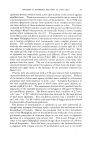
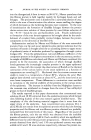
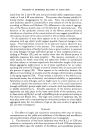
PROTEINS OF EPIDERMIS, RELATION TO AGING SKIN 341 lated from the 2 and 6 M urea extracts formed milky suspensions respec- tively in 2 and 6 M urea solutions. The protein then became soluble fol- lowing further disaggregation by the urea. Since the polydispersity of each molecular species is considerable in urea extracts of cow lip and snout, according to Mercer and Olofsson (23), differences in the state of aggrega- tion of the fibrous protein may not be detected by electrophoresis. The behavior of the epidermal extracts and of the fibrous proteins obtained therefrom as a function of the concentration of urea suggest possibilities of the isolation of some of the units involved in the synthesis of keratin. In the epidermis of man there appears to be no distinct morphological alteration with age which would suggest possible chemical changes in this tissue. The biosynthesis of' keratin in its step-wise fashion allows for pos- sibilities or irregularities in this process. For example, the monomers of the structural proteins of feather keratin have a great tendency to associate by crogs linkages through sulfhydryl groups to form complex proteins ac- cording to Woodin (29), and our studies show that the fibrous protein of epidermis possesses this same property. The manner, enzymatic or by other means, by which cross links are selectively broken or synthesized and thus reduce or increase respectively the molecular weight of the cross linked aggregates might prove to be of great significance for an under- standing and control of changes in protein systems that are associated with the process of aging (30). There appears to be similarities between the effects of cross linking on proteins and the changes which proteins undergo in the aging organism (30). These include a reduction in the ability to re- tain bound water, loss of elasticity and reduced solubility or peptizability. Alterations in cross linkages, such as might occur in a steric position, or of a chemical nature that prevents some or a few of the usual associations through sulfhydryl groups might lead to a keratin with less desirable elastic or pliable characteristics. Actually association of the keratin precursors apparently can take place in the outer most levels of the epidermis, since in these strata sulfhydryl as well as disulfide groups are present according to Van Scott and Flesch (31). The high urea content of epidermis (32, 33) may play some role in maintaining the structural proteins in a less highly aggregated state, but the influence of age on the urea content of aging skin has not been investigated. SUMMARY 1. The effect of single and successive extractions with urea of various concentrations on the yields and mobilities of the fibrous and non-fibrous (structural) proteins of beef snout epidermis was investigated. 2. The extraction of beef snout epidermis once with 0.5, 1 or 2 M urea solutions or successively with three extractions of 6 and 2 M urea solutions had little e•i•ct upon the mobility of the fibrous and non-fibrous proteins
Purchased for the exclusive use of nofirst nolast (unknown)
From: SCC Media Library & Resource Center (library.scconline.org)