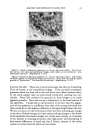
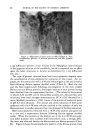
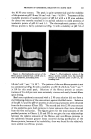
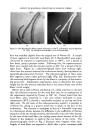
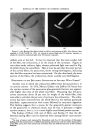
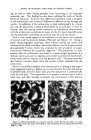
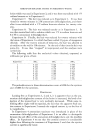
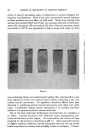
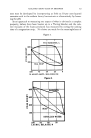
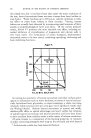
ANATOMY AND HISTOLOGY OF AGING SKIN 305 Let us turn, then, first, to the general study on the dermis and epidermis of the rat skin. We will remember that in regard to the dermis there was a rather confusing series of findings but that there was a considerable body of opinion that there are changes in the elastic connective tissue fibers and probably also changes in the white or collagenous fibers in old age. We found in our very young animals, the twenty-one-day-old rats, that there was a richly cellular dermis, large numbers of fibroblasts and of wandering cells. In these animals the fibrous feltwork generally appears rather loose and the fibers delicate. The elastic tissue was in the form of a widely open network. In the deeper parts of the dermis the fibers are coarse and tend to run parallel to the surface while in the more superficial part they are finer and often run perpendicularly upward. Dense networks are formed about the hair follicles and about the sebaceous glands and here the elastic fibers are relatively heavy. The dermis of the three-hundred-day-old (middle-aged) animals pre- sents a rather marked contrast to that of the younger immature animals in the small number of cells in all of the regions studied. The majority of the cells are pressed closely to the fibers, flattened and with deeply staining nuclei. Very few cells are seen as compared with the younger animals. The collagenous fibers here are coarser than in any of the younger speci- mens and the tissue has a denser appearance. The elastic connective tis- sue showed no change in general from that seen in the very young animals. Of particular interest of course is the appearance of the dermis in the senile rats. Here we find the degree of cellularity or the number of cells per given volume to be rather variable but in general to be much less than in the'very young animal but not to differ greatly from the dermis of the middle-aged animals. There is a larger number of wandering cells, lymphocytes and phagocytic cells in the dermis in the senile animals. The appearance of the collagenous fibers does not differ very greatly from that of the middle-aged animals. No visible evidence of real degeneration or clumping of the fibers was seen except in one 1000-day-old animal where there was a definite basophilic degeneration of fibers. Elastic connective tissue showed remarkably little difference from that in the middle-aged animals. The pattern of the elastic tissue appeared very similar to that seen in very young animals and there is no definite degeneration or clump- ing of elastic fibers seen. When we turn now, however, to the appearance of the epidermis we do find a more marked difference among the different age groups. In the young and the middle-aged animals in general the cells, particularly the nuclei of the cells, have a rather crowded aspect. These nuclei are large and vesicular with relatively little cytoplasm visible between them. This is particularly well seen in the back, the abdomen and on the ear and some- what less clearly on the forepaw.

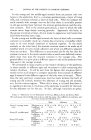
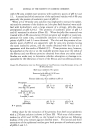
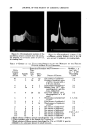
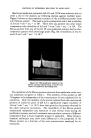
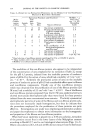
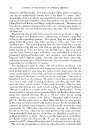
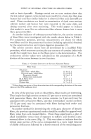
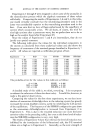
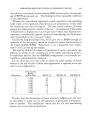
306 JOURNAL OF THE SOCIETY OF COSMETIC CHEMISTS In the young and the middle-aged animals there are present only two layers in the epidermis, that is, a stratum germinativum, a layer of living cells, and a stratum corneum, a layer of dead cells. When we compare the senile animals with younger ones we find that there is invariably present in old age another layer between the stratum germinativum and the stra- tum corneum. This is the stratum granulosum, a layer in which the cells contain many large deeply staining granules. Apparently this layer, in this group of animals at least, did not make its appearance until some time after three-hundred days of age. In the young and middle-aged animals the layer of dead cells or stratum corneum is invariably made up of plate-like structures or lamellae which seem to be very loosely cemented or fastened together. In the senile animals, on the other hand, the stratum corneum seems to be made up of lamellae which are very closely adherent and which are difficult to separate from one another. This difference is accentuated also by the fact that the stratum corneum in the senile animals takes a much more definitely eosino- philic stain than does the stratum corneum in the younger rats. The general effect is to give quite a different aspect to the senile epidermis from that seen in the younger animals. We attempted to make studies on the relative thickness of the epidermis in these animals at different ages and we present a table concerning this relative thickness. It will be seen from the figures that are given that it would not be at all proper to compare epidermis from animals of different ages if material from different regions of the body were to be used. There- fore, the only pertinent comparisons must be made between the back of young and old animals, between the abdomen of young and old animals, etc., for the various regions. When this is done, it is found that there is no significant decrease in thickness of the epidermis in senility for the back, for the abdomen nor for the ear. In fact, although variations are great, TABLE 1--T•IcKNESS Or T•E EPIDERMIS IN YOUNG, MIDDLE-AoED AND SENILE RATS (For each group the probable error is given with the mean the coefficient of variation and the range among the individual rats) Back Abdomen Ear Group I (young, imma- Thickness in u 11.38 q- 0.34 38.3 q- 1.4 18.3 q- 1.13 ture) Coefficient of 10.0 12.5 20.8 variation Range 9.9-12.8 32.7-46.2 13.5-22.0 Group II (middle-aged) Thickness in t• 13.3 q- 1.17 22.2 q- 1.35 10.8 q- 0.67 Coefficient of 41.4 28.6 19.6 variation Range 8.5-17.8 10.7-32.7 7.2-13.5 Group lII (senile) Thickness in u 16.9 q- 1.71 26.1 q- 1.63 15.2 q- 0.80 Coefficient of 47.4 29.2 24.5 variation Range 7.9-31.2 19.9-32.0 12.8-18.5
Purchased for the exclusive use of nofirst nolast (unknown)
From: SCC Media Library & Resource Center (library.scconline.org)