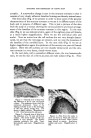
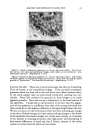
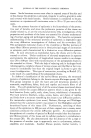
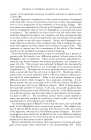
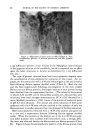
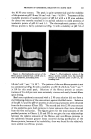
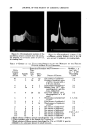
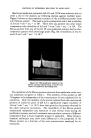
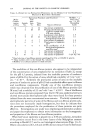
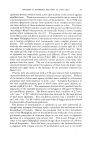
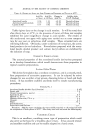
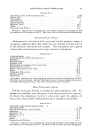
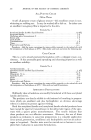
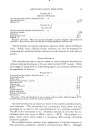
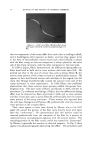
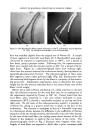
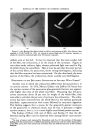
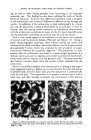
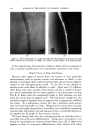
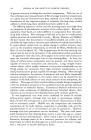
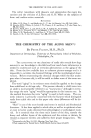
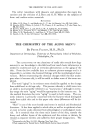
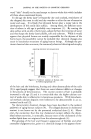
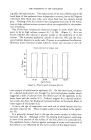
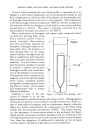
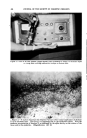
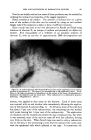
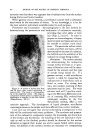
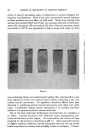
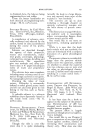
EFFECT OF BILATERAL STRUCTURE ON KERATIN FIBERS 359 ing, as well as when dyeing precedes cross sectioning, is an extremely important one. This finding has also been confirmed by work at Textile Research Institute. It shows that differential dyeing is truly a property of the cortex and is not a result of differential diffusion of dye through the cuticle. In addition, if the orthocortex is dyed preferentially by a basic dye and the paracortex is dyed preferentially by an acid dye, it must be inferred that the dyeing results represent an equilibrium phenomenon, with the orthocortex containing an excess of sites for basic dyestuff cation and the paracortex containing an excess of sites for acid dye anions. Such a view would appear to be confirmed by the amino acid analyses of several wool fractions by Golden, Whirwell and Mercer (5). Using a paper chromatographic technique, these workers carried out amino acid analyses of the whole wool fiber (Australian Merino) and of the paracortex- plus-epicuticle fraction which was prepared by the procedure of super- contraction followed by enzymatic digestion. The paracortex in com- parison with the orthocortex was found to contain larger quantities of a diabasic amino acid, such as arginine, and smaller quantities of dicarboxylic amino acids, such as aspartic acid and glutamic acid. The paracortex was also found to contain about twice the cystine content calculated for the orthocortex. Since it is possible to prepare cross sections prior to dyeing, a key experf- ment suggested itself as a logical way to test the idea that the orthocortex N preferentially dyed by basic dyes and the paracortex is preferentially dyed by acid dyes. This experiment is to prepare a section, dye it with a basic dye, and then attempt to prepare the next section a few microns ß ....• .:. •.?' '.5:, '":4' • -... : . •:?.... •. •.:• . ... •:... •. . '".: .• '• .... •::.: .... 5. "•:"'.',. ß5:-•'-' ...? • . .. : .•. ..• ß . :.. ß .- ,•.• .--.:... .• -'..=:. . :•:- .::... :•.:: ß .. -5• '.':'.• • • .- •.:•:.75 g .. -' (•) .•...' .'•, •75.":".•'•-....•:•-•7%:.•:•:•:5•.:,•.:'.'..''*?".-' • • ..... •':: '%' "% ' ' ß - :...'. '• '"• •" "•"'• "' :,- •' •'." "' "-75.• • "..'•.. •--• .•:.'•.i•5•..:• •..: •. .• . •:::•.•..:-.:%:-.:.. •? ' •:•:•%. "•- ::•'• •. • '•'•: ,. •5•: ":'"' '•5 •.'5:,: :...5 .:. ß •: . •:5 •... ,-..= •:..• •... .v ? •.• ß .g.:• . •,. •.•: :.•- i• .... :.... •-%5 -:. •.. :-) •.• :. :.•--,-.• ....•.•. .?•' •.: :•.i..........-•{ . ,•e.- ..• ..... rc:-• •-• • ' :• • ...:..-• :./•-...•:•'.'.•:.•-. ....... '• ....•....%'•.•-.,.. ¾? .•:. •'•.•....• . ß • • -'..• .' •.... 5, o.' .... ß .... • .- .... •.•...:.•.-::•.: • "'i. • -.•- .. . .... •.•. •.. '5.::. • 5.• .: . .'i i= .•. '• "•:•::i:•..•.' '•5' ' ::'•': '•:?' ::' ..ge•, ß '•?:." .. •'•'• :'•'.•":""i %• ß ' '¾%:1 •:-• •.:'.='.5: ::.•'•.•' .,• •' •. Figure 4.--Photomicrographs of successive sections of 64's Rambouillet fibers (X 660) (a) dyed with a basic dye, Janus Green B (C.I. 133), (b) dyed with an acid dye, Formyl Violet S4B (C.I. 698).

360 JOURNAL OF THE SOCIETY OF COSMETIC CHEMISTS below it in the fiber bundle. In this short length of fiber there is no opportu- nity for the preferentially stained half of the fibers to "switch sides." Accordingly, if the next section showed preferential staining of the opposite half of the corresponding fibers, when dyed with an acid dye, the views of Ohara, Horio and Kondo, and Mercer would be confirmed. Dusenbury and Coe (2) have performed experiments of this sort, and they have found, in- stead, that the acid dye preferentially stains the same side of the fibers as the basic dye. Photomicrographs of such dyed successive sections are shown in Fig. 4. These sections were prepared with a Hardy-type microtome, using Neg- O-Lac as the embedding medium. One section (Fig. 4a) was dyed with Janus Green B, a basic dye, thirty seconds at 75øC., and rinsed with distilled water. The section prepared from the next successive cut of the the microtome (Fig. 4b) was dyed with an acid dye, Formyl Violet S4B, thirty seconds at 75øC., and rinsed with distilled water. The same result has also been observed when wool fibers were embedded in a block of plasticized polymethylmethacrylate and successive cross sections were prepared with a Spencer sliding microtome and then dyed, alternately, with basic and acid dyes. This demonstrates that the method of specimen preparation has no effect on the results. The identification made by Ohara (10) and by Horio and Kondo (11), that the site of the preferential acid dyeing was the portion of the fiber not dyed preferentially by basic dyes, was based on their observation that the' outer, convex portion of the crimp curvature was preferentially stained by basic dyes, and the inner, concave portion by acid dyes. The work of Dusenbury and Coe (2) indicates this result to have been an exceptional one over a wide range of dyeing conditions, acid dyes, like basic dyes, stain the outer, convex portion of the crimp curvature. This has been observed when dyeings were made on bulk samples of 70's wool (Australian Merino), as well as on a sample of 64's wool (U.S. Rambouillet). It was found possible in one instance to reproduce Horio and Kondo's observation, using their dyestuff (Ponceau 2R, C. I. 79) and rather drastic dyeing conditions: thirty minutes at the boil in a phosphate buffer solution of pH 7.0. Further observations on these fibers that had the inner portion of the crimp curvature preferentially stained showed that the boiling buffer solution had reduced crimp frequency and had actually reversed the crimp (presumably by differential supercontraction), placing the orthocortex fraction on the inner rather than the outer portion of the crimp curvature. The preferentially dyed portion of the fiber was identified as ortho by its preferential lability to alkali. This is a possible explanation of the Horio and Kondo results with Ponceau 2R. It does not explain why they ob- served it at 60øC., whereas Dusenbury and Coe observed it only at the boil. The observed dyeing behavior shows that the orthocortex is preferentially
Purchased for the exclusive use of nofirst nolast (unknown)
From: SCC Media Library & Resource Center (library.scconline.org)