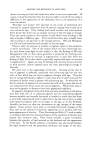
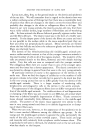
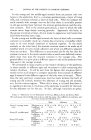
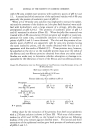
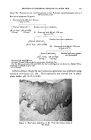
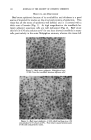
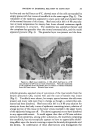
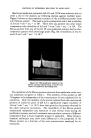
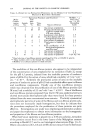
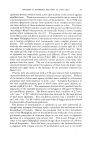
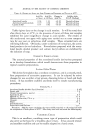
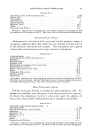
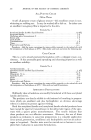
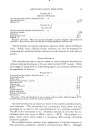
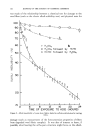
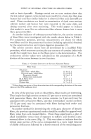
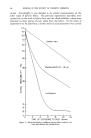
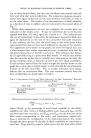
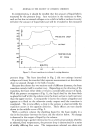
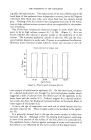
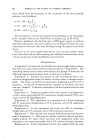
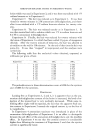
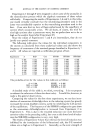
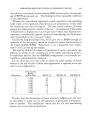
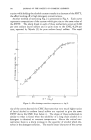
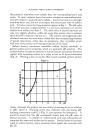
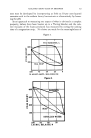
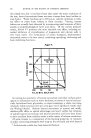
EFFECT OF BILATERAL STRUCTURE ON KERATIN FIBERS 367 out on these keratin fibers, but this time the fibers were treated with sul- furic acid while they were in bulk form. For comparison purposes measure- ments were again carried out on the same domestic wool fiber, as well as on the other three. The results of the determination of alkali solubility as a function of time in sulfuric acid are indicated by the smooth plots of Fig. 7. While these experiments are not yet complete, the smooth plots are indicative of the results so far. It may be noted from the curve that the apparel wool fiber, 64's wool, again has a break in it. This indicates that the rate of "sensitizing" of the cortex for subsequent removal by alkali may again be represented as the sum of two concurrent first-order reactions. It also indicates the fact that the wool being in the more dense fabric construction form does not have much influence on the rate of the reaction. The uppermost curve shown on the graph, the curve for human hair, has a rate constant that, within experimental error, is identical with that for the paracortex portion of the 64's wool curve. This indicates that human hair is again behaving as a paracortex fiber should. It will be seen further that the curve for mohair has an initially very steep portion and that this portion continues down to the point of only 8 per cent alkali insolubility. A rate constant derived from the initial straight-line portion shown on the graph has a value that is closely similar to that obtained for the orthocortex fraction of the 64's wool fiber. This is another indication that mohair behaves like an orthocortex fiber. The rate constants derived from the data on bulk fibers are listed below in Table 2. TABnE 2--PREn•M•rAR¾ VAnu•s voR "RA'rv. Co•rs•rA•r•rs" or Acre "SENs1TI7ING" R•ACTIO• FOR SEVERAl KERATIN F•a•s •Rate Constant (hr. -•) for• Fiber Type Orthocortex Paracortex 64's wool (Rambouillet) 0.263 0.0386 Kid mohair 0.229 Human hair . •. 0. 0433 These rate constants appear in an equation of the type: (Wool)• -- Fortho e -&ønhøt -[- Fpar. e -• .... •, 100 where (Wool)t is the percentage of wool found insoluble by the alkali- solubility test after t hours in boiling sulfuric acid kortho and kpara are the two first-order rate constants and For•ho and Fpa• are the fractions of the fiber cortex corresponding to the ortho- and paracortex, respectively. Fv• is obtained by extrapolation of the least-mean-squares line drawn through the latter portion of the plot of alkali insolubility rs. time back to zero time. Fo,•ho plus Fv•ra equal a value near to but less than unity which

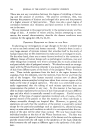
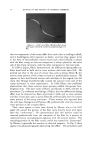
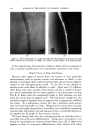
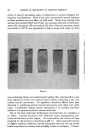
368 JOURNAL OF THE SOCIETY OF COSMETIC CHEMISTS represents the alkali-insoluble portion of the untreated fibers that is, if Fortho plus Fp,r, is 0.921, the alkali insolubility of the untreated wool is 92.1%. For kid mohair and human hair, the data are fitted using only one exponential term an "ortho" term for kid mohair and a "para" term for human hair. The data obtained so far for B. A. fleece wool show great scatter, and it is unlikely that this scatter is due to sampling problems. It is clear that the B. A. fleece wool is intermediate in behavior between human hair (para) and kid mohair (ortho) in this sense, then, it shows the behavior of an ortho-para type of fiber. Unfortunately, it is also equally clear that there is little probability that the data may be sensibly fitted by the sum of two exponential terms, as was done with the 64's wool. Another indication of ortho-para character is the tendency shown by a fiber to curl after it has been exposed to a•lkali. This tendency is consider- ably enhanced by first treating the fiber with acid. This was done for each of the four fiber types and their curling tendency in alkali was observed both before and after treatment with acid. In the case of the 64's wool, there was a slight curling tendency in alkali after twenty minutes exposure. After eight hours in boiling sulfuric acid, the same alkali exposure caused a much more pron6unced curling. The B. A. fleece wool showed little of such curling tendency either before or after acid exposure. In addition, observations made of treated fibers under polarized light were confusing, because there were apparently some strain effects in the B. A. fibers whether or not they had been treated with acid. The effect of such strains in the fibers was to render quite ambiguous any observations with polarized light. Mohair showed little tendency to curl in alkali with or without previous acid exposure. After a treatment with acid for four hours, the fibers, except for scale outlines, appeared to be extremely "porous" to the alkaline solution. After twenty minutes in alkali, wh-en these same fibers were viewed under polarized light, they were observed to have lost essentially all their birefringence. This behavior is to be expected, if the fibers were ortho ones. Human hairs behaved like mohair in their curling behavior, but, after sixteen hours in acid followed by twenty minutes in alkali, they still exhibited a large birefringence. This is another indication that human hair is a para fiber. SUMMA RY As described earlier, four criteria have been used for determining the structure of the cortices of keratin fibers. They are: dye staining, alkali solubility after exposure to acid, tendency to curl in alkali and cystine content. By any of these four standards, the 64's wool shows ortho-para dif-
Purchased for the exclusive use of nofirst nolast (unknown)
From: SCC Media Library & Resource Center (library.scconline.org)