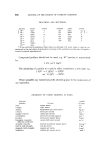
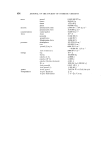
JOURNAL OF THE SOCIETY OF COSMETIC CHEMISTS 3.2. 3.3. 3.4. shall refrain from producing a critical review of the type of the subject review article described above. The syntax shall be as simple as possible and the words used should be those to be found in any ordinary dictionary. If this is not feasible, the author shall make certain that the neologisms he uses form part of the international scientific and technical vocabulary. The author is recommended to state the origin of the neologisms he uses. Should he be obliged to create some himself, he should say how this has been done, giving the etymology and definition. Finally, the author shall make sure that he does not distort the meaning of the terms belonging to the specific vocabulary of the branch of knowledge with which he is dealing. In drafting the text, the author shall describe fully the methods em- ployed and significant results obtained. Should industrial or national security considerations lead him to restrict the amount of scientific in[ormation that he •vishes to publish on the subject he is dealing with, the text shall be presented as belonging to class 2.1.2. provisional communication or preliminary notes, and not to class 2.1.1. original scientific paper. This is an absolute moral obligation for the author. It goes without saying that, in any publication, the facts observed or the methods employed must not be wilfully misrepresented. Explicit reference shall be made to any work previously published by the same author, or by another, when a knowledge of such works is essential in order to see how the text presented fits into the general picture of scientific progress. It should be stated whether these previous publications duplicate, completely or partially, the text presented. 4. OPENING PAGE It is suggested that this include: 4.1. The title. 4.2. Name(s) of the author(s), and titles. 4.3. Names and address of author(s)' laboratory, etc. 4.4. The Synopsis: This should comprise a brief and factual summary of the contents and conclusions of the paper, refer to any new information which it may contain, and give an indication of its relevance. It should enable the busy reader to decide more surely than he can from the mere title of the paper whether it merits his reading it. The author of

DIRECTIONS FOR PREPARATION OF MANUSCRIPTS 457 4.4.1. 4.4.2. 4.4.3. 4.4.4. 4.4.5. 4.4.6. every paper is therefore requested to provide also a synopsis of it, in accordance with the following suggestions. Use complete sentences rather than a mere list of headings. Any reference to the author of the article should be in the third person. Standard rather than proprietary terms should be used. Unnecessary contractions should be avoided. It should be presumed that the reader has some knowledge of the subject but has not read the paper. The synopsis should therefore be intelligible in itself without refer- ence to the paper. (For example it should not cite sections or illus- trations by their numerical references in the text.) Content. As the title of the paper is usually read as part of the synopsis, the opening sentence should be framed accordingly so as to avoid repetition of the title. If, however, the title is not sufficiently indicative, the opening sentence should indicate the subjects covered. Usually, the beginning of a synopsis should state the objects of the investigation. It is sometimes valuable to indicate the treatment of the subject by words such as--brief, exhaustive, theoretical, etc. The synopsis should indicate newly observed facts, conclusions of an experiment or argument, and if possible, the essential parts of any new theory, treatment, apparatus, technique, etc. It should contain the names of any new compound, mineral species, etc., and any new numerical data, such as physical constants if this is not possible, it should draw attention to them. It is important to refer to new items and observations, even though some may be incidental to the main purpose of the paper such information may otherwise be hidden although in fact it might be very useful. When giving experimental results the synopsis should indicate the methods used for new methods, the basic principle, range of opera- tion, and degree of accuracy should be given. References, citations: If it is necessary to refer in the synopsis to earlier work, the reference should always be given in the same form as in the paper otherwise, references should be omitted. Length. The synopsis should be as concise as possible. Only in exceptional cases should it exceed 200 words. S. PREPARATION OF MANUSCRIPTS These should be submitted in duplicate (original and one carbon copy), double-spaced typescript, leaving a 30mm margin on the left-hand side,
Purchased for the exclusive use of nofirst nolast (unknown)
From: SCC Media Library & Resource Center (library.scconline.org)