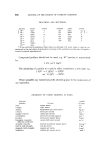
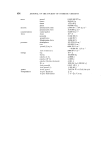
458 JOURNAL OF THE SOCIETY OF COSMETIC CHEMISTS with formulae in careful manuscript. Only one side of the paper should be used. The author should always retain a carbon copy for his own use. To assure typographical correctness in the printed proofs, the following suggestions should be carefully observed in the preparation of manuscripts. 5.1. Matters that are to be set in Greek type should be clearly indicated. Some Greek letters, when handwritten, are difficult to distinguish from similar-looking English letters. In case of both Greek and English letters if not typewritten, it should be made clear if they are to be set in capital or small (lower case) type. 5.2. The letter 1 should be looped when typewritten in equations, etc., to avoid confusion with the figure 1. There should also be a clear differentiation between zeros and the letter 0 (or the small o) which often look the same when typewritten or handwritten. 5.3. Superior and inferior positions should be clearly indicated. 5.4. In general, equations and formulations should be dearly and carefully written, taking care to have all figures and symbols, especially in fractions and equations, in the alignment in which they are to be printed. 5.5. Footnotes. These, as distinct from literature references, should be avoided as far as possible. Where they are essential, reference is made by the symbols * t } [II ô in that order. 6. ILLUSTRATIONS All photographs should be black and white, glossy, and unmounted. Diagrams, graphs, charts, etc., should be about twice the final size required, and should be drawn in Indian ink on tracing paper, or on white drawing paper. All letterings and figures should be large enough to be capable of reduction to the required size. The following standard symbols should be used on line drawings since they are easily available to the printers. ß A I [] O + o © x •, On the back of each illustration, photograph, etc., should be written the author's name and the figure number. Legends for the figures should be supplied on a separate sheet. 6.1. Each illustration, figure, graph, or chart, should be numbered con- secutively using Arabic numerals, e.g. Figure 1. 6.2. Tables should be numbered consecutively, using Roman numerals, e.g. Table I.

DIRECTIONS FOR PRF•PARATION OF MANUSCRIPTS 459 7. REFERENCES The names of all the authors of papers to be cited should be given when reference is first made in the text. In cases where there are more than two authors subsequent citations should give the first-named author followed by the words et al underlined once. References should be indicated in the text by bracketed numbers, and the full reference should be given at the end of the paper in the following form. 7.1. Journals. It is essential that the authors' names and initials, the abbreviated title of the journal, the volume number, the page number, the month and year of publication should be given. Abbreviations of journals should be in accordance with the practice followed by Chemical Abstracts (cf. list of periodicals, abstracted by Chemical Abstracts). If access to that publication is not available then the name of the journal should be given in full. 7.2. Books. It is essential that the authors' names and initials, the full title of the book, the page number, the year of publication, the name and address of publishers should be given. 7.3. Patents. Only the patent number should be cited, e.g. Brit. Pat. 805,202. 7.4. Please note that in the typewritten manuscript 7.4.1. the abbreviated or full title of the journal, or the title of the pub- lished book, should be underlined once 7.4.2. the volume of the journal should be underlined by a wavy hne 7.4.3. the month of publication, the year of publication, and the publisher in the case of books, should be bracketed independently of each other, e.g. (1) Fregert, S. Acta Dermato-Venereol. 40 206 (July) (1960). (2) Baer, R. L. in McKenna, R. M. B. Modern trends in dermatology 232 (1954) (Butterworths, London). If references are likely to be accessible only with difficulty, the inclusion of a suitable abstract reference is also desirable. 8. UNITS OF MEASUREMENT Only SI units may be used [see J. 19 449 (1968)1.
Purchased for the exclusive use of nofirst nolast (unknown)
From: SCC Media Library & Resource Center (library.scconline.org)