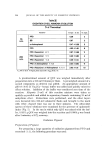
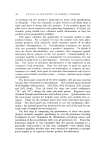
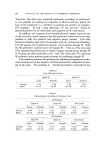
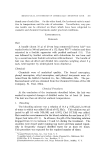
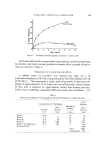
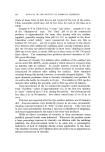
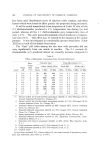
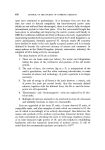
388 JOURNAL OF THE SOCIETY OF COSMETIC CHEMISTS Fortunately, that is not the question the authors set out to answer. What was required from examining the hedonic scores was if the local and national panels were divergent. From the three exercises tabulated for hedonic data, it is concluded that the panels trended in parallel. The only possible exception seen was a higher regard for their own brand shown by the local panel R-preferrers, but this balanced out in Table V where 57.2% of them and 58.2% of the national R-preferrers scored R equal with or higher than their own brand. Effect of Test Procedure on Responses It should be remembered that a reason for the use of small panels of discriminating and articulate consumers, as represented by the local panel, is to obtain the necessary product information as efficiently as possible, as is the case for most consumer test operators. Each local panel member has been relied on to respond succinctly in a blank space of 7•/2 X 1•/5 in. to the following questions' "What did each member of your family think about these toothpastes ? What did he like and dis- like about each one ? Which one of the two did he like better ? Why did he like it better ? Please explain as fully as you can." Table V Preferrers' Ratings of the Two Products in Comparison with Their Own Brands (Derived from Hedonic Scores) R-Preferrers About R About W Local National Local National (%) (%) (%) (%) [21.9 23.66} 582 Morethan 10.0 { 2.0 0.•} 10.4 57.2 (35.3 34 ' Equal to 8.0 9. 42.8 41.6 Less than 88.0 84.6 0 0.3 No answer 2.0 5.1 W-Preferrers About W About R Local National Local National (%) (%) (%) (%) •34.8 34 71 4 31 6 ' 3 66.3 (31.5 37 ' Equal to ' 28.3 16.9 f 33.7 26.4 Less than 67.4 73.6 0 2.1 No answer 1.1 3.2

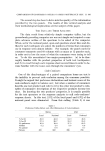
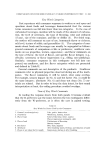
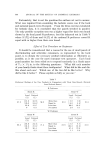
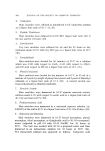
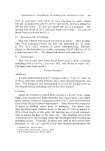
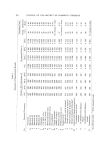
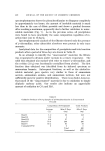
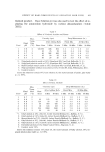
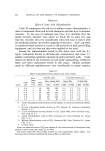
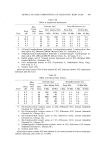
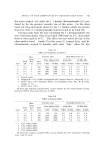
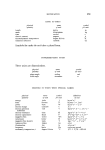
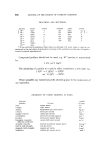
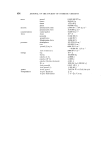
COMPARISON OF CONSUMER PANELS IN PAIRED PREFERENCE TEST. II 389 In contrast, the national panel, being a cross section of the popula- tion, was thought to need some guidance in responding. Consequently, these panelists received a more structured questionnaire: four separate questions called for likes and dislikes about the two test products, and two separate questions asked: "How would you describe the flavor of... ?" These description questions produced more meaningful in- formation than the like-dislike questions, which in turn tended to pro- duce general information. For the national panel, 3407 separate comments were punched, and for the local, 763 were punched. Although the laboratory profile panel found no differences in texture, consistency, degree, and duration of suds, these physical properties (i.e., nonflavor) as well as observations on tooth cleansing were cited. A slightly higher percentage of the national panelists' comments were in the nonflavor category, i.e., 15% national and 13% local. But this is to be expected, since the national panel's instructions required one sample to be used for the first week and the second sample for the second week. This procedure permitted observa- tions on tooth cleansing, brightening, and whitening. Another difference in performance between the two panels is directly ascribable to the difference in questionnaires. The national panel produced 5.1 flavor comments per person, while the local panel produced 2.1 flavor comments. But on the other hand, of all the national panel's flavor comments, 47% were general comments whereas, of all the local panel's flavor comments, only 24% were general ones. Another way of stating this is: the average number of specific (as opposed to general) flavor comments per person was 2.7 for the national panel and 1.6 for the local one. It remains to determine if, despite the difference in "volubil- ity," the two panels provided the same or different information. Rank Order of Specific Flavor Comments One way of determining this is shown in Table VI, which ranks by frequency the specific flavor comments obtained from both panels. These have been segregated according to preference and they include both the positives about the preferred toothpaste and the negatives about the other. In addition, the adults are considered separately from the chil- dren, since they obviously had different attitudes. Two points are immediately evident: (a) good agreement in rank order occurred with the R-preferrers of both panels and with the W-pre- ferrers of both panels (b) the R-preferrers and the W-preferrers saw the issues between the two toothpastes differently. For example, the adult
Purchased for the exclusive use of nofirst nolast (unknown)
From: SCC Media Library & Resource Center (library.scconline.org)