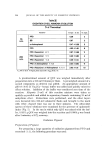
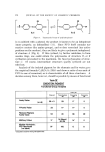
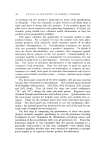
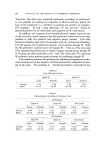
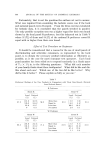
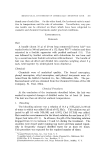
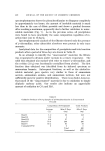
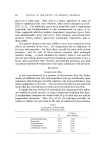
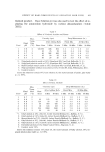
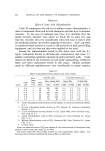
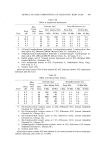
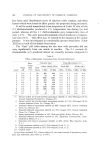
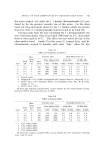
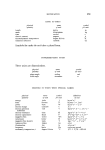
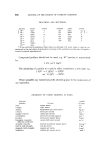
390 JOURNAL OF THE SOCIETY OF COSMETIC CHEMISTS R-preferrers commented most often about flavor-level and flavor-type the adult W-preferrers commented most often about the cleansed im- pression in the mouth and flavor-level. The children R-preferrers were mainly concerned with hot factors, but the children W-preferrers placed hot factors last in rank, emphasizing flavor-type. To help visualize the way the preferrers saw the pairs of samples, typical descriptions are shown in Table VII. The table also illustrates Table VI Rank Order of Specific Flavor Cmnments Adults Children Local National Local National R-Preferrers (q- about R -- about W) Level (44) Type (157) Type (32) Hot (112) Type (39) Level (123) Hot (30) Type (86) Clean (32) Clean (115) Level (29) Level (31) At (28) At (90) Clean (16) Clean (28) Hot (9) Hot (50) At (5) At (5) W-Preferrers (q- about W -- about R) Clean (29) Clean (82) Type (18) Type (42) Level (24) Level (63) Clean (11) Level (31) Type (19) Type (57) Level (8) Clean (28) At (19) At (32) At (8) At (10) Hot (10) Hot (12) Hot (4) Hot (5) Table VII Typical Descriptions for the Two Products By R-Preferrers Key Word -• About R -- About W Level Mild Type Minty Clean Clean feel refreshing At Refreshing Hot Cool didn't burn Too strong fiat Antiseptic soapy powdery Not clean not refreshing Dislike too long not refreshing Too hot burny hurt By W-Preferrers Key Word -• About W -- About R Clean Clean feel refreshing Not clean not refreshing Level Distinct stronger Bland not strong enough Type Minty Soapy oily harsh At Refreshing lively Not long dull Hot More powerful Bity

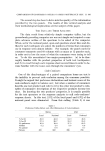
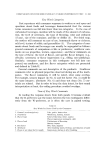
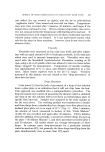
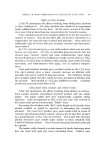
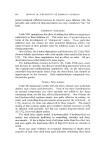
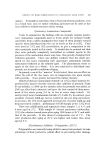
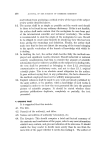
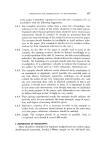
COMPARISON OF CONSUMER PANELS IN PAIRED PREFERENCE TEST. II 3•1 overlaps and apparent contradictions which might have defied interpre- tation had the authors not been thoroughly familiar with the two prod- ucts through their flavor and brushing profiles. An example of an ap- parent contradiction is seen for the R-preferrers' negative comments about W's flavor-level. Some said W's flavor was too strong, others said it was flat. Both descriptions are credible. Consumers, rightly or wrongly, frequently diagnose the problems for us. For example, "this soup is not salty enough" means that the re- spondent would correct its flavor by salt, not that she thought the salt taste was too low. Similarly, some of the R-preferrers felt that the ef- fects they perceived could be ascribed to too much flavoring, while others rightly said that the flavoring of W didn't have much unified identity. In fact, by monitoring the products during the consumer test- ing period, it became evident that W's flavoring had fallen apart, un- fortunately. This fact is reflected in negative remarks about its flavor- type--antiseptic may be menthol or astringency of the base soapy may be an unblended component of the flavoring or the base coming through powdery may be an impression from the flavoring or chalkiness from the base. Now, proceeding to the W-preferrers--they thought W's flavor level was distinct and stronger. This is definitely the same kind of thinking that the R-preferrers showed that is, W made a strong impression. In contrast, the W-preferrers said that R did not make a strong enough impression, and furthermore, they could detect unflavored base (soapy, oily, harsh) in R. They, too, were correct according to profiles. SUMMATION The data given in this paper, in the authors' opinion, make two sig- nificant contributions to consumer product testing methodology: 1. They provide further support for a pilot test approach which asks relatively small panels of articulate discriminators to respond through simple open-end or free-response questionnaires. In this paper and its predecessor the parallelism of the local and national panels was unequivocally demonstrated, both horizontally in over-all trends and vertically when data were considered according to the consumer panel- ists' preference votes. The obvious advantage gained from using ar- timlate discriminators is the saving of time and effort it doesn't take as long to gain a perspective of the test parameters resulting from the two test products' properties it doesn't require the coding of masses of inarticulate terms that emanate from a cross-sectional consumer panel
Purchased for the exclusive use of nofirst nolast (unknown)
From: SCC Media Library & Resource Center (library.scconline.org)