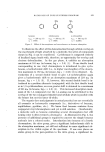
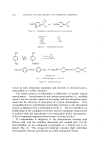
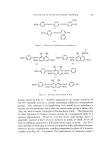
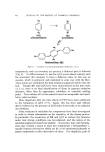
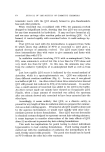
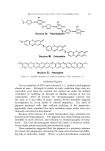
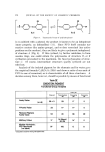
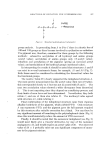
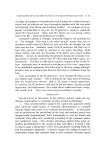
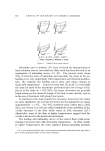
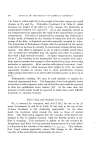
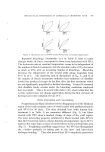
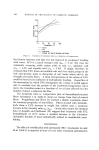
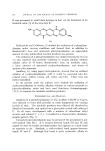
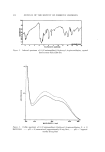
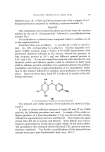
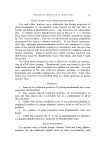
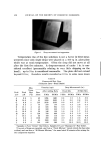
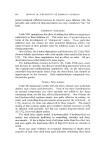
354 JOURNAL OF THE SOCIETY OF COSMETIC CHEMISTS -.•/•k /•.•o + /•k /0- H2N '--•Nxa 0 • H2N•N,• 0 Figure 4. Resonance contribution by an auxochrome (CH:•)2N-- --C1 --NH• --Br --OH --CHa --OCHa Figure 5. Auxochrome Groups N02 N02 ½ 9 HCI + NH2 N-•N:C1- (CH•)2N-• (CH•)0N--•N=N--•N02 + 0- Orange-red X ...... = 470 mt• (log e = 4.5) (6) Figure G. Typical azo dye crease in both absorption maximum and intensity is obtained and p- nitroaniline is a yellow substance. The amino group in p-nitroaniline is illustrative of groups termed auxochromes. Auxochromes do not contain unsaturation (i.e., multiple bonds), but are usually capable of increasing both the absorption maxi- mum and the intensity of absorption of a given chromophore. They accomplish this by contributing nonbonding electrons to the delocalized system as illustrated for p-nitroaniline in Fig. 4. The over-all effect is a lengthening of the conjugated systems, and the maximum enhancement is realized when the auxochrome is in conjugation with a chromophore. A list of commonly employed auxochromes is shown in Fig. 5. If p-nitroaniline is subjected to the diazotization reaction with nitrous acid, and the resulting diazonium salt coupled into N,N-di- methylaniline, an azo compound recognizable as a typical dye is ob- tained (Fig. 6). This orange-red molecule contains eight individual chromophores and one auxochrome in a fully conjugated system.

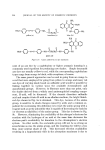
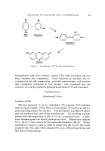
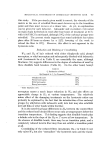
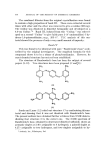
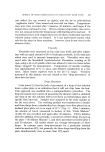
RATIONALE OF DYES SYNTHESIS PROGRAM 355 In his day-to-day laboratory work, the dye synthesis chemist em- ploys reasoning based on the general principles that have just been briefly presented. With experience, he will have accumulated a fairly extensive, fingertip knowledge of the general effect of various structural modifications on the color of a given chromophoric system. His may be described as a "shifty" occupation for, in essence, he begins with a particular colorless or colored molecule and, by synthesizing appropriate derivatives, imparts bathochromic or hypsochromic shifts to its absorp- tion spectrum to obtain the desired range of colors. Usually super- imposed on the color itself is the additional requirement of end use, for the dyes must have affinity for the substrates for which they are being designed, be it cotton, wool, nylon, hair, or what have you. This latter requirement often complicates the solely color aspect since substantivity to a particular substrate may also require structural modification of the chromophore, and the effect of such variations on absorption must also be taken into account in deciding what structures will give the desired color. Finally, the dyes which the chemist makes must meet certain practical requirements such as washfastness, lightfastness, perspiration stability, stability toward bleach, and so on. To illustrate the general approach taken by the organic chemist, it may be useful to take a hypo- thetical, specific problem of the type which is often presented and follow its development. DYE SYNTHESIS PROGRAM The aromatic chemicals department of Company XYZ, which also manufactures a range of dyes, has put into large-scale, economical pro- duction a colorless aromatic amine not previously commercially avail- able, viz., sulfanilic acid. Having a strong position in aromatic (benzene and naphthalene) intermediates plus a good position in acid dyes for wool, the management feels that it would be worthwhile to prepare a preliminary series of acid azo dyes for wool using the newly available amine to determine possible commercial utility. The dye synthesis man has had, therefore, the characteristic chromophore defined for him as the azo group. In addition, the added requirement of sulfonic acid groups has been imposed so that the dye will go on wool. In general, he knows that the color and dyeing properties of this class of dyes will be a function of the number and position of the azo groups, the type of aro- matic nuclei employed (benzene, naphthalene, pyridine, etc.), the number and position of additional chromophores and auxochromes and, finally,
Purchased for the exclusive use of nofirst nolast (unknown)
From: SCC Media Library & Resource Center (library.scconline.org)