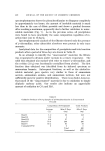
392 JOURNAL OF THE SOCIETY OF COSMETIC CHEMISTS which, according to the best advice, has to be guided to respond through specific and pointed questions it doesn't necessitate the analysis of reams of print-outs. From these data, it is not claimed that a panel, as represented by the local one, can be applied without reservation to all types of flavorful products. Because they are used nationally, toothpastes were selected as the test products. This pair was really quite similar, not like a com- parison of wintergreen versus spearmint. It is entirely conceivable that regional preferences for a different type of product would create different preference trends between a local and national panel. But since an aim in consumer product testing is to isolate the important product integers for subsequent product improvement if necessary, this aim could be at- tained with facility from a local panel, and the positive and negative aspects of the product integers could then be interpreted in the light of knowledge of regional preferences. A less controversial approach would entail having pre-established regional panels of articulate discriminators, who provide not only reliable information, but also representative pref- erence and hedonic score trends for the particular region. The point of this work is this: one can use a panel of articulate discriminators more advantageously than a cross-sectional panel. 2. The data also demonstrate the need to consider the panelists' qualitative comments and the positive and negative tones of the com- ments in order to interpret the over-all statistical data. In a paired comparison test one rarely finds a vast majority preferring one product over the other, unless there is a considerable difference in quality in the pair. Thus, one must delve into the issues as seen through the eyes of the preference voters. In this test, one sample was clearly preferred but the choice was based on the negative aspects of the not-preferred sample. This is hardly a realistic situation in the commercial world. But a small corps really liked the rejected-by-the-majority sample. This is an im- portant piece of information and it surely could tip the scales of decision in favor of the less popular product, if one were considering which prod- uct to turn over to marketing. Even so, on the basis of the panelists' comments and the internal laboratory analyses of the liked-by-the- minority product, it would be possible to suggest certain steps for im- provement: stabilizing the flavoring so that it would cover the base better and still present a lively highly stimulating but cooler mouth impression. (Received September 11, 1967)

COMPARISON OF CONSUMER PANELS IN PAIRED PREFERENCE TEST. II 393 REFERENCES (1) Caul, J. F., and Raytnond, S. A., Principles of consumer product testing, J. Soc. Cosmetic Chemists, 16, 763-776 (1965). (2) Caul, J. F., and Raymond, S. A., Comparison of local and national consumer panels in a paired preference test. I. Statistical data, Ibid., 18, 123-133 (1967). (3) Caul, J. F., Evaluation of a root-beer flavored fountain syrup, Proc. 13th Ann. Meeting Soc. Soft Drink Technologists, 117-130 (1966). (4) Caul, J. F., and Raymond, S. A., Home-use test by consumers of the flavor effects of disodium inosinate in dried soup, Food Technol., 18, 353-394 (1964).
Purchased for the exclusive use of nofirst nolast (unknown)
From: SCC Media Library & Resource Center (library.scconline.org)