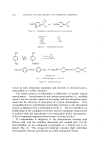
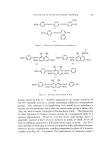
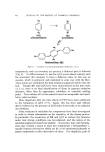
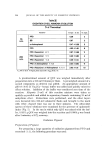
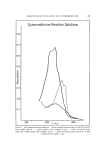
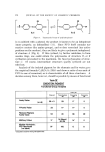
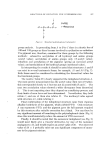
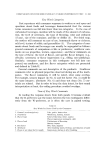
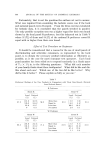
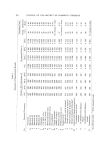
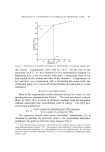
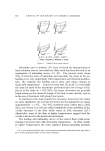
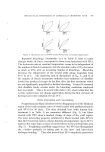
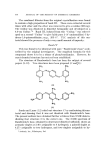
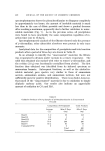
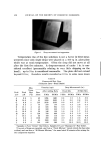
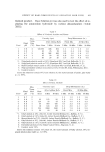
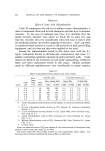
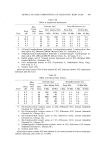
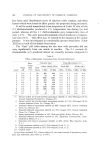
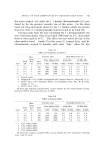
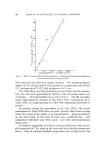
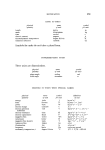
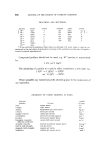
MECHANICAL HYSTERESIS OF CHEMICALLY MODIFIED HAIR Figure Simple mechanical model of keratin fiber more than the work required for extension. This may be interpreted by a spring-dashpot model (oversimplified) (Fig. 3), in which the viscosity of the dashpot is temperature dependent while the springs are essentially independent of temperature. Such a model produces instantaneous elasticity from S• and retarded elasticity from S2 and D• during loading. During unloading, S• is responsible for the immediate rapid loss of stress, while S2 and D• account for the slow release of further stress almost to the initial length. From this point on, the simple model fails to explain the rapid loss in stress to zero load. It is, therefore, concluded that the apparent second order phase transition signals a change in viscosity of the matrix with temperature. Consequently, a change in the hysteresis ratio is related to a change in the viscosity of the matrix. Effect of Introduction of Bulky Groups Watt and Leeder (20) have shown that the introduction of bulky additives into keratin (treatments 2 and 6a in Table I) produces a decrease in the equilibrium water content at high humidities. This was interpreted by them as indicating removal of possible sites for water binding. Since water is considered to be a plasticizer for keratin (16, 27), removal of such sites should lead to a more rigid or viscous material. Feughdman and Watt (9) drew a similar conclusion from the observed increase of the wet torsional modulus by addition of bulky groups to keratin fibers and attributed their findings to an increase in matrix viscosity. Farnworth (29) showed that phenyl isocyanate reacts with the amino, carboxyl, and thiol groups of wool and, possibly, with other active sites, thereby introducing bulky groups into a number of environ- ments in the hair. The present study shows dependence of the hysteresis ratio on the type and number of added bulky groups. Mercuric acetate (treatment

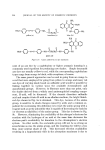
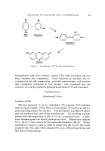
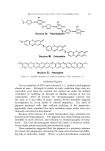
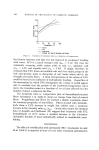
4O4 JOURNAL OF THE SOCIETY OF COSMETIC CHEMISTS 7 in Table I), which adds 8% to the weight of the fiber, causes only small changes in W20 and//20. Ninhydrin (treatment 2 in Table I), which increases the weight of the fiber by 15%, changes Woo drastically at temperatures between 0 øC and 25 øC. tt2o is also markedly altered at low temperatures but approaches the value of the control fibers at higher temperatures. This may be interpreted by assuming that Ruhemann's Purple, which is formed by the reaction of ninhydrin with the amino groups of the fiber, is deposited near sites normally occupied by water. The interaction of Ruhemann's Purple with the molecules of the matrix could effect an increase in viscosity by mechanical rubbing during defor- mation. This effect is analogous to one in polycrystalline textile fibers (16), in which the crystallites may rub against each other to produce a fiber with a high internal viscosity. At higher temperatures, especially above Tt, the viscosity of the deaminated (due to reaction with ninhy- drin) matrix becomes low enough to flow around these large obstructing molecules or aggregates. After reaction with phenyl isocyanate (treat- ment 6a in Table I), which increases fiber weight by 2•3%, the matrix apparently becomes so viscous (due to steric interferences between bulky groups) that there is no observable transition point, at least up to 80 øC. Hydrophobie bonding (30) may be used similarly to explain the observed experimental facts. The formation of new hydrophobie bonds in the fiber in effect squeezes water out of the fiber and would be expected to alter the equilibrium water content (20). At the same time, the presence of such bonds would be expected to make fibers more difficult to stretch, i.e., increase viscosity. Main Chain and Oxidative Scission W20 is lowered by treatment with 0.01N HC1 for one or for 24 hours (treatments 3a and 3b in Table I) but only in the case of the 24-hour treatment is this weakening appreciable. On the other hand, the hysteresis ratios remain the same as those of control fibers. This observation suggests that the viscosity of the matrix (the dashpot in Fig. 3) remains constant, while the fibrillar portion of the fiber is changing. This conclusion is similar to the one reached by Feughelman and Watt (9) from torsional measurements of a ratio which is a function of the viscosity of the matrix, i.e., •wet/•dry- They indicate that "bond scission apparently causes little change in the effective viscosity of the wool structure maintaining the stress."
Purchased for the exclusive use of nofirst nolast (unknown)
From: SCC Media Library & Resource Center (library.scconline.org)