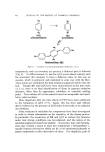
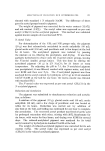
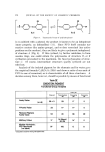
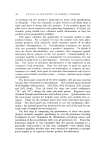
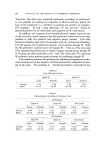
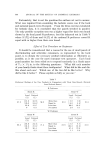
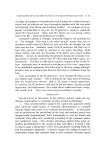
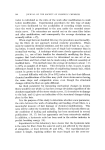
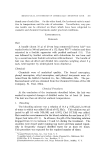
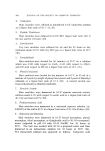
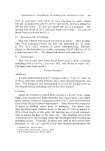
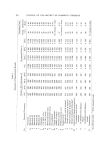
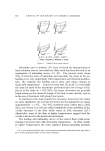
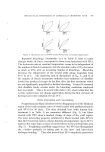
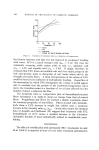
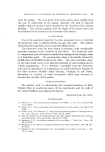
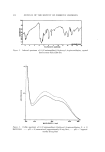
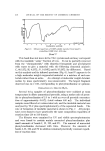
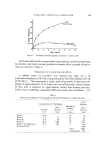
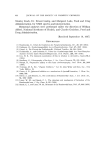
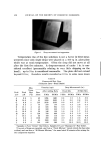
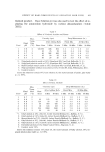
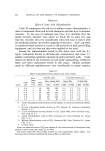
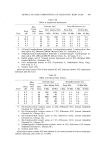
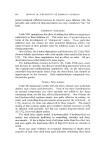
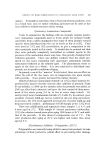
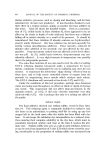
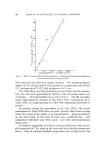
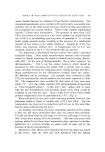
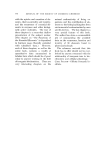
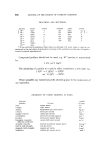
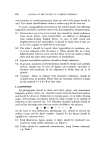
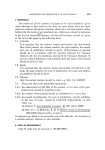
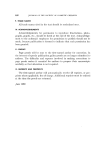
MECHANICAL HYSTERESIS OF CHEMICALLY MODIFIED HAIR 405 Strain Strain 0 ø C 250 C Strain Strain 650 C 800 C Figure 4. Hysteresis curves of PFO-treated human hair at various temperatures Repeated bleachings (treatments la-e in Table I) seem to cause changes which, at times, correspond to those from hydrolysis with HCI: The hysteresis ratio at constant temperature seems to be independent of the number of bleach treatments but the absolute value of W20 decreases as much as 35% with an increasing number of bleachings. Bleaching increases the temperature of the second order phase transition from 46 øC to 56 øC. The surprising lack of dependence of H20, T•, and HE of the number of bleach treatments indicates that oxidation (of disulfide bonds) has produced changes in the fiber after the first treatment which are not significantly magnified by further bleaching. It must be assumed that disulfide bonds scission under the bleaching conditions employed here was slight. This is in accord with Zahn's (31) observation that the cystine content does not change appreciably during the first six hours of hydrogen peroxide oxidation even at 50 øC. Helix Disruption and Crosslinking Feughelman and Haly (23) observed the disappearance of the Hookean region of the load-extension curve of wool treated with perfluorooctanoic acid (PFO)for 30 days. The data obtained here (with human hair, treatment 8 in Table I) are somewhat different (Fig. 4), but fibers treated with PFO show a marked change of slope of the yield region. The most interesting property exhibited by fibers treated with PFO is that their hysteresis ratio is a linear function of temperature (up to 80 øC) and has the same slope as that of control fibers in the pretransition area (Fig. 5). Feughelman and Haly suggest that "the PFO has disorganized the a-helices probably by taking part in the inter- and intra-chain hydrogen bonding." They also proved that PFO completely penetrates

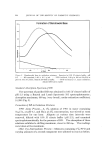
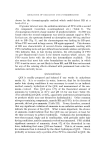
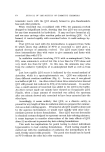
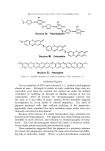
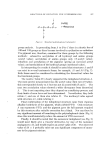
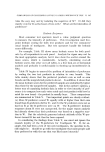
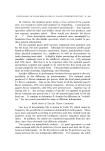
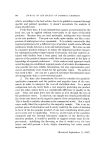
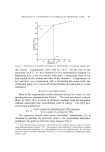
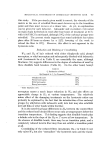
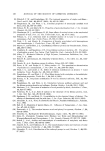
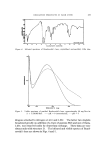
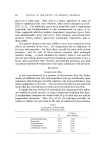
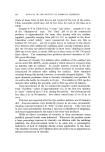
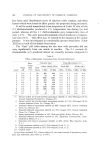
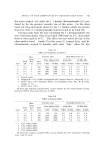
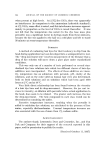
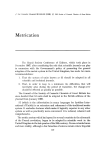
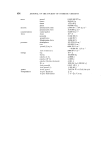
4O6 JOURNAL OF THE SOCIETY OF COSMETIC CHEMISTS 0.8 ÷ o 2'5 50 75 I•)O Temperature øC -- Control .... PFO --o-- Deominoted ......... Reduced with Benzyl MercZlptan ond Blocked Figure 5. Variation of hysteresis ratio as a function of temperature the keratin structure and that it is not removed by prolonged washing with water. PFO is a much stronger acid (PK• = 2.14) (32) than the commonly occurring acidic amino acids in hair, i.e., glutamic acid (pK• = 4.07) and aspartic acid (pr• = 3.86). It might, therefore, be reasoned that PFO forms an insoluble salt with free amino groups in the hair and thereby leads to disruption of salt bonds which add to the strength of keratin fibers. A third interpretation of the action of PFO could be based on the influence of hydrophobic bonding. Regardless of the mechanism by which PFO disorganizes the a-helix, it would appear safe to conclude that the portion of the hysteresis/temperature curve above the transition point is a function of (or at least affected by) the number of intact a-helices in the fiber. The hysteresis ratio rs. temperature plot of formaldehyde-treated fibers (treatment 5 in Table I) shows no change from that of control fibers. Feughelman and Watt (9) reached a similar conclusion about the torsional properties of wool fibers. Fibers treated with formalde- hyde show a 2.5% increase in weight but exhibit only a moderate increase in the viscosity ratio •}wet/•ldry. On the other hand, the chemical data of Asquith and Parkinson (33) suggest that treatment with 37% formaldehyde at 52øC causes a marked increase in the B-keratose (insoluble) fraction of wool undoubtedly related to considerable cross- linking. Esterification The effect of esterification with methanolic HC1 (treatments 4a and 4b in Table I) is opposite to that of every other treatment performed in
Purchased for the exclusive use of nofirst nolast (unknown)
From: SCC Media Library & Resource Center (library.scconline.org)