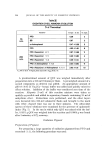
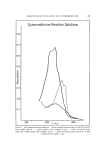
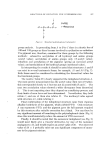
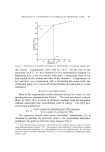
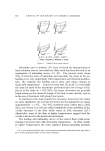
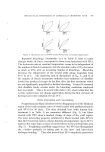
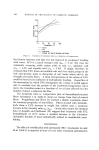
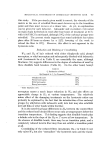
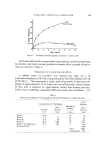
MECHANICAL HYSTERESIS OF CHEMICALLY MODIFIED HAIR 409 tract the spring. The cross head of the tester moves more rapidly than the rate of contraction of the spring therefore, the load is removed rapidly while the spring is held extended by the viscosity of the viscous medium. This analogy explains how the shape of the return curve can be attributed to an increase in the viscosity of the matrix. CONCLUSIONS One of the questions raised by the data presented above is whether the hysteresis ratio, as defined herein, has any real value. The authors believe that this question can be answered affirmatively. The hysteresis ratio has been shown to measure, with considerable precision, changes in the viscosity of hair fibers. The hysteresis ratio vs. temperature plot of normal or moderately damaged hair changes slope at a transition point. The pretransition slope is drastically altered by modification of disulfide bonds in the fiber. The post-transition slope, on the other hand, seems to be affected primarily by salt bonding and/or a-helix organization. It is, therefore, concluded that the hysteresis ratio and its dependence of temperature are useful whenever damage to the fiber involves disulfide bond cleavage, breaking of salt bonds, disruption of a-helices, or other treatments which may increase or decrease the viscosity of the matrix. ACKNOWLEDGMENT The authors wish to acknowledge the technical assistance of Miss Virginia May in conducting many of the experiments and the help of Mr. James Skillman in preparing the figures. 'Received June 20, 1967) REFERENCES (1) Brown, J. C., The determination of damage to wool fibres, J. Soc. Dyers Colourists, 75, 11-21 (1959). (2) Glynn, M. V., Diazo compounds in the determination of wool damage, Ibid., 68, 16-20 (1952). (3) Lemin, D. R., and Vickerstaff, T., Some physico-chemical properties of damaged wools, Soc. Dyers Colourists, Syrup. Fibrous Protein, 129-41 (1946). (4) Zahn, H., Einiges aus der Wollforschung, lerner fiber einfache Methoden zum Nachweis von Wollschaden, Melliand Textilber., 30, 275-81 (1949). (5) Speakman, J. B., Intracellular structure of the wool fibre, J. Textile Inst., Trans., 18• 431-53 (1927). (6) Speakman, J. B., Mechano-chemical methods for use with animal fibres, Ibid., 38, 102- 26 (1947). (7) Mitchell, T. W., and Feughelman, M., The bending of wool fibers, Textile Res. J., 35, 311-14 (1965).

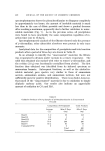
410 JOURNAL OF THE SOCIETY OF COSMETIC CHEMISTS (8) (9) (10) (11) (12) (13) (14) (15) (16) (17) (18) (19) (20) (21) (22) (23) (24) (25) (26) (27) (28) (29) (30) (31) (32) (33) (34) Mitchell, T. W., and Feughelman, M., The torsional properties of single wool fibers-- Part I and II, Ibid., 30, 662-67 (1960) 31,455-59 (1961). Feughelman, M., and Watt, I. C., Torsional properties of chemically modified wool fibers, Ibid., 36,849-50 (1966). Edman, W. W., and Marti, M. E., Properties of peroxide-bleached hair, J. Soc. Cosmetic Chemists, 12, 133-45 (1961). Hamburger, W. J., and Morgan, H. M., Some effects of waving lotions on the mechanical properties of hair, Pro& Sci. Sect. Toilet Goods Assoc., 18, 44-8 (1952), Wibaux, G., et al., Relations entre la solubilit• alcaline de la laine et ses propri•t•s m•caniques, Bull. Inst. Textile France, 17, 709-31 (1963). Watt, I. C., and Morris, R., Comparison of keratin cross-linked with benzoquinone and formaldehyde, J. Textile Inst., Trans., 57, 425-7 (1966). Mason, P., and Griffith, J. C., Crosslinking of fibrous proteins by formaldehyde, Nature, 203,484-6 (1964). Cockburn, R., and Speakman, J. B., Cross-linking reactions in keratin--III. The action of ninhydrin on wool, Pro& Intern. Wool Textile Res. Conf., Australia, C, 314-39 (1955). Alfrey, T., Mechanical Behavior of High Polymers, Interscience Publishers, Inc., New York, N.Y., 1948. Bull, H. B., and Gutmann, M., Elasticity of keratin fibers, J. Am. Chem. Soc., 66, 1253- 9 (1944). Grosch, K., et al., Breaking energy of rubbers, Nature, 212,497 (1966). Rowe, A. W., and Phelps, E. P., Ether studies--II. The quantitative determination of peroxides as a contaminant, J. Am. Chem. Soc., 46, 2078-85 (1924). Watt, I. C., and Leeder, J. D., Effect of chemical modifications on keratin q- water isotherms, Trans. Faraday Soc., 60, 1335-43 (1964). Feughelman, M., and Watt, I. C., Wool fibers treated with ninhydrin or formaldehyde: Mechanical properties, Textile Res. J., 34,643-4 (1964). Koenig, N.H., Isocyanate modification of wool in dimethyl sulfoxide, Ibid., 31, 592- 6 (1961). Feughelman, IV[., and Haly, A. R., Interaction between perfiuoro-octanoic acid and the fibrous proteins keratin and collagen, Blochim. Biophys. Acta, 43,550-1 (1960). Maclaren, J. A., The extent of reduction of wool proteins by thiols, Australian J. Chem., 15,824-31 (1962). Patterson, W. I., et al., Role of cystine in the structure of the fibrous protein, wool, J. Res. Natl. Bur. Std., 27, 89-103 (1941). Speakman, J. B., and Stott, E., A contribution to the chemical theory of dyeing: The affinity of deaminated wool for acid dyes, J. Soc. Dyers Colourists, 50, 341-8 (1934). Alexander, P., et al., Wool, Its Chemistry and Physics, Franklin Publishing Co., Palisades, N.J., 1963. Bull, H. B., Elasticity of keratin fibers--II. Influence of Temperature, J. Am. Chem. Soc., 67, 533-6 (1945). Farnworth, A. J., The reaction between wool and phenyl iso-cyanate, Biochem. J., 59, 529-33 (1955). Nemethy, G., Hydrophobe Wechselwirkungen, Angew. Chem., 79, 260-71 (1967). Zahn, H., Chemische Vorg/inge beim Bleichen von Wolle und Menschenhaar mit Wasserstoffperoxid und Peroxys/iuren, J. Soc. Cosmetic Chemists, 17, 687-701 (1966). Radell, J., et al., Acidity and autocatalysis of esterification of acetylenic and fiuoro acids, J. _Phys. Chem., 69,928-32 (1965). Asquith, R. S., and Parkinson, D.C., The morphological origin and reactions of some keratin fractions, Textile Res. J., 36, 1064-71 (1966). Alexander, P., et al., Esterification of the carboxyl groups in wool, Biochem. J., 48,629- 37 (1951).
Purchased for the exclusive use of nofirst nolast (unknown)
From: SCC Media Library & Resource Center (library.scconline.org)