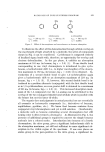
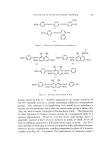
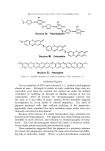
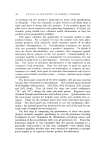
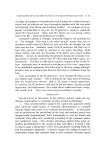
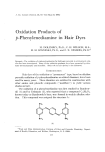
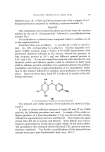
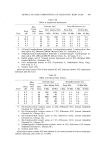
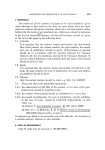
J. Soc. Cosmetic Chemists, 19, 411-422 (May 27, 1968) Oxidation Products of p-Phenylenediamine in Hair Dyes M. DOLINSKY, Ph.D., C. H. WILSON, M.S., H. H. WISNESKI, Ph.D., and F. X. 1)EMERS, Ph.D.* Synopsis--The oxidation of p-phenylenediamine by hydrogen peroxide in ammoniacal solu- tion has been investigated. Some of the oxidation products have been separated by thin- layer chromatography and identified. Their role in hair dyeing is also discussed. INTRODUCTION Hair dyes of the oxidation or "permanent" type, based on alkaline peroxide oxidation of p-phenylenediamine or related diamines, have been used for many years. These diamines are oxidized in combination with other amino and phenoli½ compounds ("modifiers") to yield various shades on hair. The oxidation of p-phenylenediamine was first studied by Bandrow- ski (1) and by Erdmann (2), who reported that a compound C•sH•sN0, known today as Bandrowski's base, was formed in weakly alkaline solu- tion. This compound was assigned the structure A: NHz NHz NH= NH= (A) * Food and Drug Administration, Division of Color and Cosmetic Chemistry, Depart- ment of Health, Education, and Welfare, Washington, D.C. 20204. 411

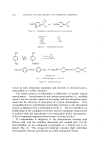
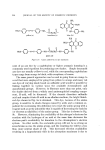
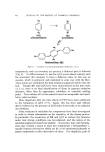
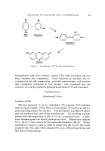
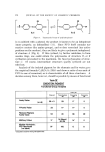
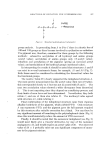
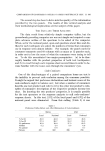
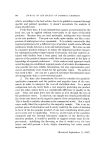
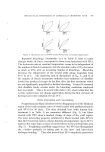
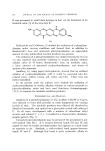
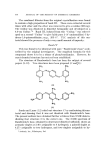
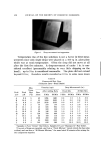
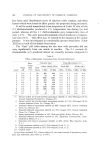
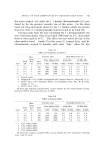
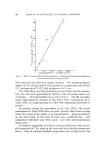
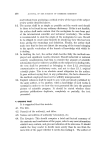
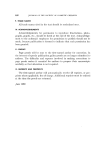
412 JOURNAL OF THE SOCIETY OF COSMETIC CHEMISTS It was presumed to yield black dyeings on hair via the formation of an insoluble azine (3) of the structure B: i • •H / • •"•N / • •NH• Heiduschka and Goldstein (4) studied the oxidation of p-phenylene- diamine under varying conditions and showed that, in addition to Bandrowski's base and unreacted phenylenediamine, an appreciable amount of other unidentified reaction products was present. The oxidation of p-phenylenediamine was studied extensively by Cox (5) who reported that peroxide oxidation in weakly alkaline solution yielded (after 24 48 hours) Bandrowski's base, an insoluble azine, a large amount of unreacted p-phenylenediamine, and traces of quinone plus ammonia. Sandberg (6), using paper electrophoresis, showed that an oxidized solution of p-phenylenediamine (pH 7) could be separated into five colored zones--yellow, brown, red, violet, and blue. These were not further identified. In the present work the authors have studied the oxidation of p-phenylenediamine in weakly alkaline solution at various peroxide to phenylenediamine ratios and have used thin-layer chromatography (TLC) to separate the insoluble oxidation products. EXPERIMENTAL AND RESULTS Solutions of p-phenylenediamine (2-4%) in dilute NH4OH or Na2CO3 were allowed to react with peroxide at room temperature for varying periods of time. The insoluble products were filtered off, dissolved in dimethyl formamide, and spotted on a glass plate coated with silica gel G. In all cases, development with a mixture of chloroform, ethyl acetate, and ethanol (7 d- 2 d- 1) resulted in a characteristic chromato- graphic pattern (Fig. 1). Unreacted phenylenediamine may be present if the precipitate is not well washed with H20. It is located between bands III and IV and cannot be seen on freshly developed plates but appears as a dark band on exposure to air. Similarly, a violet-colored band appears between bands IV and V. Although this band is quite noticeable, efforts to
Purchased for the exclusive use of nofirst nolast (unknown)
From: SCC Media Library & Resource Center (library.scconline.org)