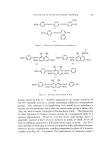
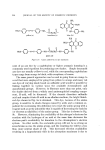
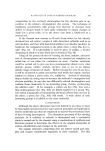
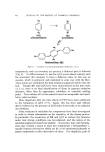
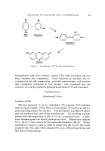
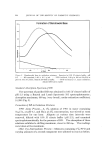
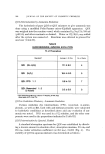
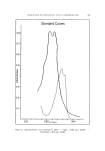
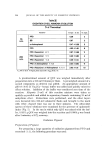
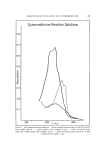
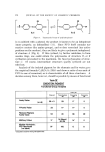
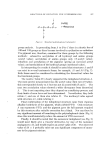
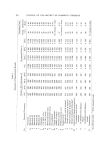
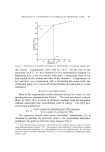
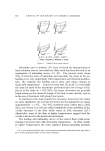
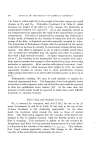
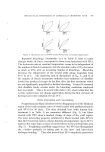
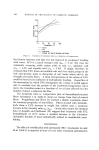
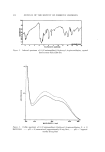
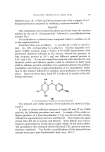
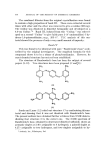
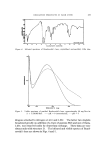
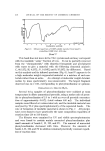
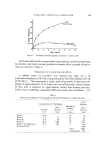
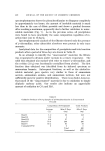
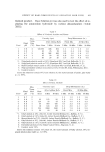
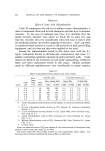
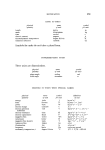
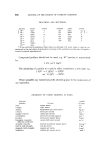
OXIDATION PRODUCTS IN HAIR DYES 421 HAIR DYEING WITH PHENYLENEDIAMINE Cox and other workers have attributed the dyeing properties of phenylenediamine to an insoluble azine formed on the hair fiber by further oxidation of Bandrowski's base. Our work does not substantiate this. A solution of pure Bandrowski's base in H20 or (1 -+- 1) alcohol- H20, when treated with dilute peroxide and NH4OH, showed no change in TLC characteristics. The use of concentrated peroxide completely decomposed the base to colorless materials. It was found experimen- tally that, although phenylenediamine itself is not substantive to hair, each of the colored oxidation products is substantive and can give fast dyeings on wool or hair from alcohol-H20 or DMF-H•O solution without further oxidation. Bands I and II gave yellow dyeings, band III red- dish-brown, band IV (Bandrowski's base) blue-black, and band V dark red-brown. The black shade obtained on hair is believed to be due to a combina- tion of all of these dyeings. Bandrowski's base was found to give the same shade on hair with or without the addition of peroxide. In each case, extraction of the hair with hot ethanol, pyridine, or dimethyl formamide only partially stripped the color from the hair. That color which was recovered was identified from its visible spectrum as Band- rowski's base. SUMMARY 1. Some of the oxidation products of p-phenylenediamine have been separated and identified. 2. The various colored oxidation products are all substantive to hair the final black color is probably due to a combination of all of these dyeings. 3. Under hair dyeing conditions part of the phenylenediamine is completely oxidized to simple aliphatic carboxy acids as well as to CO•. and H•O. 4. No evidence of azine formation from Bandrowski's base was found. 5. NMR data support the N, Nf-bis-(4-aminophenyl)-2,5-diamino - 1,4-quinonediimine structure proposed for B androwski's base. ACKnOWLEDGMEnT The authors wish to thank Joseph Damico, Food and Drug Admin- istration, for the molecular weight data via mass spectrometry, and

422 JOURNAL OF THE SOCIETY OF COSMETIC CHEMISTS Stanley Koch, Dr. Ernest Lustig, and Margaret Lake, Food and Drug Administration, for NMR spectra and interpretation. Elemental analyses were performed under the direction of William Alford, National Institutes of Health, and Charles Graichen, Food and Drug Administration. (Received September 19, 1967) (1) (2) (3) (4) (5) (6) (7) (8) (9) (10) (11) (12) REFERENCES Bandrowski, E., Ueber die Oxydation des Paraphenylendiamins, Ber., 27, 480 (1894). Erdmann, H., Oxydationsprodukte des p-Phenylendiamins, Ibid., 37, 2907 (1904). Ginzel, A., Die Chemic der Pelzfarbstoffe, Melliand Textilber., 29,384 (1948). Heiduschka, A., and Goldstein, E., Ueber das Oxydationsprodukt des Para-Phenylen- diamins (Ursols) durch Wasserstoffsuperoxyd, Arch. Pharm., 254, 584 (1916). Cox, H. E., The chemical examination of furs in relation to dermatitis, Analyst, 59, 3 (1934). Sandberg, G., Polarography of fur dyes, J. Soc. Dyers Colourists, 72, 235 (1956). Balogh, B., Preparative analog to thin layer chromatography, Anal. Chem., 36, 2498 (1964). Newman, M. S., Ed., "Organic Syntheses," Vol. 40, John Wiley and Sons, Inc., New York, 1960, p. 18. Green, A. G., Quinonoid addition as a mechanism of dyestuff formation, J. Chem. Soc., 1913, 933. Ritter, J., and Schmitz, G., The constitution of Bandrowski's base, J. Am. Chem. Soc., 51, 1587 (1929). Lauer, W. M., and Sunde, C. I., The structure and mechanism of formation of the Bandrowski base, Y. Org. Chern., 3,261 (1938). Sunde, C. I., and Lauer, W. M., Structure of the Bandrowski base, Ibid., 17, 609 (1952).
Purchased for the exclusive use of nofirst nolast (unknown)
From: SCC Media Library & Resource Center (library.scconline.org)