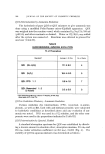
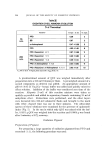
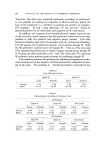
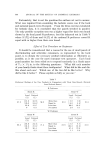
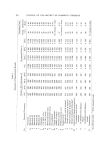
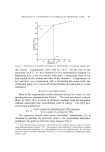
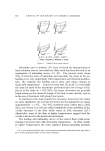
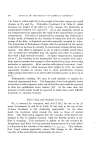
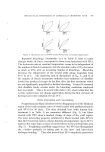
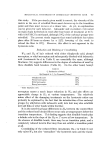
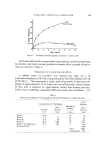
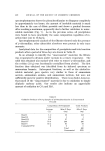
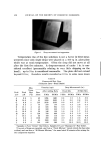
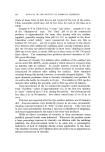
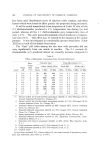
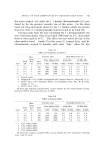
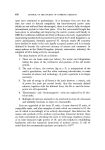
EFFECT OF BASE COMPONENTS ON OXIDATION HAIR DYES 427 off the plate the exact amount is immaterial when products perform this poorly. Dyeing Tests Immediately after mixing the dye base with an equal amount of 20 vol hydrogen peroxide as described above, the dye was applied to natural white human hair (with no attempt at quantification) by brushing onto the strands while they were on one glass plate, then transferring the swatches onto a clean plate where they were allowed to stand at room temperature for 30 minutes. They were then rinsed thoroughly (with water only) and dried. Aging Tests Some dye bases do not thicken properly when mixed with peroxide, or they change shade over a period of time, or show sedimentation. The above tests were therefore carried out three times: once on freshly prepared solutions, again after aging 1000 hours at 48 øC, and again on a separate bottle of the same batch aged 1000 hours at 2 øC. Viscosity measurements were run only once however, 48 hours after the solutions were first prepared. pH Measurements These were performed routinely on the base before addition of peroxide, as well as afterwards. In those few cases where excessive heating occurred after addition of the peroxide (indicating an exo- thermic reaction) the pH was observed to drop drastically, e.g., from pH 9.3 for the fresh mixture to pH 7.2 upon standing 135 hours. COMMERCIAL HAIR DYES In order to have a meaningful point of comparison, the black shade from each of 12 commercially available oxidation hair dyes, products of the recognized leaders in this field on the American market, was also first put through this same series of tests. The results are summarized in Table II, which clearly shows that there is very little agreement in any of the major factors which are considered. This was most unexpected a number of equally successful commercial products seem to have been formulated from diametrically opposed viewpoints regarding such factors as temperature rise, viscosities, or drop-movement. An alterna- tive explanation is that some of these factors were simply not considered at the time the products were formulated. It is also true that the black

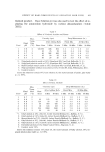
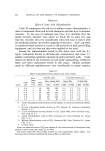
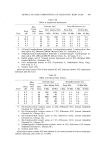
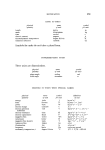
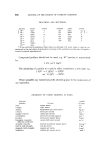
428 JOURNAL OF THE SOCIETY OF COSMETIC CHEMISTS shade of many lines of hair dyes is not typical of the rest of the series. Thus, anomalies noted may not in fact exist for each of the lines as a whole. Samples A-F in Table II are "Creme" hair colors samples G-L are of the "Shampoo-in" type. The "final" pH of all the commercial products is approximately the same after mixing with the oxidizer supplied, generally ranging from pH 9.9-10.1 as applied to the head. Viscosities varied widely: most commercial dye bases are thin as bottled (25-140 cps) one (J) is quite heavy in contrast to the others. Five minutes after adding the oxidizing agent (usually hydrogen perox- ide) the viscosity has altered radically in most cases, climbing to about 2000 cps in two cases, to about 1000 cps in three cases, to 500-750 cps in three others. The remaining four products showed viscosities of 110- 360 cps at this stage. Increase of viscosity five minutes after addition of the oxidizer was on the order 300-4000%, except sample J which showed a viscosity drop on dilution with its oxidizer. As oxygen bubbles evolved in the dye base, three of the products showed further increases in viscosity when remeasured 30 minutes after adding the oxidizer. Most remained constant during this period, however, or actually dropped slightly. The most dramatic performer (from a viscosity standpoint) was product B. As sold in the bottle its viscosity is 25 cps. This climbs to 1000 cps five minutes after adding the peroxide, and to 2050 cps after 30 minutes. Drop-movements of the 12 commercial samples varied enormously, from "excellent" values of approximately 1 in. in the first five minutes to "poor" values of up to 5.8 in. during this period. Six of them moved less than 2 in. in 30 minutes five others varied from 4.5 to 10 in. or over. This test was repeated after the dye-oxidizer mixture was 30 minutes old drop-movements were distinctly greater in six eases, presumably showing a greater tendency to "drip" as time went on. They were less in two eases (presumably showing a decrease in likelihood of dripping), and stayed approximately the same in the other four products. While no direct correlation of viscosity to drop movements seems justified, general trends seem indicated. Whenever the product shows a large percentage increase in viscosity (on dilution with the oxidizing solution), the drop-movement tends to be quite low, a presumptive indication of lack of dripping during actual application to the head. The absolute viscosity after dilution does not seem to be as important as this per cent increase in viscosity.
Purchased for the exclusive use of nofirst nolast (unknown)
From: SCC Media Library & Resource Center (library.scconline.org)