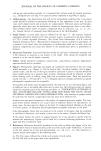
502 BOOK REVIEW include fat splitting, fatty acid distilla- tion, and neutralization. The flow sheets generally supplied by the manufacturers are included. The processing of the wet soap into the dried, pressed bars is presented in a gen- eral descriptive manner with very little of a technical nature included. The narrative leads one through the processing steps from the wet soap-drying operation to the milling, extrusion, and bar-pressing stages. The equipment of various sup- pliers is shown accompanied by brief de- scriptions. This broad area of production is treated in a very superficial manner. The section on the recovery and re- fining of glycerine is well done. The au- thor is obviously intimate with this sub- ject and details: (1) the glycerine quality requirements, (2) the analytical proce- dures used, (3) the treatment techniques used in handling the impure glycerine- containing solutions from both the sapon- ification process and the fat-splitting pro- cess, and (4) the evaporation and distilla- tion stages. Descriptions of old processes used and the processes offered by several manufacturers of glycerine recovery plants are presented in a clear and complete manner. A discussion of the physical prin- ciples involved in these operations along with considerations of thermal and glyc- erine recovery assist the reader in under- standing the critical aspects involved. The latter part of the book is devoted to sulfonation, spray drying, and liquid de- tergents, which encompasses 82 pages of the total 440 of the book, a very small portion indeed, considering the impor- tance of--and interest in--these sub- jects. It is clear that the author is not inti- mate with these processes and covers them in a manner that can only be termed su- perficial. Most of the information on sul- fonation can be found in the literature of the manufacturers of detergent plants. Some minor calculations concerning spray tower thermal efficiency, the effect of re- cycling tower exhaust air, and the im- portance of minimum water content in the slurry to be sprayed are the extent to which a technical approach is made. Surveying the book as a whole, it does accomplish its objective of presenting an update of the manufacturing processes and equipment used in the soap and detergent industry. It is an excellent book for a be- ginner in these fields as an introduction to the latest technology available and who the manufacturers of this technology are. It is convenient to have all this informa- tion put together in one book for ready reference. Books of this nature are sorely needed in the soap and detergent in- dustry, but it is hoped that future works will be less wide-ranging and delve much more thoroughly into the theory, thermo- dynamics, and engineering principles in- volved in the individual processes.--SAL- VATORE SILVIS, Ph.D.--Colgate Palmolive Company. EMULSIONS AND SOLUBILIZA- TION, by Kozo Shinoda and Stig Fri- berg. John Wiley & Sons, New York, 1986. 174 pages. Price $45.00. Emulsification, solubilization, and emulsion stability are problems that are encountered by practicing cosmetic chemists day by day. A number of clas- sical treaties have discussed these subjects extensively (e.g., P. Becher in Encyclopedia of Emulsion Technology). In this book, the authors choose to emphasize the prepara- tion and properties of emulsions that con- tain mainly non-ionic, polyethylene glycol-type surfactants. The authors state as their principal objective their wish to describe the factors affecting the hydro- phile-lipophile balance (HLB) of surfac- tant in various systems and to define the conditions that are required for achieving optimal HLB values, since optimization of

JOURNAL OF THE SOCIETY OF COSMETIC CHEMISTS 503 the HLB values generally brings about the maximization of solubilization power and high emulsion stability. The book is divided into five main chapters. First, the authors discuss the re- lationships that exist between the solution behavior of surfactants, solubilization of hydrocarbons, and the formation of mi- croemulsions. The second chapter dis- cusses, at some depth, the hydrophile-li- pophile balance (HLB). The authors com- pare the various systems that have been devised for measuring HLB values and make the important point, often over- looked, that temperature and salt concen- trations are important factors that can greatly affect HLB values. This chapter also contains a valuable compilation of HLB values of many commercial surfac- rants. Finally, the authors outline some practical examples for the use of the HLB concept in product formulation. The third chapter deals with the concept of Phase Inversion Temperature (PIT) of emul- sions. The authors believe PIT to be one of the most important quantities that characterize emulsions. Therefore, they describe at considerable length the various factors which can influence the PIT values, (e.g., lengths of hydrocarbon chain and oxyethylene chain, salt concen- tration, pH, etc.). Chapter 5 discusses the stability of emulsions. The authors de- scribe the various methods used for emul- sification (PIT method, emulsification by inversion, etc.) and also point out that the method of preparation, among other factors, has an important bearing on the subsequent stability of the resulting emulsion. Again, considerable scope is given to the discussion of other factors that affect emulsion stability. Emulsions and Solubilization is a valuable contribution to the literature. The au- thors, who both have contributed greatly to our understanding of emulsions, give a very wide-ranging review of the present state of the science of emulsions. How- ever, this work is not a reference book rather, it should be regarded as an intro- ductory textbook for young scientists and chemists who are new to the field of for- mulation science and who wish to ac- quaint themselves with the basic prin- ciples of emulsion technology. The book suffers somewhat from lack of editorial at- tention. The language is often difficult and involved and does not lend itself to an easy reading there are a number of printing errors. Whereas the scientific data and facts given are far-reaching, it is not always straightforward to discern the implications of the data shown. The au- thors should have put more emphasis on giving interpretations and explanations rather than just presenting experimental findings. Too often, the reader is left to his own devices to find his way and to draw the right conclusions from the wealth'i-of experimental facts presented. This requires considerable time and thought and hinders the easy use of the book in helping to solve problems as they emerge during routine formulation work. In spite of some of these shortcomings, however, Shinoda and Friberg's book should become a valuable addition to cos- metic chemists' and product formulators' bookshelves--MIKLOS M. BREUER, Ph.D., The Gillette Company.
Purchased for the exclusive use of nofirst nolast (unknown)
From: SCC Media Library & Resource Center (library.scconline.org)