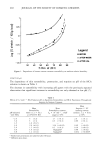
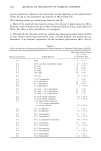
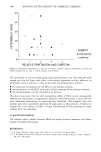
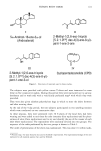
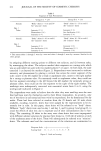
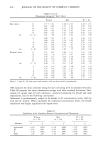
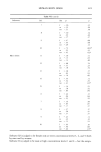
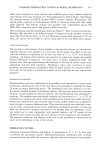
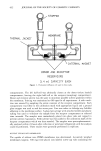
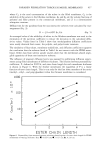
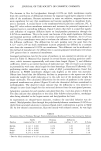
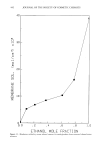
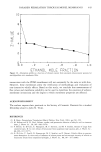
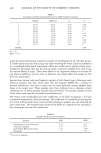
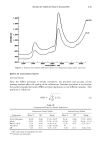
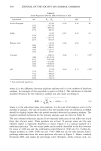
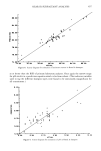
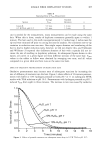
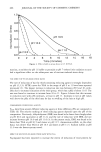
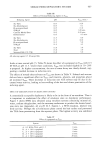
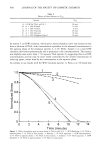
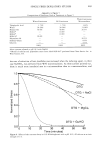
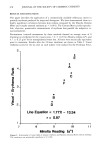
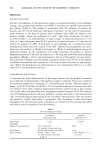
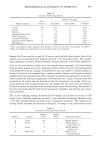
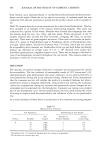
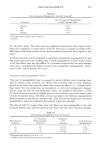
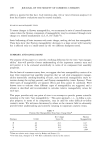
SINGLE FIBER DEPILATORY STUDIES 463 where 'y is the liquid-air surface tension. Work in our laboratory indicates that the assumption of a zero receding hair-liquid contact angle is reasonable, especially since cos 0 is relatively insensitive when 0 is small. Figure 1 shows the percent of diameterical swelling and loss in tensile stress as different sections of the same hair were reduced in sodium dihydrolipoate (6,8-dithiooctanoate) containing 0.1% of an ethoxylated linear fatty alcohol nonionic surfactant. When the tensile stress was reduced by 50%, the hair had swollen to --112% of its original wet diameter. By the time the tensile force was reduced by 95%, the hair was swollen to about 145%. At this point, the hair, which had been dark brown, was translucent and was easily broken by rubbing between the fingers. CORRELATION TO IN VIVO DEPILATION Figure 2 shows SFTK curves obtained for two commercial depilatory products con- taining thioglycolate, using a subject's leg hair. Product B is seen to reduce the tensile force much faster than product A. The time to reduce the tensile stress by 95%, T95 %, was 5 minutes for product B. Product A reduced the tensile force to a constant level after about 12 minutes. The hair was totally weakened by this point, and we believe that the small difference from baseline is due to the high viscosity of the product, which did not allow the Instron © clamp to settle to exactly the same position as in the buffer solution. The time to reach 95% of this final level was approximately 8 minutes. Table I shows the approximate percent of hair removed from the legs of this same individual lO[ 80- 60- 40- 20- I i I I I • i 0 10 20 30 40 50 60 70 Time (minutes) Figure 1. Swelling of hair measured by wetting force, and reduction measured by SFTK, 0.14 M lipoate, pH 9.0, 22øC.

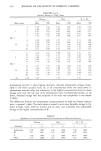
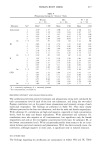
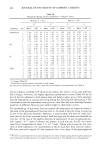
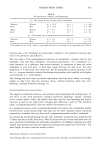
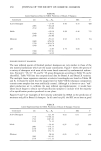
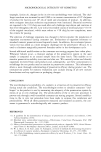
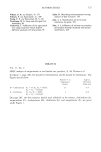
464 JOURNAL OF THE SOCIETY OF COSMETIC CHEMISTS 1.0 0.8 0.6 0.4 0.2 0.0 I -•! \*- Product A -i • pH12.5 \ Product B - •xX'pH 12.0 2 4 6 8 I I I I 10 12 14 16 Time (minutes) Figure 2. Stress decay of human leg hair by commercial depilatories. after treatment for various times with these two products. The products were applied to circular patches of the subject's legs, controlling amount/unit area, after clipping the hair to a uniform V4" length. Hair was removed with firm strokes of a damp washcloth. Percent removal was estimated by two judges. At both 4 and 6 minutes, product B had removed more hair than product A. The T95 % measurement correctly predicted the order of effectiveness of these two products and gave a reasonable approximation of the time for complete removal of hair. REPRODUCIBILITY OF THE T95 % MEASUREMENT The reproducibility of T95 % for head hair treated with either a commercial depilatory cream or 0.5M thioglycolate (TGA) solutions at pH 11.5 is shown in Table II. Means and standard deviations for 22 and 14 runs, respectively, are shown. Data in Table II are for different hairs from the same source. Since only a short section of hair (1.5-2.5 Table I Percent Removal of Hair by Commercial Depilatories vs. Treatment Time Product A Product B Time Right Leg Left Leg Right Leg Left Leg 4 min. 25% 30% 40% 75% 6 min. 90% 90% 100% 100% 10 min. 100% 100% 100% 100%
Purchased for the exclusive use of nofirst nolast (unknown)
From: SCC Media Library & Resource Center (library.scconline.org)