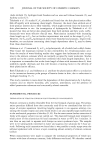
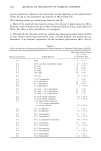
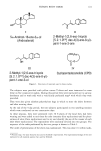
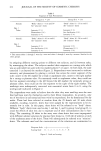
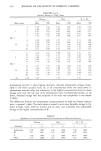
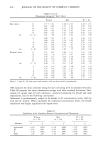
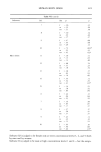
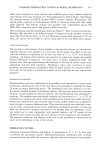
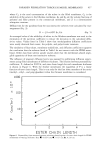
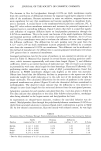
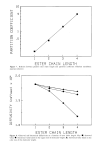
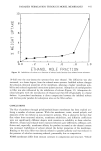
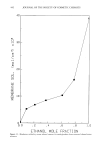
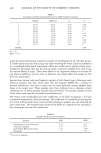
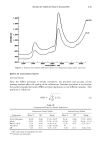
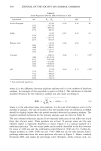
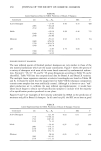
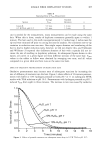
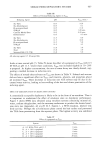
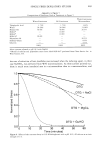
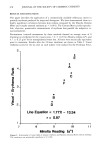
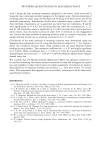
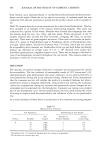
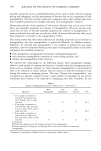
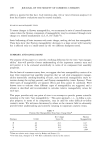
454 JOURNAL OF THE SOCIETY OF COSMETIC CHEMISTS 1. •oo, ß 800' • ß 500' • lEO0 1400 1600 t800 EOO0 P. EO0 E400 WAVELENGTH (nat) Figure 6. Near infrared reflectance spectrum of benzoic acid. A comparison of the wavelengths chosen by multiple linear regression analysis (Tables IV and V) for ALS and SLS and the wavelength assignments (Table VII) indicates that there is a pattern to wavelength selection. The wavelengths selected for active detergent Table VII Frequency Assignments for ALS, SLS, and Benzoic Acid ALS SLS Benzoic Acid 24O4 24O4 2352 2352 2312 2312 2272 2272 2144 2040 1920 1760 1760 1728 1728 1568 1412 1412 1208 1208 2140, 2160 2464 1664 1132 Combination aliphatic C-H Combination aromatic C-H Combination N-H Combination O-H First overtone aliphatic C-H First overtone aromatic C-H First overtone N-H Combination aliphatic C-H Second overtone aliphatic C-H Second overtone aromatic C-H

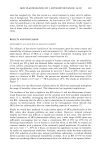
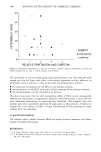
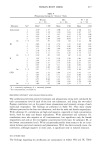
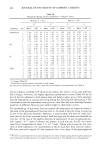
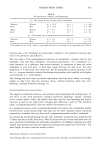
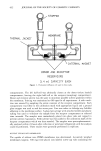
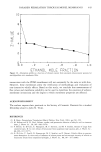
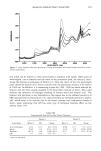
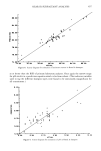
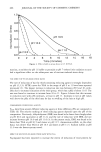
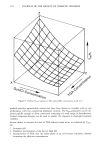
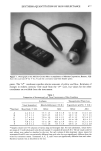
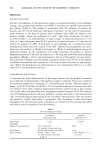
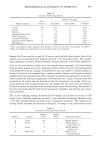
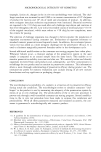
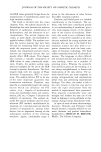
NEAR IR SURFACTANT ANALYSIS 455 ß •50' ß 200' t50' ß too ' ' I ' I ' I 200 1 aO0 1600 1800 2000 HAVELENGTH (nm) ß 050 • ' I ' I ' 2200 2400 Figure 7. Near infrared reflectance spectra of a variety of shampoos with water bands removed by mathe- matical subtraction. and solids can be linked to either water bands or aliphatic C-H bands. Often pairs of wavelengths, one at baseline and the other on the prominent peak, are selected, simu- lating the derivative techniques of Norris (12). Note the choice of the two wavelength pairs chosen for benzoic acid, which coincide with the prominent aromatic C-H stretch at 1685 nm. In addition, it is interesting to note the 1300- 1400 nm bands selected for benzoic acid are those usually assigned to the broad first overtone of water. This could indicate the influence of hydrogen bonding of solvent water and benzoic acid. The benzoic acid spectrum is very featureless in this region due to the infrared inactivity of OH symmetrized by dimerization (13). Also of interest are the bands selected to predict pH, which seem to be entirely due to the broad overtone and combination bands of water, again indicating that pH has some type of hydrogen bonding effect on the solvent water (14). Table VIII Compositional Data for Finished Product Shampoo Brand A Brand X Constituent Mean % SD Range Mean % SD Range Active Detergent 11.32 0.72 10.3-15.35 10.89 0.77 7.27-12.72 Solids 20.65 1.14 19.43-25.21 16.18 1.15 12.86-20.86 Moisture 80.76 2.09 74.68-86.51 83.77 2.27 79.27-87.46 pH 5.71 0.10 5.55-6.0 * , * pH not measured.
Purchased for the exclusive use of nofirst nolast (unknown)
From: SCC Media Library & Resource Center (library.scconline.org)