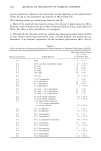
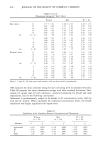
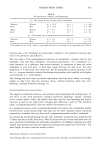
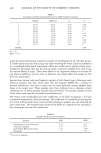
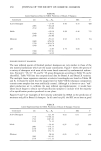
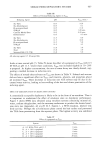
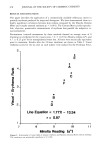
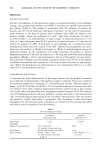
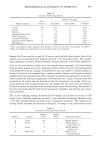
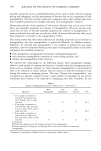
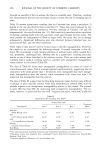
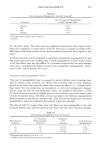
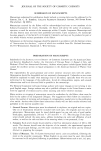
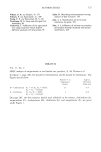
MICROBIOLOGICAL INTEGRITY OF COSMETICS 485 Table IV Consumer Use-Testing History Number of Samples Total Product Category Products Acceptable Unacceptable % Failures Creams 28 1121 0 0.00 Lotions 73 2177 5 • 0.22 Mascaras 1 79 0 0.00 Shampoos/Shower Gels 9 250 42 1.60 Hair Conditioners 4 140 0 0.00 Eyeshadows/Eyeliner 7 123 0 0.00 Lipsticks & Other Makeup 12 200 0 0.00 Miscellaneous 9 232 0 0.00 These unacceptable samples represent three products, or five out of a total of 232 samples. See Table V. These four samples are representative of one product panel of 23 consumers. Shower Gel D was used by a panel of 19 once or twice daily for three weeks. Four of the samples were unacceptable with high recoveries of 103 cfu/g upon retest. The contam- inant organisms included Citrobacter freundii, Serratia marcescens, and Serratia liquefaciens. Each of the four products which were unacceptable were reassessed. All three lotions had previously passed our in vitro challenge criteria. Lotions A and C were reformulated with preservative system changes. Imidazolidinyl urea was added to methyl paraben in Lotion A Lotion C was changed from a methyl paraben, benzoic acid system to methyl paraben with imidazolidinyl urea. The consumer-use panel was repeated for Lotion B in order to assess the statistical significance of the recovery of E. c/oacae. The panel size was increased to 34 people and the duration of the test increased to six weeks. After con- tinual daily use with increased panel size, all samples met the criteria for acceptability with no recoveries of microbes from the used product upon initial testing. The results of the first panel for Lotion B could not be reproduced therefore, this formula was consid- ered acceptable. The in vitro challenge testing of Shower Gel D resulted in low level recoveries (200 cfu/g) of two challenge organisms on week 3, one week after rechallenge. Replates were 10 cfu/g. Results indicate a product that is marginally preserved. The consumer-use testing results validated the formula as marginal. A change in the preservative system Table V Consumer Use-Testing Product Failures Samples Samples Product Category Tested Failed Preservative System A Lotion 189 3 B Lotion 12 1 C Lotion 27 1 D Shower Gel 19 4 Methyl paraben Methyl paraben, diazolidinyl urea Methyl paraben, benzoic acid Benzoic acid, phenoxyethanol

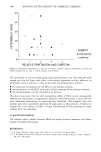
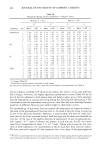
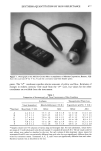
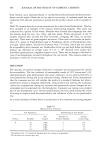
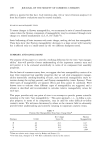
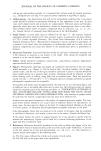
486 JOURNAL OF THE SOCIETY OF COSMETIC CHEMISTS from benzoic acid, phenoxyethanol to methychloroisothiazolinone/methylisothiazo- linone was the result of both the in vitro and in vivo testing. A consumer panel test was conducted with the new preservative system and the product shown to be acceptable in use. Table •I contains data on an in-use mascara test for a water-based formulation. This has been included as an example of the mascara panel-testing program. This study was conducted for a period of four weeks. Panelists were divided into subgroups that used the mascara daily for one, two, three, and four weeks. Thirty-six percent of the 79 samples returned after use had low level recoveries, averaging 106 cfu/g, on nutrient agar only. There were no gram-negative recoveries. There were no recoveries on enrich- ment of S. aureus on Vogel-Johnson agar or Pseudomonas species on Pseudomonas isola- tion agar. Upon replate, all positive recoveries were 10 cfu/g, which met our criteria for acceptability after consumer use. Swabs taken of the eye area both before and during product use indicated an average count of 1.27 x 10⁴ cfu/swab (cm 3) surface skin microflora (gram-positive coagulase negative cocci). There was no change in the level or type of microorganisms recovered throughout the test period. This mascara passed our acceptance criteria for in-use testing. DISCUSSION The majority of cosmetic samples subjected to consumer-use testing passed the criteria for acceptability. The low incidence of unacceptable results (0.22% lotions and 1.6% shampoos/shower gels) demonstrates that good correlation can be achieved between in vitro preservation testing and in-use consumer testing. Shower Gel D also demonstrates that the consumer use test will validate the results of a standard challenge test when a preservative system is marginal. Essentially, those products not meeting the acceptance criteria for consumer-use testing are reviewed and preservative system changes are rec- ommended and incorporated into the formulation. Consumer-use testing is an integral part of the development cycle. Several modifications have been made during the course of testing to improve both the predictability and validation of the in vitro preservation test. As a result of product failures which occurred early in the consumer-use testing program Table VI Mascara In-Use Evaluation Test Parameters Microbiological Test Results Test Number of Average Product Panelists Length Positive Samples 2 Count (cfu/g) 2O 1 Wk 9 176 18 2 Wk 7 154 17 3 Wk 7 27 24 4 Wk 6 70 All replates were 10 cfu/g and therefore met the criteria of acceptability. All recoveries on nutrient agar only.
Purchased for the exclusive use of nofirst nolast (unknown)
From: SCC Media Library & Resource Center (library.scconline.org)