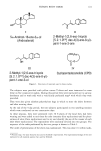
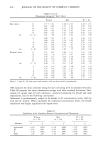
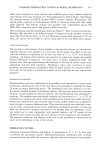
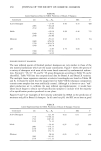
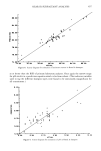
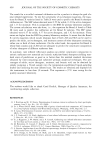
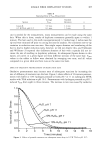
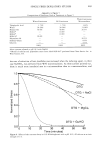
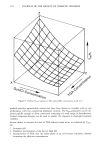
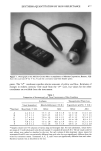
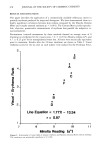
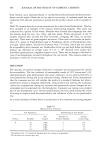
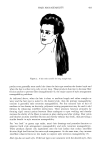
HAIR MANAGEABILITY 495 Figure 4. A hair style suitable for medium length very curly (kinky) hair. METHODS TO EVALUATE MANAGEABILITY STYLE ARRANGEMENT MANAGEABILITY TESTS We recommend two types of tests to evaluate different aspects of style arrangement manageability: ß dry hair combability tests ß wet hair combability tests Garcia and Diaz (7) have already pointed out that combability is "closely associated with manageability," and our intent here is to clarify that association. As described previously, style arrangement manageability is the ease of arranging hair into any par- ticular style. This operation consists of moving a device such as a comb, brush, or pick through the hair to untangle and to arrange the fibers of an assembly to the optimum position for the desired style. Generally, greater work and greater forces are involved in moving the styling device through the fibers than in moving the hair to the position consistent with the desired style. Therefore, it seems reasonable to consider quantitative combing methods as one measure of style arrangement manageability. Several procedures have been described to quantitatively evaluate combability of hair tresses (7-9). Combing hair simply involves the ease or difficulty of moving a comb

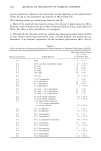
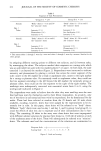
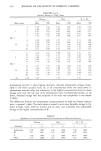
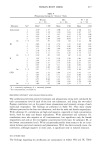
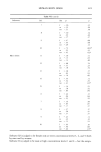
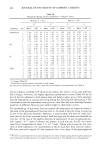
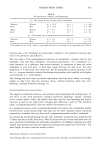
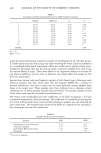
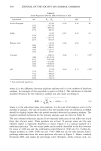
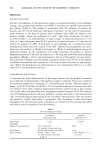
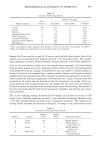
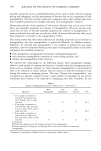
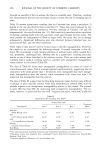
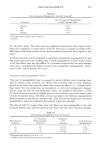
496 JOURNAL OF THE SOCIETY OF COSMETIC CHEMISTS through an assembly of hair to arrange the fibers in a parallel array. Therefore, combing ease measurements provide one convenient means to assess the ease of arranging hair in place. Table II contains quantitative combing data for Caucasian hair using a procedure (1) similar to the one described by Garcia and Diaz (7). These data were evaluated by two different statistical tests: the parametric two-way Analysis of Variance (10) and the nonparametric two-way Friedman test (11). Both statistical procedures show significant decreasing combing loads with each successive comb pass through the hair (runs). The more parallel the arrangement of fibers to begin with, the easier they are to arrange subsequently. Significant differences were also observed between bleached hair, po- made-treated hair, and the other treatments. These types of data may be used in various ways to describe manageability. However, for simplicity we recommend the following scheme. A control treatment is first de- fined. We recommend a high cleaning shampoo or sodium lauryl sulfate washed hair, and, preferably, undamaged hair. Develop data by a quantitative combing procedure similar to one of those described in the reference section. Then use either average peak combing load or work of combing values to calculate style arrangement manageability values relative to the control (Table III). The data of Table III define style arrangement manageability in terms of a ratio of control/treatment values. This is a simple approach mathematically, suggesting that all treatments with values greater than 1.00 provide more manageable hair (style arrange- ment manageability) than the control, while treatments with values less than 1.00 make hair less manageable than the control. The data of Table III suggest that the bleaching treatment makes the hair more difficult to arrange in place than the control, while both stearalkonium chloride (SAC) and the pomade improve style arrangement manageability relative to the control. The pomade is more effective than SAC for improving style arrangement manageability. The po- made, however, is useful only for "wet look" or greasy hair styles, while SAC is effective Table II Quantitative Dry Combing Test Data @ Grams Peak Load Treatment Treatments @ Run 1 Run 2 Run 3 Means Bleached (Maxi Blonde 1-Hr) 42.50 19.54 15.83 25.96* SLS (10% sodium lauryl sulfate) 20.29 12.28 10.71 14.43 SAC ( 1% stearalkonium chloride) 18.00 12.86 8.43 13.09 Pomade (mineral oil/petrolatum) 8.09 5.08 5.00 6.06* Run Means 22.22* 18.44' 9.99* @ For additional details regarding treatments and experimental procedures, see reference (1). Three-gram tresses were prepared from undamaged 8-inch dark brown Caucasian hair from DeMeo Brothers, New York. * Indicates significant difference via 2-way Friedman test.
Purchased for the exclusive use of nofirst nolast (unknown)
From: SCC Media Library & Resource Center (library.scconline.org)