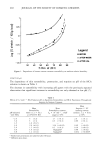
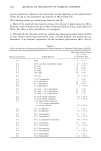
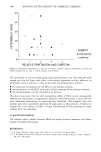
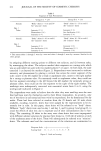
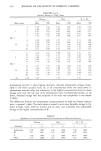
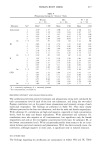
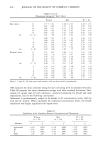
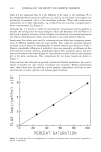
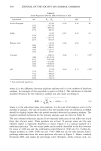
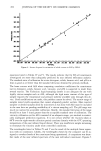
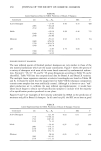
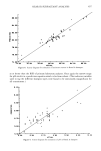
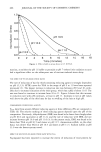
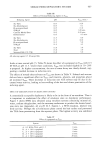
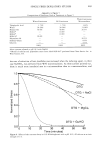
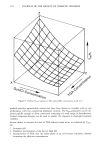
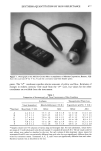
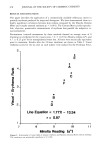
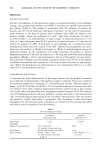
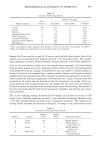
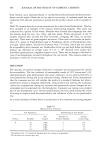
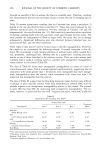
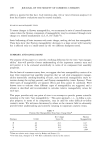
478 JOURNAL OF THE SOCIETY OF COSMETIC CHEMISTS RESULTS AND DISCUSSION This paper describes the application of a commercially available reflectance meter to quantify erythema produced by soaps and detergents. We have demonstrated there is a highly significant correlation between skin redness measured by the Minolta Chroma Meter and visually assessed erythema (p 0.001). The Chroma Meter yields reproduc- ible, objective, quantitative measurements of erythema that parallel the subjective vi- sual assessments. Pretreatment (control) assessments by three methods showed an average score of 0 (meaning no erythema) for the visual scores, 7.4 - 0.29 for Minolta redness (a*), and 4.7 - 0.25 g/m 2 hr for transepidermal water loss. All sites were statistically equivalent prior to treatment. Results after the 24-hour treatment are shown in Table I. Visual erythema scores for the six sites on each subject were ranked (for the Friedman Test), _ c D Figure 2. Relationship of visual ranks of product erythema and Minolta Chroma Meter redness readings. The correlation was statistically significant p • 0.003. 7 8 9 10 !! Minolta Reading (a*) Line Equation - 1.77X - 13.34 r= 0.97

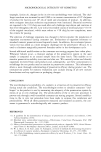
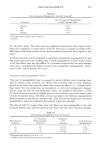
ERYTHEMA QUANTITATION BY SKIN REFLECTANCE 479 with 1 being the least irritating treatment (assigned to the lowest visual score) and 6 being the most irritating treatment (assigned to the highest score). Statistical analysis of resulting ranks was done using the Friedman test (8) along with the Conover test (8) for multiple comparisons. Instrumental results were compared using a paired T-test. All three methods of assessment are in agreement and show that two treatments, B and D, were significantly (p • 0.01) less irritating than the other four treatments (A, C, E, and F). All treatments caused a significant (p • 0.001) increase from control (pretreat- ment) values thus all products produced some level of irritation in this exaggerated test. Each of the three methods of assessing irritation leads to a similar conclusion, that products B and D were not as irritating as products A, C, E, and F. Correlations of the three methods of assessing irritation were determined using the Spearman (non-parametric) test (9), using the data from all subjects (n = 21). Figure 2 shows the correlation between mean visual erythema and the mean Minolta redness readings for each product. The correlation coefficient of r = 0.97 was highly significant (p • 0.003). Other correlations were r = 0.86 (p • 0.03) for visual erythema versus transepidermal water loss and r = 0.96 (p • 0.004) for Minolta redness versus transepi- dermal water loss. We conclude that the Minolta Chroma (Reflectance) Meter has adequate sensitivity to be used for estimating the relative irritation potential of soaps and detergents in a patch test and probably in other clinical protocols where assessments of erythema are desired. Reproducibility of duplicate readings was excellent, i.e., they were within 1% of each other. This instrument thus appears to be an excellent, noninvasive tool for objectively quantifying erythema. REFERENCES (1) G. Wyszecki and W. S. Stilles, Color Science: Concepts and Methods, Quantitative Data and Formula, 2nd ed. (John Wiley and Sons, New York, 1982) pp 165-168. (2) J. B. Dawson, D.J. Barker, D.J. Ellis, E. Grassam, J. A. Cotterill, G. N. Fisher, and J. W. Feather, A theoretical and experimental study of light absorption and scattering by in vivo skin, Phys. Med. Biol., 25, 695-709 (1986). (3) L. L. Hantman, Methods for studying the skin surface, J. Soc. Cosmet. Chem., 34, 407-418 (1983). (4) B. L. Diffey, R. J. Oliver, and P. M. Farr. A portable instrument for quantifying erythema induced by ultraviolet radiation, Brit. J. of Dermat., 111, 663-672 (1984). (5) P.M. Farr and B. L. Diffey, Quantitative studies on cutaneous erythema induced by ultraviolet radiation, Brit. J. ofDermat., 111, 673-682 (1984). (6) P. J. Frosch and A.M. Kligman, The soap chamber test. A new method for assessing the irritancy of soaps,J. Am. Acad. Dermat., 1, 35-41, (1979). (7) P. G. M. van der Valk, J.P. Nater, and E. Bleumink, Skin irritancy or surfactants as assessed by water vapor loss measurements,J. Invest. Dermat., 82, 291-294 (1984). (8) W. J. Conover, Practical Norparametric Statistics, 2nd ed. (John Wiley and Sons, New York, 1980), pp 299-300. (9) R. Langley, Practical Statistics Simply Explained (Dover Publications, Inc., New York, 1970), pp 199-211.
Purchased for the exclusive use of nofirst nolast (unknown)
From: SCC Media Library & Resource Center (library.scconline.org)