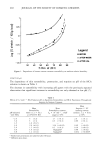
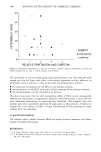
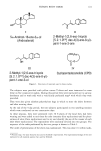
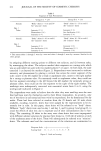
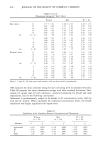
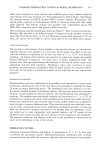
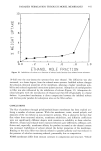
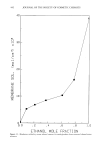
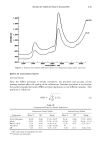
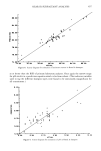
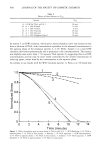
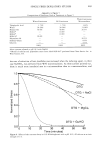
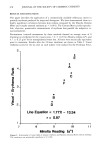
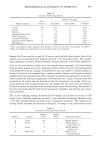
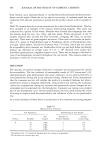
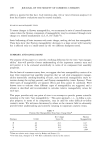
442 JOURNAL OF THE SOCIETY OF COSMETIC CHEMISTS 4O A SO 2O 10 0.0 .2 .4 .• .B •.0 ETHANOL MOLE FRAETION Figure 11. Membrane solubility versus ethanol content for methylparaben from saturated ethanol-water mixtures.

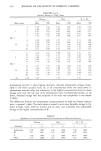
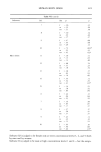
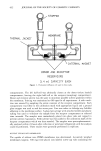
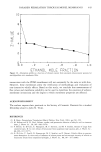
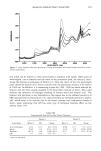
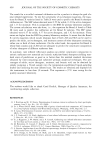
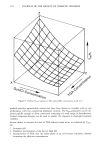
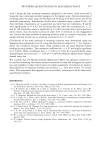
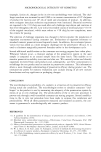
PARABEN PERMEATION THROUGH MODEL MEMBRANES 443 W 0 I I I I • I , I 0.0 .2 4 .8 .8 1.0 ETHANOL MOLE FRAoeTION Figure 12. Adsorption profile as a function of ethanol content from saturated ethanol-water systems for methylparaben onto membrane filler. interactions with the PDMS membranes will not necessarily be the same as with skin. However, these membranes allow the verification of methodology and evaluation of non-interactive vehicle effects. Based on this study, we conclude that measurement of flux values and membrane solubility can be used to determine the existence of solvent- membrane interactions and the degree to which membrane properties are affected. ACKNOWLEDGEMENT The authors express their gratitude to the Society of Cosmetic Chemists for a student fellowship award to John N. Twist. REFERENCES (1) B. Barry, DermatologicalFormulations (Marcel Dekker, New York, 1983), pp 238-239. (2) M. Nakano and N. K. Patel, Release, uptake, and permeation behavior of salicylic acid in ointment bases, J. Pharm. Sci., 59, 985-988 (1970). (3) F. Bottari, G. Di Colo, E. Nannipieri, M. F. Saettone, and M. F. Serafini, Release of drugs from ointment bases. II: In vitro release of benzocaine from suspension-type aqueous gels, J, Pharm, Sci., 66, 926-931 (1977). (4) G. Di Colo, V. Carelli, B. Giannaccini, M. F. Serafini, and F. Bottari, Vehicle effects in percuta- neous absorption: In vitro study of influence of solvent power and microscopic viscosity of vehicle on benzocaine release from suspension hydrogels, J. Pharm. Sci., 69, 387-391 (1980).
Purchased for the exclusive use of nofirst nolast (unknown)
From: SCC Media Library & Resource Center (library.scconline.org)