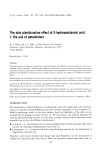
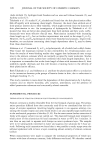
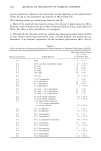
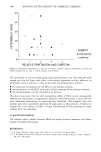
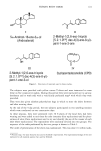
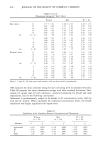
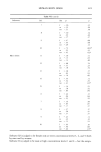
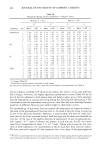
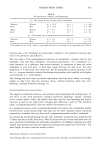
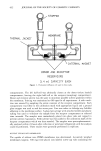
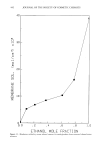
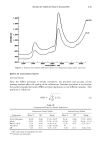
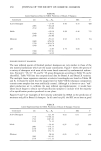
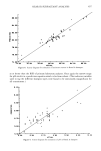
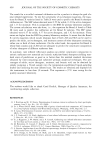
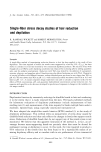
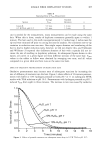
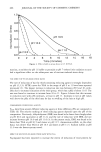
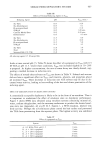
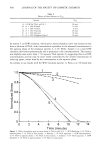
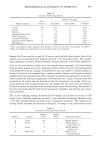
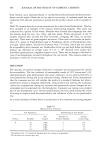
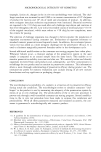
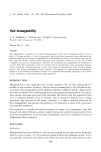
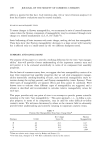
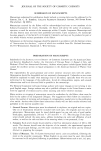
432 JOURNAL OF THE SOCIETY OF COSMETIC CHEMISTS • STOPPER DONOR AND RECEPTOR RESERVOIRS 9.4 ml CAPACITY EACH Figure 1. Horizontal diffusion cell used in this study. compartments. The left half-cell was arbitrarily chosen as the donor (solute loaded) compartment, leaving the right half-cell as the receptor (sampling) compartment. Donor and receptor solvent was the same to minimize possible solvent gradients within the membrane. Stirring was maintained at 600 rpm for all experiments. A sink condi- tion was assured by sampling the entire contents of the receptor compartment. Each compartment was filled to the calibration mark with appropriate liquid and a ground glass stopper was used to seal the access port. Care was taken to dislodge any bubbles adhering to the membrane surface. A glass luer syringe with attached needle and plastic tubing was used to withdraw the sample from the receptor compartment at selected time intervals. The samples were immediately placed into glass vials and capped to prevent solvent evaporation. Fresh solvent was then added to the calibration mark of the receptor compartment which was then resealed. The samples were spectrophotometric- ally analyzed within 24 hours after collection or were kept refrigerated until the analysis could be performed. These studies were generally performed in triplicate. SOLVENT UPTAKE INTO MEMBRANES The uptake of solvent into PDMS membranes was determined. Accurately weighed membranes (approx. 500 mg) were placed into labeled screw-cap vials containing the

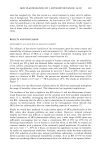
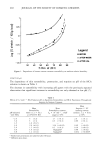
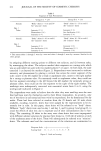
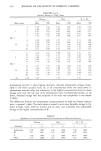
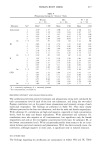
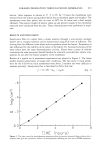
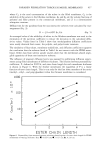
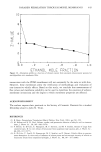
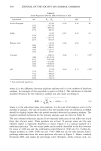
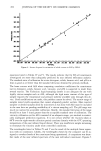
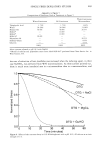
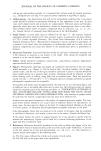
PARABEN PERMEATION THROUGH MODEL MEMBRANES 433 solvent. After exposure to solvent at 37 - 0.2øC for 72 hours the membranes were removed from the solvent and quickly blotted dry on absorbent paper and weighed. The membranes were then placed into an oven at 60øC for 24 hours and a final weight obtained. The percent weight of solvent taken up and percent weight of the membrane extracted were calculated from the data. These determinations were performed in tripli- cate. RESULTS AND DISCUSSION Steady-state flux of a solute from a donor solution through a non-reactive isotropic barrier into a receptor solution can be characterized using Fick's law of diffusion. The driving force for diffusion is the solute activity gradient across the barrier. Permeation is also influenced by the mobility of the solute in the barrier (9). Saturated solutions of the same solute have the same thermodynamic activity. Fluxes from a series of vehicles containing the same permeant should therefore be identical, provided that vehicle com- ponents do not alter the barrier property of the membrane. Results of a typical set of permeation experiments are plotted in Figure 2. The linear profile denotes achievement of steady-state conditions. The lag times to reach steady- state for the 0.0254-cm thick membranes were about 2 minutes and were difficult to measure precisely. Steady-state flux is described by Fick's first law: J - D' PC' (CD- C•t)/h (Eq. 1) .8 ¸ • 4 0.0 0 2 4 8 T ME (hours) Figure 2. The time course for methylparaben permeation from an aqueous saturated donor solution into a receptor sink Q is the cumulative amount of methylparaben diffusing per unit area of PDMS membrane.
Purchased for the exclusive use of nofirst nolast (unknown)
From: SCC Media Library & Resource Center (library.scconline.org)