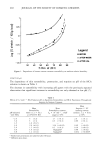
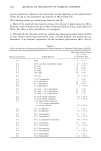
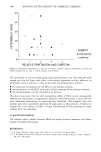
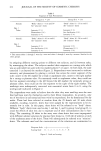
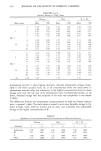
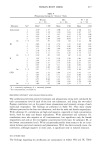
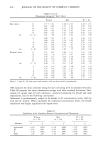
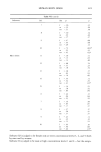
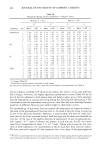
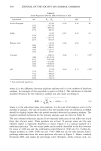
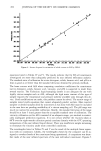
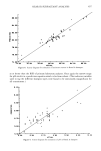
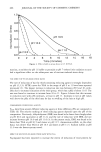
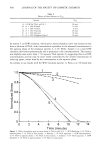
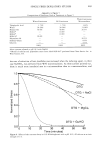
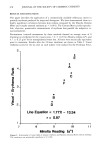
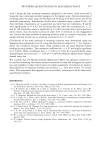
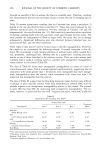
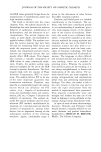
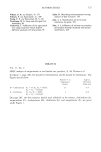
452 JOURNAL OF THE SOCIETY OF COSMETIC CHEMISTS 33.00' 32.50' 32.00' o 31 50' M * o 31.00, 30.50, 30.00, 29.50' 29.00' 28.5C • 28.50 29.00 29.50 30.00 30.50 31.00 31•50 32.00 32.50 ACTUAL Figure 4. Scatter diagram •restimation ofsolidscontentin SLS by NLRA. ß ß ß ß ß ß ß 33. O0 equations listed in Tables IV and V. The results indicate that for SLS all constituents investigated are more than adequately predicted by near infrared reflectance analysis. The standard error of calibration for active detergent, solids, benzoic acid, and pH is at least as good as or better than the standard deviation obtained by primary methods. The lesser success with ALS when comparing correlation coefficients for constituents (active detergent, solids, benzoic acid, viscosity, and pH) is suspected to result from several sources. The Technicon liquid-sampling drawer is not adequate for use with highly viscous samples such as ALS, although the high water content of this type of sample requires the temperature and pressure stability available only through this de- vice. Until modifications are made, this problem cannot be solved. The narrow range of samples tested yields equations that cannot adequately predict outliers. More rejected samples or altered samples dried by microwave as was done with SLS must be included in the next data set pending availability of a viscous sampling cell. The pH range was much too narrow for acceptable calibration. Ideally, the standard deviation of the range should be at least 5 times greater than the acceptable standard error of calibration. The viscosity calibration set for ALS consisted of an adequate range, yet resulted in statisti- cally inadequate prediction equations. It is not certain whether the viscosity taken at 80øF over the eight-month collection period correlates linearly with the 45øC operating temperature of the near infrared liquid drawer. There was insufficient sample remaining to remeasure the viscosity under more controlled conditions. The wavelengths listed in Tables IV and V are the result of the multiple linear regres- sion with no constraints. Ideally, the wavelengths chosen by the computer can be as- signed to covalent bonds of the constituent being quantitated. A comparison was there- fore made of the near infrared spectrum of the neat individual constituent. Figures 5

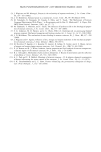
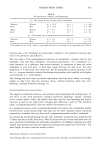
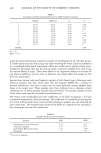
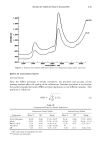
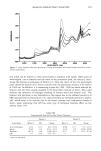
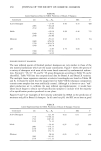
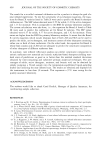
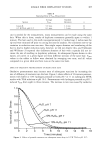
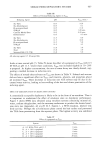
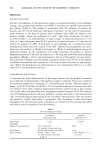
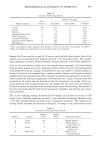
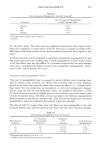
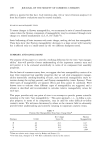
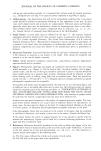
NEAR IR SURFACTANT ANALYSIS 453 Table VI Some Characteristic Functional Group Frequencies in NIR (11) Aliphatic Hydrocarbons Aromatic Hydrocarbons Carboxylic Acids 1600-1800 nm 1100-1250 nm 2000-2400 nm 1300-1450 nm 1685 nm 1143 nm 2150, 2460 nm 1420-1450 nm 1450 nm 1900 nm 2100 nm Ammonium Ion 1540 nm 1900-2300 nm Water 1330-1550 nm 1850-2090 nm First overtone C-H stretch Second overtone C-H stretch Combination Combination First overtone C-H stretch Second overtone C-H stretch Combination Combination First overtone O-H stretch Second overtone C-O stretch Combination O-H stretch/bend First overtone N-H stretch Combination N-H stretch/bend First overtone O-H stretch Combination O-H stretch/bend and 6 are NIR spectra of reagent grade SLS, dried ALS raw material, and reagent grade benzoic acid. (The physical properties of viscosity and pH of themselves have no near infrared spectrum but are suspected of altering hydrogen bonding and thus effecting the water bands.) Characteristic functional group frequencies for these constituents are listed in Table ¾I. Based on the frequency ranges of Table ¾I and the near infrared spectrum of Figures 5 and 6, the absorption bands for ammonium lauryl sulfate, so- dium lauryl sulfate, and benzoic acid can be assigned and are listed in Table VII. t.aO0' t.000' .800' .600' .400' .200' I I I I I I I 1200 t400 1600 1800 2000 2200 2400 HAVELENGTH Figure 5. Nearin•ared reflectancespectra •rreagent grade SLS and dried ALS raw material. AL•q •L•q
Purchased for the exclusive use of nofirst nolast (unknown)
From: SCC Media Library & Resource Center (library.scconline.org)