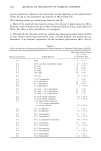
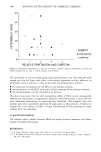
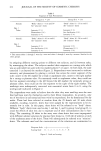
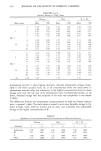
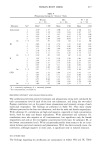
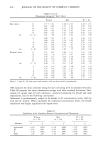
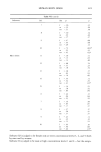
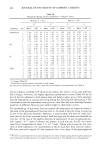
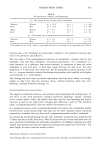
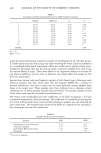
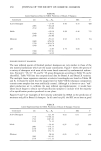
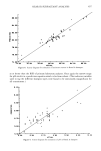
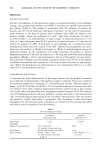
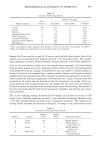
458 JOURNAL OF THE SOCIETY OF COSMETIC CHEMISTS The search for a so-called universal calibration set for a product is always the goal of a near infrared experiment. To test the universality of our shampoo equations, the equa- tions for Brand X varieties listed in Table X were used to predict the Brand A shampoo calibration set. The SEP values obtained were 0.55 for solids, 0.41 for active detergent, and 1.13 for moisture. This is comparable to the RSD for primary laboratory analyses. The reverse calculations were also done, i.e., the equations for Brand A listed in Table IX were used to predict the calibration set for Brand X varieties. The SEP values obtained were 0.57 for solids, 0.77 for active detergent, and 3.42 for moisture. These errors are higher than the RSD for primary laboratory analyses. It seems that the Brand X variety equations which incude shampoo base of both ALS and SLS can be used to predict the solids, active detergent, and moisture content of other shampoos containing either one or both of these surfactants. On the other hand, the equations for Brand A whose base consists only of ALS are not adequate to predict the constituent composition of other shampoos of different surfactant base. In summary, near infrared reflectance analysis can predict constituent composition in anionic surfactant raw materials and anionic surfactant-based shampoos yielding stan- dard error of predictions as good as or better than the residual standard deviations obtained by time-consuming and subjective primary analytical techniques. The per- centages of solids, active detergent, moisture, and benzoic acid can be obtained by simply pumping a 50-mL sample into the temperature-equilibrated liquid-sampling drawer and initiating the near infrared scan. The results are obtained and displayed on the instrument in less than 30 seconds. This represents a 97% time saving for the quality assurance laboratory. ACKNOWLEDGEMENT The authors would like to thank Carol Dudick, Manager of Quality Assurance, for coordinating sample collection. REFERENCES (1) I. Ben-Gera and K. H. Norris, Determination of moisture content in soybeans by direct spectropho- tometry, IsraelJ. Agr. Res., 18, 125 (1968). (2) D. L. Wetzel and H. Mark, Scanning NIR of grains, oilseeds and their components, ICC Symposi,m.' Use ofNear-l,frared Tech,iq,es (6th World Bread Congress, Winnepeg, 1978), Paper No. s2.1. (3) E. Lanza, Determination of moisture, protein, fat, and beef by near infrared spectroscopy, J. FoodSci., 48(2), 471-474 (1983). (4) J. F. Frank and G. H. Birth, Application of near infrared reflectance spectroscopy to cheese analysis, J. Dairy Sci., 65, 1110-1116 (1981). (5) G. J. Higgerson, J. w. Marler, and J.P. Connell, Calibrating near infrared reflectance instruments for wool base and wool content, J. Textile l,st., 76(3), 133-144 (1985). (6) M. Bernardini, O. Cozzoli, F. Mignini, and E. Fedeli, Determination of cosmetic composition by N.I.R.A. technique, XIVth I.F.S.C.C. Co,gress (Barcelona, 1986), Paper No. s. 1.19. (7) S. Gravina, Applications of near IR reflection spectroscopy: Analysis of detergents, La Rivista ltalia,a Delle Sosta,ze Grasse, 61, 99-104 (1984). (8) D. E. Honigs, G. M. Hieftje, H. Mark, and T. B. Hirschfeld, U,iq,e Sample Selectio, via Near I,frared S,btractio, (Indiana University, personal communication, 1985).

NEAR IR SURFACTANT ANALYSIS 459 (9) Potentiometric Determination of Anion-Active and/or Cation-Active Detergents Wtth Ion-Specific Electrodes (Metrohm Application Bulletin, 1982) No. 138e. (10) A.D. White, Applications ofpotentiometric titration for the determination of anionic-active matter, Soap/Cosmetics/Chemical Specialties, 49 - 52 (Novera ber 1983). (11) L. G. Weyer, Near infrared spectroscopy of organic substances, Applied Spectroscopy Reviews, 21(1&2), 1-43 (1985). (12) I. Ben-Gera and K. H. Norris, Direct spectrophotometric determination off at and moisture in meat products, •/. Food Sci., 33, 64-67 (1968). (13) N. Alpert, W. Keiser, and H. Szymanski, Theory and Practice of lnfraredSpectroscopy (Plenum: New York, 1970), p. 299. (14) L. J. Bellamy, Advances in Infrared Groazp Frequencies (Methuen, Great Britain, 1968), p. 242.
Purchased for the exclusive use of nofirst nolast (unknown)
From: SCC Media Library & Resource Center (library.scconline.org)