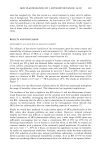
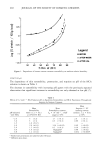
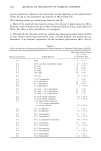
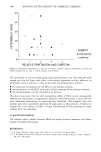
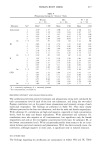
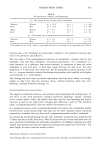
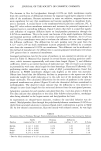
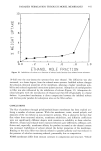
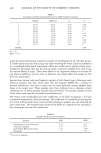
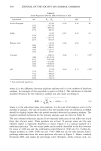
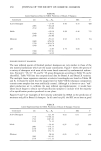
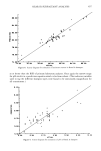
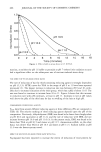
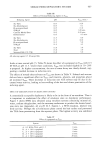
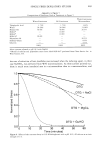
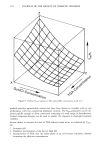
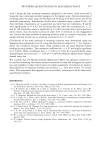
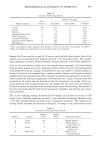
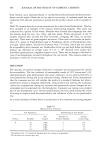
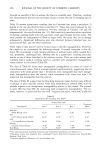
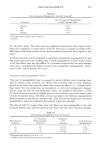
SKIN PLASTICISATION BY 2-HYDROXYOCTANOIC ACID 405 Table III Effect of Penetration Enhancers and Structurally Related Materials on HCA Penetration and Sorption by Stratum Corneum From 0.2 tool 1-1 HCA solution Added Material Relative* Permeability Constant ( _+ half range) at 30øC Relative* Sorption (-+2 X S.E.)at 30øC None 1 1 2% nmp 1.4 (-+0.9) 2 6%nmp 1.6 (ñ0.5) 5 10% nmp 2.0 (+0.6) 0.6 10% 2-pyrrolidone 3 (-+ 1) 0.77 5% nmp + 5% 2-pyrrolidone 2 (+2) 1.2 0. 125% decyl methyl sulphoxide 0.4 (_+0.2) 0.28 + 0. 125% sucrose monostearate in 33% aq. ethanol 5% 1,2-ethanediol 3.1 (-+0.3) 2.3 5% 1,2-propanediol 3 ( + 2) 1.7 5% 1,2,3-propanetriol 1.4 (-+0.4) 1.7 (glycerol) 5% 1,3-butanediol 1.2 (---0.5) 2.1 5% 2,4-pentanediol 2 (-+2) 4 -+ 1) -+2) -+0.3) +0.05) -+0.2) -+0.3) _+ 1.0) -+0.5) -+0.7) -+ 0.4) -+2) * Relative to HCA alone. ample, adding 2% nmp increases plasticisation by a factor of 4 while penetration is increased by only -40%. The influence of ethanediol is to increase penetration (-- X 3) whilst not influencing extensibility at all. The lack of any simple relationship be- tween penetration enhancement and extensibility is shown clearly in Figure 3. In any case, the effect on extensibility (a steady-state measurement) would be expected to depend more on steady-state sorption (i.e., the amount of HCA associated with the skin) rather than on the rate at which HCA passes through the skin. c. If we look at the relative steady-state sorption figures, however, we can see that the ability of a material to act as a plasticisation potentiator is not related to its effect on sorption (as shown also in Figure 3). For example, 10% nmp increases the plasticisation effect of HCA by a factor of 5 but actually decreases sorption by about 20%. It is worthy of note that this is not in conflict with the use of Fick's first law of diffusion to explain the relation between penetration and sorption in the pH dependence section above. The adjustment of pH merely changes the quantity of the unionised species interacting with given penetration routes in the skin. Thus the diffusion coefficient D remains unchanged and kp is proportional to K (the partition coefficient, see above). The presence of a penetration enhancer will alter the behaviour of the solute during penetration and therefore change D. Then kp is no longer proportional to K (12). For the foregoing reasons, we have chosen to call materials that enhance plasticisation by HCA plasticisation potentiators. d. The degree to which plasticisation potentiators enhance plasticisation generally in- creases with increasing concentration. e. The ability of the diols to enhance plasticisation increases with increasing chain length.

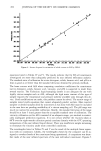
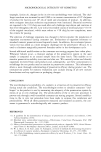
406 JOURNAL OF THE SOCIETY OF COSMETIC CHEMISTS 50- 40- 30- 20- 10- [] ß ß [] ß [] [] ß ß ß [] [] ß I I I 1 1 2 3 4 RELATIVE PENETRATION AND SORPTION Legend ß PENETRATION [] $ORPTION Figure 3. Epidermis extensibility as a function of stratum corneum's relative permeability constant and relative sorption for 0.2 mol 1-• HCA solution with additives. The mechanism of action of these plasticisation potentiators is not clear from the work carried out thus far. Since their effect is not simply dependent on their influence on penetration rates or sorption, it may be that they are altering one or more of: ß the molecular environment of the HCA in the stratum corneum. ß the distribution of the HCA within the cellular structure of the stratum corneum. ß the thermodynamic activity of the HCA in solution. The above data show that the skin extensibility effect of HCA can be substantially enhanced by the presence of appropriate additives, while HCA alone is more effective than traditional moisturisers in improving skin flexibility. This suggests that such systems may have considerable potential for application to skin products. Evidence to support the in vivo efficacy of HCA is being collected and will be published by other workers from this laboratory. ACKNOWLEDGEMENTS The authors wish to thank Christine Black for expert technical assistance and Dieno George for helpful discussions. REFERENCES (1) B. Idson, Dry skin, Drug Cosmet. Ind., 104, 44-47 and 161-162 (June 1969). (2) I. H. Blank, Factors which influence the water content of the stratum corneum, J. Invest. Dermatol., 18, 433-440 (1952).
Purchased for the exclusive use of nofirst nolast (unknown)
From: SCC Media Library & Resource Center (library.scconline.org)