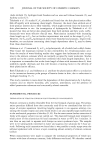
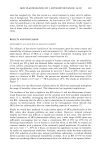
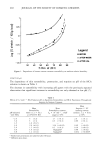
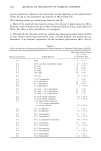
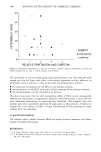
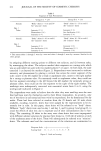
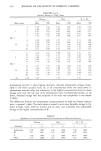
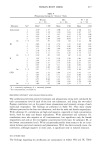
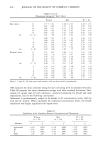
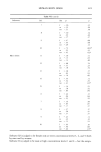
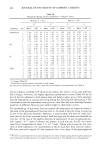
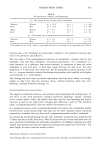
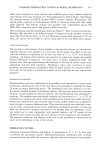
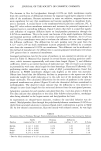
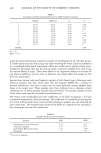
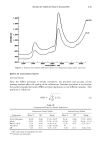
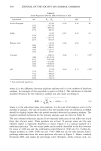
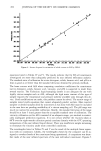
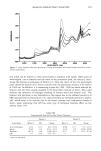
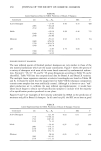
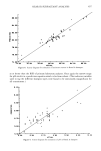
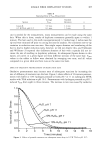
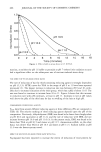
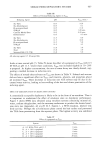
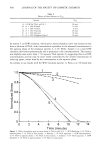
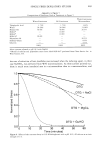
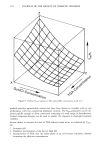
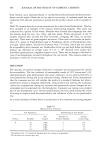
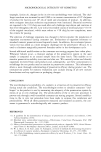
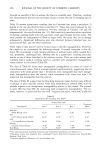
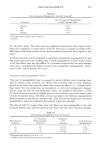
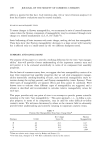
456 JOURNAL OF THE SOCIETY OF COSMETIC CHEMISTS Table IX Linear Regression Data for NlRA Prediction of Brand A Shampoo Constituent nm K o . . K n r SEC F Active Detergent - 27.45 0.96 0.35 408 2083 - 384.28 2139 470.83 Solids - 89.16 0.98 0.46 725 1940 - 98.12 2348 292.86 Moisture 253.23 0.93 0.76 154 1680 4258.50 1790 -4634.74 1940 246.78 pH 11.85 0.79 0.06 34 1380 - 87.61 2360 32.25 FINISHED PRODUCT SHAMPOOS The near infrared spectra of finished product shampoos are very similar to those of the raw material surfactants which are the major constituents. Figure 7 shows the spectra of a variety of shampoos with most of the water bands removed by mathematical subtrac- tion. Typical C - H, O - H, and N - H group frequencies according to Table VI can be identified. Table VIII lists the compositional data for Brand A and Brand X varieties. The multiple linear regression statistics at selected wavelengths are listed in Tables IX and X. It should be noted that the ranges listed in Table VIII for shampoo composition contain some samples that were artificially created. Although it is better to use a "real" plant production set to calibrate the near infrared spectrophotometer, it would have taken much longer to obtain out-of-specification samples to include with the majority of in-specification product produced in our plant. Figures 8 and 9 are examples of the linearity achievable by NIRA in the prediction of moisture and pH in Brand A shampoo. In all cases but pH, the SEC are at least as good Table X Linear Regression Data for NIRA Prediction of Brand X Shampoo Varieties Constituent nm K o .. K n r SEC F Active Detergent 121.39 0.92 0.31 215 1710 - 3790.16 1722 3387.62 2139 73.32 Solids - 56.49 0.97 0.27 690 2083 - 476.13 2130 238.21 2270 374.73 Moisture 58.94 0.95 0.71 418 1905 103.83 2139 - 171.33

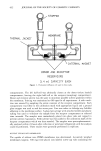
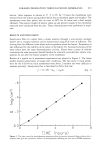
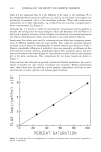
NEAR IR SURFACTANT ANALYSIS 457 86.00' 84.00' o 82.00. '" u :l:+ o 4. : 80.00. + ,I, =1, + 78.00 76.00 74.00 ' I 74.00 76.00 78.00 80.00 82.00 84.00 86.00 ACTUAL Figure 8. Scatter diagram •restimation of moisture contentin Brand A shampoo. as or better than the RSD of primary laboratory analyses. Once again the narrow range for pH results in a prediction equation which is far from robust. (The indicator variables used to tag the different shampoo types were found to be statistically insignificant for all constituents.) 6.i0' 6.00' 5.90 + o i- u + o 5.80 tu + n + + ,I, + + + 5.70 + + $ + + 4. :• + + +4. 5.60, + 5.50 5.50 5.60 5.70 5.80 5.90 6.00 ACTUAL Figure 9. Scatter diagram •restimation ofpH in Brand A shampoo. 6.10
Purchased for the exclusive use of nofirst nolast (unknown)
From: SCC Media Library & Resource Center (library.scconline.org)