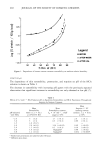
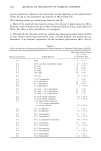
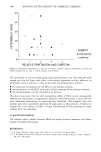
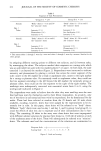
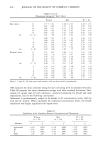
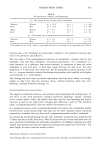
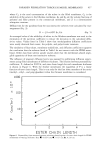
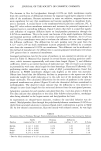
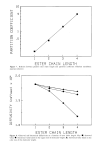
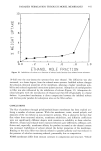
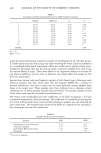
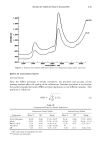
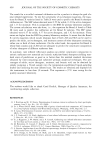
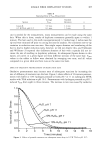
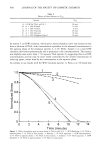
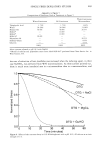
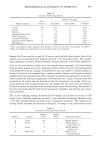
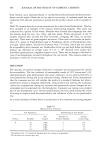
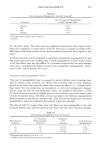
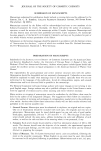
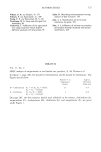
SINGLE FIBER DEPILATORY STUDIES 465 Table II Reproducibility of T95 • Measurement Average Standard System T95 % Deviation n Cream B 5.9 min. 1.2 min. 22 0.5 M TGA, pH 11.5 8.1 min. 1.2 min. 14 cm) is needed for the measurement, many measurements can be made using the same hair. When this is done, results of duplicate treatments generally agree to within 1 minute. The hair used in this work was approximately 12 inches long 2 inches near the tip end were trimmed off prior to cutting sections for analysis. No consistent root-to-tip variation in reduction rate was seen. One might expect abrasion and weathering of the hair to lead to higher reduction rates however, we did not observe this, and Yablonski and Williams (1) reported that deliberate abrasion of hair with a spatula did not in- crease the rate of swelling in depilatory solutions. In subsequent figures shown in this report, all curves in a given figure are from different sections of the same hair. T95 % values in the tables to follow were obtained by averaging two runs, and all values compared in a given table are from runs on the same two hairs. EFFECT OF OXIDATIVE PRETREATMENT ON REDUCTION RATE Oxidative pretreatments may increase rates of subsequent reactions by increasing the rate of diffusion of reactants into the hair. Figure 3 shows effects of 30-minute pretreat- ments with buffer or 10% hydrogen peroxide at both pH 7 or 11 on subsequent SFTK results with TGA solutions at pH 10.5. Pretreatment with hydrogen peroxide at pH 11 reduced T95 % from eight to three minutes. The increase in rate was caused by oxidative • •.'..•..•, x.•..-10% H202, pH 7 0.2 - \ •'"".',, 'x %'• 10% H202, pH 11 o.o "--'. ............ , ........ 0 2 4 6 8 10 12 14 16 Time (minutes) Figure 3. Effects of peroxide treatment on subsequent stress decay in 0.5 M TGA at pH 10.5.

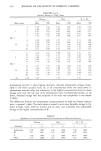
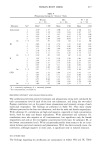
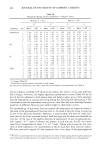
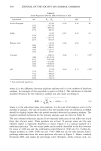
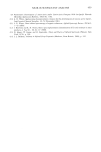
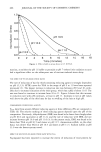
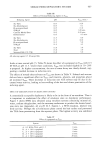
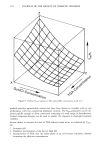
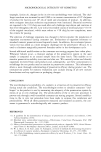
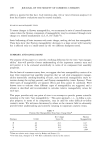
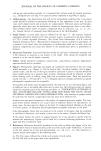
466 JOURNAL OF THE SOCIETY OF COSMETIC CHEMISTS 1.0 0.8 0.6 .N_ 0.4 E o z 0.2 _ .,. ,, ........., \. •p. 12.0 "......... ' \'\- pH 13.0 'x. 0.0 - • ' •, tx.,,, I I I .......... t ............ I ...... I I 0 2 4 6 8 10 12 14 16 18 Time (minutes) Figure 4. Effect of pH on stress decay in 0.5 M TGA. reaction, as neither the pH 11 buffer or peroxide at pH 7 (where little oxidation occurs) had a significant effect on the subsequent rate of reactant-induced stress decay. THE EFFECT OF PH ON REDUCTION RATES The rate of reduction of hair by thiol-containing reducing agents is strongly dependent on pH (2,3,5). SFTK curves for TGA in the range of pH 9 to 11 have been reported previously (3). The largest increase in reduction rate was between pH 9 and 10, prob- ably due to increased ionization of the thiol group, which has a pKa of about 10.0. The rate was found to Continue to increase from 10 to 11. Figure 4 shows that this increase in reduction rate with pH continues, at least to pH 13. Increases in rate at pH values well above the pKa of the thiol may be due to swelling of the hair at high pH. COMPARISON OF REDUCING AGENTS T95 % data from several different reducing agents at three different pH's are compared in Table III. The relative ranking of these reducing agents depends upon the pH of the comparison. Previously, dihydrolipoate (DHL) was found to be faster than thioglycolate at pH 10.0 and equivalent at pH 11.0, and the rate of reduction with DHL did not increase between pH 10.0 and pH 11.0 (3). In the present study, DHL was found to be faster than TGA at pH 10.5 and slower at pH 11.5. Ammonium sulfide, on the other hand, was slower than TGA at pH 10.5 and faster at pH 11.5. Sodium sulfide at pH 13.0 was the fastest system tested. EFFECT OF SOLVENTS ON REDUCTION RATE WITH TGA N-propanol has been reported to increase the extent of reduction of wool protein by
Purchased for the exclusive use of nofirst nolast (unknown)
From: SCC Media Library & Resource Center (library.scconline.org)