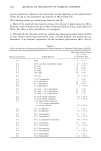
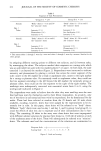
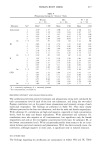
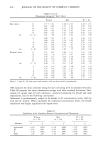
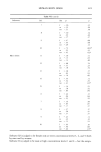
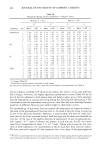
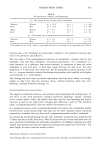
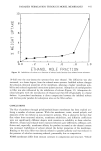
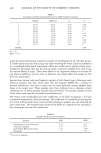
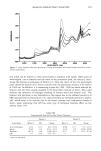
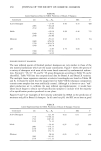
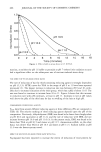
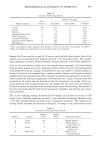
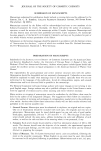
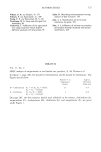
SINGLE FIBER DEPILATORY STUDIES 467 Table III Effects of Various Reducing Agents on T95 % Reducing Agent pH T95 % (min.) Na TGA 10.5 14.0 Na dihydrolipoate 10.5 9.2 [3 mercaptoethanol 10.5 11.0 (NH4)2S 10.5 20 min. Cysteine Methyl Ester 10.5 20 min. Dithiothreitol 10.5 4.5 min. Na TGA 1 l. 5 8.0 Na dihydrolipoate 11.5 10.0 [3 mercaptoethanol 11.5 5.0 (NH4)2S 11.5 4.5 Na TGA 13.0 3.0 Na2S 13.0 1.0 Saturated BaS (0.5 M) 13.0 5.0 All reducing agents 0.5 M except BaS. thioIs at near neutral pH (7). Table IV shows the effect of n-propanol on T95 % with 0.5 M TGA at pH 11.5. Under these conditions, T95 • was increased slightly at 10-20% n-propanol. At higher concentrations, the rate of stress decay was clearly slowed, sug- gesting a marked decrease in reduction rate. The effects of several other solvents on T95 • are shown in Table V. Ethanol and acetone did not have a significant effect on T95%, and triacetin, glycerin, and propylene glycol all increased T95 %. These decreases in reduction rate with solvent may be due to de- creased water activity, leading to less swelling of the hair and slower penetration of the reducing agent. EFFECT OF EMULSION STATE ON REDUCTION KINETICS A cosmetically acceptable depilatory is likely to be in the form of an emulsion. Thus it is important to understand the effect of emulsion state on depilatory performance. Figure 5 shows SFTK data obtained using emulsion systems containing mineral oil, water, sodium thioglycolate, and the necessary surfactants to produce the desired emul- sion state (see Appendix), all at pH 10.5. System 1, a W/O emulsion, showed very little activity. Perhaps the oil-continuous phase coated the hair surface and prevented the TGA from penetrating from the aqueous phase. The highest activity was exhibited Table IV Effect of n-propanol on T95•o System T95% A. 0.5 MNaTGA, pH 11.5 B. A + 10% n-propanol C. ,A + 20% n-propanol D. A + 40% n-propanol E. A + 50% n-propanol 6 min. 9 min. 8 min. 12 min. 20 min.

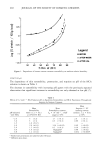
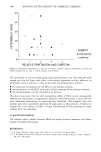
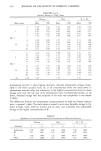
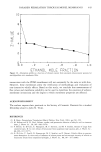
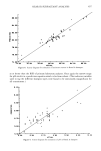
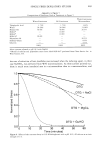
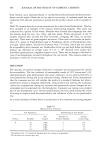
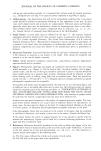
468 JOURNAL OF THE SOCIETY OF COSMETIC CHEMISTS Table V Effects of Other Solvents on T95 % System T95 % A. 0.5 M Na TGA, pH 10.5 B. A + 20% Ethanol C. A + 20% Acetone D. A + 20% Triacetin E. A + 20% Glycerin F. A + 20% Propylene Glycol 10 min. 11 min. 9 min. 20 min. 18 min. 14 min. by system 5, an O/W emulsion, which gave a stress relaxation curve very similar to that from a solution of TGA, with concentration equivalent to the assumed concentration in the aqueous phase of the emulsion (system 4, 4.3% TGA). System 3 is a clear O/W emulsion that forms spontaneously and is presumed to be a microemulsion. This system was slightly more active than 1.7% aqueous TGA (system 2), suggesting that in a O/W microemulsion activity may be more nearly controlled by the overall concentration of reducing agent, rather than by the concentration in the aqueous phase. In contrast to our results with the W/O emulsion (system 1), Parra eta/. (9) found that 0.8 0.6 E0.4 0.2 0 2 4 6 8 14 Time (minute) Figure 5. Effect of emulsion type on stress decay in TGA at pH 10.5. 1. W/O Emulsion: 4.3% TGA in aqueous phase 1.7% TGA in total system. 2. Solution: 1.7% TGA (aqueous). 3. O/W Microemulsion: 4.3% TGA in aqueous phase 1.4% TGA in total system. 4. Solution: 4.3% TGA (aqueous). 5. O/W Emulsion: 4.3% TGA in aqueous phase 1.7% TGA in total system.
Purchased for the exclusive use of nofirst nolast (unknown)
From: SCC Media Library & Resource Center (library.scconline.org)