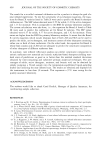
444 JOURNAL OF THE SOCIETY OF COSMETIC CHEMISTS (5) S. H. Yalkowsky and G. L. Flynn, Correlation and prediction of mass transport across membranes. II: Influence of vehicle polarity on flux from solutions and suspensions, J. Pharm. Sci., 63, 1276-1279 (1974). (6) S. Tanaka, Y. Takashima, H. Murayama, and S. Tsuchiya, Studies on drug release from ointments. V. Release of hydrocortisone butyrate propionate from topical dosage forms to silicone rubber, Int. J. Pharm., 27, 29-38 (1985). (7) C. R. Behl, E. E. Lin, G. L. Flynn, C. L. Pierson, W. I. Higuchi, and N. F. H. Ho, Permeation of skin and eshar by antiseptics. I: Baseline studies with phenol, J. Pharm. Sci., 72, 391-396 (1983). (8) J. L. Zatz and U. G. Dalvi, Evaluation of solvent-skin interactions in percutaneous absorption,J. Soc. Cosmet. Chem., 34, 327-334 (1983). (9) W. I. Higuchi and T. Higuchi, Theoretical analysis of diffusional movement through heterogeneous barriers,J. Pharm. Sci., 49, 598-606 (1960). (t0) G. L. Flynn and R. W. Smith, Membrane diffusion. Ill: Influence of solvent composition and per- meant solubility on membrane transport, J. Pharm. Sci., 61, 61-66 (1972). (t t) C. F. Most, Some filler effects on diffusion in silicone rubber, J. Appl. Polym. Sci., 14, t019-1024 (1970). (12) G. L. Flynn and T. J. Roseman, Membrane diffusion. II: Influence of physical adsorption on molec- ular flux through heterogeneous dimethylpolysiloxane barriers, J. Pharm. Sci., 60, 1788-1796 (1971). (13) G. L. Flynn and S. H. Yalkowsky, Correlation and prediction of mass transport across membranes. I: Influence of alkyl chain length on flux determining properties of barrier and diffusant, J. Pharm. Sci., 61, 838-852 (1972).

j. Soc. Cosmet. Chem., 37, 445-459 (November/December 1986) Application of near infrared reflectance spectroscopy to the quality assurance of surfactants PRISCILLA LABONVILLE WALLING and JACQUELYN M. DABNEY, Helene Curtis Inc., North Ave., Chicago, IL 60639. Received June 3 o, 1986. Synopsis The suitability of near infrared reflectance analysis spectroscopy for the quality assurance of raw material detergents and batch process shampoos has been investigated. The artionic surfactants, ammonium lauryl sulfate and sodium lauryl sulfate, were analyzed by primary analytical techniques for active detergent, solids, moisture, benzoic acid, pH, and viscosity. Two brands of shampoo were analyzed for active deter- gent, solids and moisture. All were scanned in the near infrared from 1100 nm to 2500 nm to develop prediction equations. The results indicate that all of the chemical constituents investigated can be predicted by near infrared. The advantages of this procedure over wet chemical or st.andard instrumental methods include no sample preparation and analysis time of less then one minute. INTRODUCTION Near infrared reflectance analysis (NIRA) is a simple non-destructive technique for predicting the percentage composition of constituents in a mixture. The near infrared region of the electromagnetic spectrum extends from 800 nm to 2500 nm. The strongest absorptions in this region are due to combinations and overtones of vibrational stretching fundamentals related to O- H, N-H, and C- H bonds. Just as chemical structure and bond strength shift vibrational fundamentals, so do they shift the corre- sponding overtones and combinations. More importantly, bands are shifted and broad- ened by matrix effects and physical properties which influence hydrogen bonding. As a consequence, spectra consist of broad, overlapping, unresolved, weakly absorbing, and highly reflective bands. Because the reflectance/absorbance ratio is high, the near in- frared region is linearly correlated with concentration. With the advent of the micro- computer, the problem of finding wavelengths in this region for a good Beer's Law/Ku- belka-Munk standard concentration curve has been solved. Using multiple linear re- gression, wavelengths are selected such that the absorbance statistically correlates with the percentage composition determined by primary analyses, automatically correcting for background effects. Slopes and an intercept are calculated to fit a prediction equa- tion of the form: %Concn = K o + K•log(1/R•) + K21og(1/R 2) .... (1) where K represents the intercept and slope constants and R, the reflectance at the chosen wavelengths. 445
Purchased for the exclusive use of nofirst nolast (unknown)
From: SCC Media Library & Resource Center (library.scconline.org)