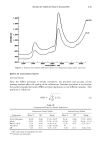
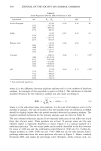
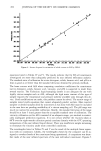
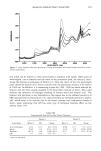
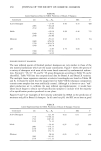
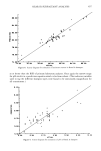
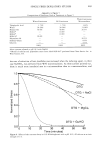
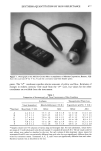
446 JOURNAL OF THE SOCIETY OF COSMETIC CHEMISTS The greatest commercial application of NIRA spectroscopy to date has been in the agricultural industry (1,2). Recently applications have been developed for the dairy, meat, and textile industries (3,5). Two cosmetic applications have appeared: the suit- ability of applying NlRA for the measurement of ethyl alcohol, water, and essence in perfume (6) and the potential use of NlRA for quantitative analysis of detergents (7). The purpose of this study was to investigate the feasibility of applying NlRA to the quantitation of raw material surfactants and different types of finished product shampoos in order to reduce quality assurance time and cost. MATERIALS AND METHODS SAMPLES With the help of our quality assurance laboratory, plant samples of raw material deter- gents and shampoos were collected over an eight-month period. The raw material set included fifty ammonium lauryl sulfate (ALS) samples and fifty sodium lauryl sulfate (SLS) samples. These sets contained rejected and non-conformance samples as well as samples within specification. Microwave drying of the surfactant was used on twelve SLS samples. No ALS samples were altered because they were initially too viscous for the near infrared liquid cell. Shampoo samples consisted of 35 Brand A, a shampoo with ALS base, and 165 of Brand X, a shampoo with ALS/SLS base with various colors and fragrances. Non-production artificial samples of SLS and the shampoo sets were created in order to broaden the range. Cold-compounded shampoos were spiked with surfactant or diluted with water to obtain a range of constituents larger than that expected in normal plant production. SPECTRAL ANALYSIS Reflectance spectra were obtained over a range of 1100 nm to 2500 nm using a Tech- nicon IA/500 coupled with a Hewlett Packard 1000 microcomputer. Initially 50 milli- liters of sample was injected into the liquid drawer with a disposable plastic syringe. Due to the high viscosity of the samples, especially ALS, this method proved to be physically difficult. Subsequently all viscous samples were pumped via a peristaltic pump. The Technicon liquid transflectance drawer was maintained at 45øC. It con- sisted of a ceramic reflector and a quartz window separated by a constant cell thickness. All samples were preheated in a 40øC waterbath before being pumped into the liquid drawer. Optical data in the form of absorbance (log i/reflectance) were collected in 4-nm increments and stored on a hard disc. PRIMARY ANALYSIS The raw material surfactants were analyzed for active anionic detergent, solids, mois- ture, benzoic acid, viscosity, and pH. The.shampoos were analyzed for active anionic detergent, solids, moisture, and pH. Anionic surfactant was measured by potentiomet- ric titration with Hyamine 1622 (diisobutylphenoxyethoxyethyl-dimethyl-benzyl-am- monium chloride monohydrate) (Fluka AG) using either a nitrate electrode (9) or a surfactant electrode (10) and a Fisher autotitrator. Solids were measured using a CEM

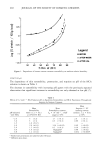
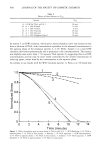
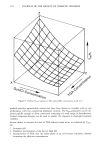
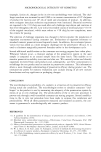
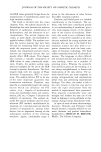
NEAR IR SURFACTANT ANALYSIS 447 Automatic Volatility Computer. Moisture was determined via Karl Fischer titration. Benzoic acid (Aldrich, Milwaukee, WI) was determined spectrophotometrically using the method of standard addition in the ultraviolet range at 222 rim. Viscosity was measured using a Brookfield Model RVTD viscometer at a speed of 20 rpm for 3 minutes and spindle 3 at 80øF. DATA ANALYSIS The raw optical data was subjected to step-up multiple linear regression search for one to nine wavelengths. Plots of the standard error of calibration (SEC) (difference between the primary analysis and the optical predictions can also be referred to as standard error of estimate (SEE)) and F-level (ratio of variances which gives an indication of the ro- bustness of regression) were constructed versus the number of wavelengths. The final number of wavelengths chosen for best correlation with each primary constituent ana- lyzed was determined to be that number which gave the highest F-level and corre- spondingly smallest SEC. Figure 1 indicates that the maximum number of wavelengths for statistical significance in predicting the active detergent in ammonium lauryl sulfate is five. The raw data were then subjected to an all-possible-combination (combo) search F-LEVEL ß SEE -t -.8 -.6 -.4 -.2 • "' •" • • • • i 0 t 2 13 •4 5 15 7 8 9 t0 NUNBER OF NAVELENGTHS Figure 1. Plot of statistical parameters of F-level and standard error of calibration used to determine maximum number of wavelengths before overfitting of data occurs for the active detergent prediction in ALS.
Purchased for the exclusive use of nofirst nolast (unknown)
From: SCC Media Library & Resource Center (library.scconline.org)