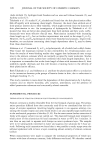
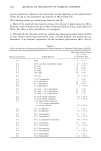
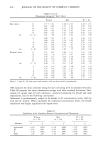
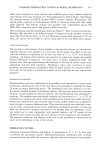
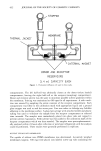
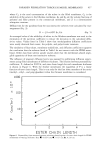
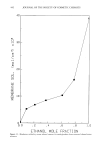
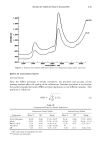
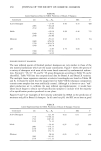
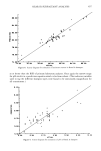
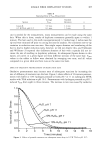
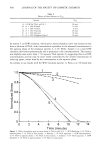
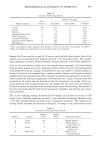
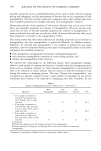
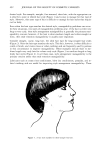
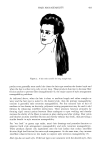
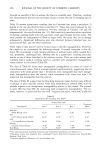
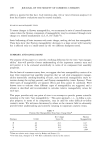
436 JOURNAL OF THE SOCIETY OF COSMETIC CHEMISTS x .35 - .28 .21 .14 .07 IvlETHYL- PROPYL- PARABEN BUTYL- •-'•J AOUEOUS J• P.G. 40% Figure 5. Effect of donor composition on steady-state flux from saturated aqueous and propylene glycol 40% w/w/systems. where PC is the polymer/solvent partition coefficient, (bl is the volume fraction of polymer, Cs is the saturation concentration, and ? is the tortuosity due to filler. Filler present in the commercial membranes reduces steady-state flux by increasing the effective thickness of the membrane (tortuosity) and decreasing the volume fraction of the polymer (diffusion medium). The volume fraction of polymer was calculated from the known weight fraction of filler (0.234) and densities of filler (2.2 g/cm 3) and polymer (0.97 g/cm3). A value of 0.88 was calculated for the polymer volume fraction. The tortuosity of the filled membranes was determined from permeation studies using custom-made filled and fillerless membranes. These membranes were from the same batch of polymer and were identically cured. The tortuosity is given by: ß = J'/(J/0O (Eq. 3) where J' is the flux from the fillerless membranes. The tortuosity was experimentally found to be 1.15 --+ 0.08 which is in agreement with a calculated value of 1.1 from the data of Most (11). Flynn and Roseman (12) evaluated the influence of filler on the apparent membrane solubility. Their data indicated that the adsorption of both ethyl p-aminobenzoate and p-aminoacetophenone was proportional to the solute concentration in the polymer phase. Adsorption to filler present in commercial membranes increases the total con- centration of solute present and can be described by: C T = Cp 01 -}- Cp 02 Z (Eq. 4)

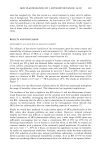
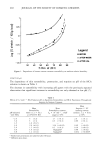
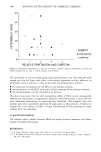
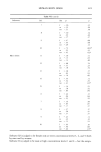
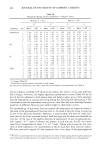
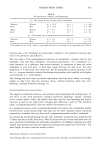
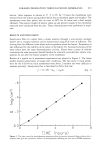
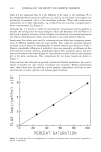
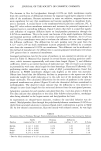
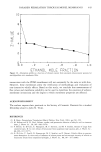
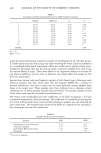
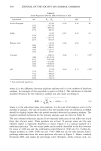
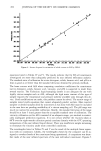
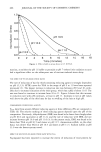
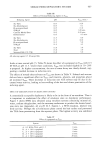
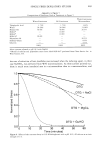
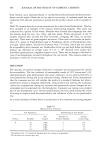
PARABEN PERMEATION THROUGH MODEL MEMBRANES 437 where C T is the total concentration of the solute in the filled membrane, Cp is the solubility of the solute in the fillerless membrane, 4)• and 4)2 are the volume fractions of polymer and filler present in the commercial membrane, and Z is a dimensionless adsorptive constant. Diffusivities for the parabens from the non-interactive solvents were calculated by rear- rangement (Eq. 2): D = (J h 'r)/(PC 4)• Cs) (Eq. 5) An averaged value of the solubility of solute in the fillerless membrane was used in the estimation of the partition coefficient to reduce the deviation in the calculated diffu- sivity values. Values listed in Table I show that methylparaben diffusion coefficients were nearly identical from water, the polyols, and polyol-water mixtures. The similarity of flux values, membrane solubilities, and diffusion coefficients supports the conclusion that the solvents listed in Table I do not interact with the PDMS mem- brane. Other data from solvent uptake studies show that the membranes absorb negli- gible quantities of these non-interactive solvents. The influence of stagnant diffusion layers was assessed by performing diffusion experi- ments using filled membranes of different thickness. The relation between permeability coefficient, P, defined as D PC/h, and ester chain length for each membrane thickness is shown in Figure 6. With the thicker membranes the logarithm of P is a linear function of ester chain length. This is true only for the first three members of the series (methyl-, ethyl-, and propylparaben) when the thinnest membrane is considered. x L E lOOO lOO lO 1 2 3 4 ESTER EH^IN LENGTH Figure 6. Permeability from saturated aqueous solutions plotted against the ester chain length for PDMS membranes of varying thickness. Key: I, 0.0254 cm O, 0. 127 cm ', 0.219 cm.
Purchased for the exclusive use of nofirst nolast (unknown)
From: SCC Media Library & Resource Center (library.scconline.org)