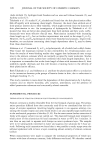
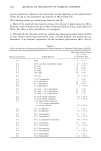
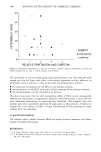
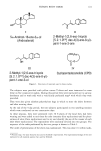
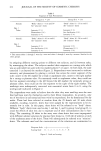
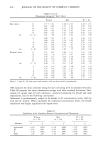
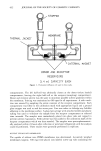
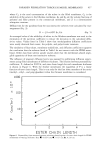
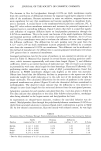
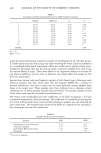
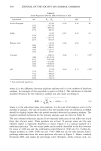
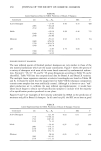
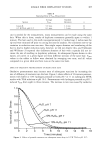
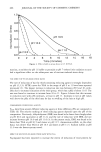
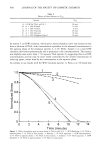
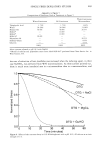
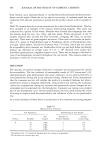
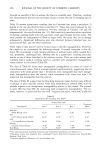
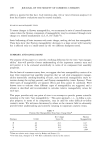
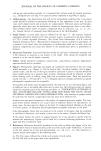
412 JOURNAL OF THE SOCIETY OF COSMETIC CHEMISTS Table I Sequence of Task Presentation Group I (n = 29) Group II (n = 30) Stimuli: Day 1 Tasks: "Body" shirts 1-5 (m and f)* All "solution" shirts Intensity (1 X ) Pleasantness (3 X Intensity (1 X ) "Body" shirts 11-15 (m and f) All "solution" shirts Intensity (1 X ) Sex Attribution (3 X ) Intensity (1 X ) Stimuli: Day 2 Tasks: "Body" shirts 6-10 (m and f) All "solution" shirts Intensity (1 X ) Sex Attribution (3 X ) Intensity (1 X ) "Body" shirts 16-20 (m and f) All "solution" shirts Intensity (1 X ) Pleasantness (3 X) Intensity (1 X ) * This means shirts 1 through 5 worn by a man and shirts 1 through 5 worn by a woman. Similar for the other groups. by assigning different starting points to different test subjects, and (2) between tasks, by rearranging the shirts. The subjects marked their responses on a rating scale which was an undivided line scale with two markers placed 7 cm apart. At both ends, the scale extended 1 cm beyond the markers (Figure 2). Respondents were instructed to indicate intensity and pleasantness by placing a vertical line across the center segment of the scale: nearer to the left marker for a weak or unpleasant odor, nearer to the right marker for a strong or pleasant odor. For extremely weak or unpleasant odors, they could use the line segment extending to the left beyond the left marker for extremely strong or pleasant odors, they could use the line segment to the right of the right marker. The markings were subsequently converted into numerical scores from 0 to 8, using the scoring scale indicated in Figure 2. The respondents were made to believe that the shirt they were smelling were the ones that had been worn by themselves and by their fellow respondents. In actuality, only ten of the shirts in each array had been worn by respondents, five by females and five by males. These had been selected at random from the 29 female and 30 male shirts available, avoiding, however, shirts that were judged by the experimenters to be ex- tremely low in odor. In this paper, these shirts will be referred to as "body" shirts. Different "body" shirts were used on day 1 and day 2, and by group I and group II, to avoid the effects of odor loss due to exposure and of odor contamination due to han- dling. The remaining 20 shirts in the array were clean shirts that were impregnated with different odorant solutions by placing three drops (ca. 0.06 ml) of solution at each of the underarm areas of the shirts. These will subsequently be referred to as "solution" shirts. The odorants used and the concentrations of the solutions are summarized in Response Scale [ [ Scoring Scale 0. 1 . 2 . 3 ß 4. 5 . 6. 7 . 8 Figure 2. Scale and scoring

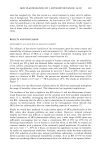
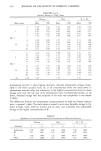
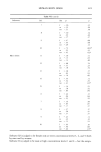
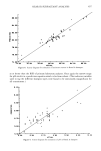
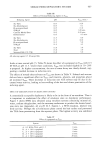
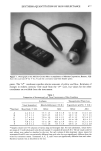
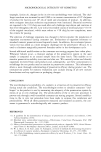
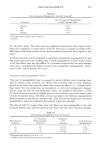
HUMAN BODY ODOR 413 Table II. The solvent in all cases was 96% ethanol. The solutions were placed on the shirts 30 minutes before the beginning of the sniffing sessions. The "solution" shirts used on day 2 were clean shirts freshly treated with odorant solutions, as on day 1. The concentrations of the odorant solutions had been chosen so that they represented a range of intensity levels comparable to the range shown by the shirts actually worn. The appropriate concentrations were determined in a pre-test in which 16 male and 16 female respondents participated these belonged to the same student body as the partici- pants of the main test, but they were different individuals. In the pre-test, the subjects were screened for anosmia to the odorants tested. They were provided with yellow cotton T-shirts and asked to wear them on five consecutive nights, using the same precautions as described for the main test. Reference arrays of the four odorants were prepared. Each array consisted of eight cotton swabs on which three drops of alcoholic odorant solution had been placed, using eight different odorant concentrations. Each subject was instructed to compare 16 shirts (eight female, eight male) with each of the four reference arrays, and to indicate, for each shirt and each odorant, with which swab it corresponded most closely in odor intensity. The concentration represented by the swab indicated was noted by the experimenter. For each odorant, the reference concen- tration ratings were grouped across all respondents and all shirts. The 12.5% highest and the 12.5% lowest concentrations were eliminated. The remaining concentration range was divided logarithmically into four equal steps, giving the five concentration levels which were then used in the main part of the test. Table II Concentration of the Odorant Solutions Solution Concentration Dilution Odorant No. (g/l) Factor* "Androstenol" (I) 1 10.000 1:1 2 1.429 1:7 3 0.204 1:49 4 0.029 1:343 5 0.004 1:2401 III 1 5.000 1:2 2 1.250 1:8 3 0.313 1:32 4 0.078 1:128 5 0.020 1:512 II 1 1.250 1:8 2 0.313 1:32 3 0.078 1:128 4 0.020 1:512 5 0.005 1:2048 Cyclopentadecanolide 1 10.000 1:1 "CPD" (IV) 2 1.429 1:7 3 0.204 1:49 4 0.029 1:343 5 0.004 1:2401 * Starting from a 1.00% solution.
Purchased for the exclusive use of nofirst nolast (unknown)
From: SCC Media Library & Resource Center (library.scconline.org)