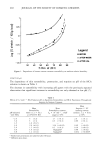
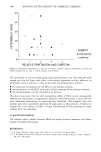
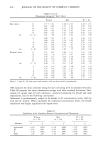
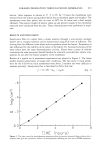
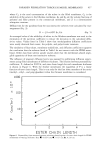
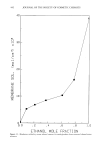
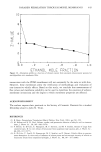
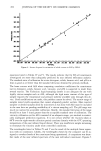
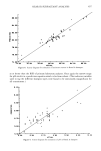
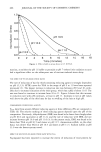
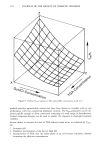
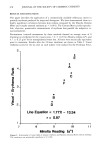
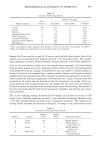
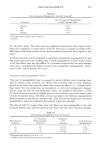
SKIN PLASTICISATION BY 2-HYDROXYOCTANOIC ACID 403 Penetration and sorption also decrease as the pH increases. This is consistent with the general observation that unionised molecules have a higher stratum corneum:water par- tition coefficient than their ionised counterparts (14). The higher sorption at low pH, where HCA is essentially unionised, leads to an increase in the penetration rate as expected from Fick's first law of diffusion (12). The higher sorption of HCA at low pH also produces a greater extensibility increase, proba• ,, due to the higher equilibrium concentration of HCA in the skin. It thus appears that the pH dependence of extensibil- ity is simply a consequence of altering the concentration of undissociated HCA. This is shown clearly in Figure 2 in which extensibility is shown to be approximately linearly dependent on the free acid concentration in the vehicle calculated from a pKa value of 3.85 measured by other workers in this laboratory. EFFECT OF ADDITIVES The data in Table I suggest that increases in penetration and/or sorption (e.g., due to the presence of penetration enhancers) may be paralleled by an increase in extensibility. As a result, we have carried out a more complete investigation of the effect of a range of o 2.5 I ! I I 0.04 0.08 0.12 0.16 FREE ACID CONCENTRATION (mol 1-1) Figure 2. Dependence of epidermis extensibility on free acid concentration in solution. Initial HCA con- centration = 0.2 tool 1-•, pH adjusted with triethanolamine.

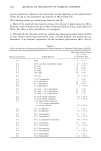
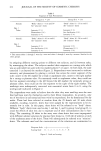
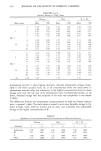
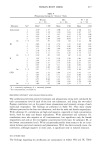
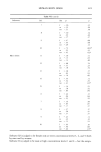
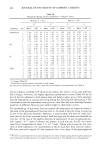
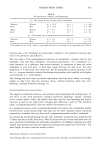
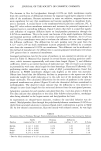
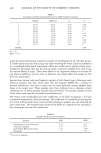
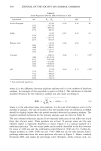
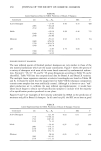
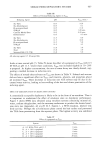
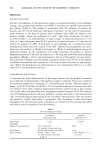
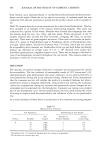
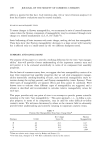
404 JOURNAL OF THE SOCIETY OF COSMETIC CHEMISTS known penetration enhancers and structurally similar materials on skin plasticisation (Table II) and on the penetration and sorption of HCA (Table !II). The following points are evident from Tables II and III: a. Many of the materials tested greatly increase the delivery of plasticisation by HCA. However, none of them has any great effect on the extensibility of skin in the absence of HCA. The effect is thus potentiation, not synergism. b. Although all the materials tested that enhance the plasticisation effectiveness of HCA do also increase steady-state penetration rates, it seems unlikely that penetration en- hancement is an adequate explanation for the increased plasticisation effect. For ex- Table II Effects of Penetration Enhancers and Structurally Related Materials on Epidermis Plasticisation by HCA HCA Concentration Added Material Mean Extensibility Ratio (-+2 X S.E.) at 20øC/65% RH 0.2 0.2 0.2 0.2 0.2 0.2 0.0 0.2 0.2 0.2 0.0 0.2 0.2 0.2 0.2 0.0 0.2 0.2 0.0 0.2 0.0 0.2 0.2 0.0 0.2 0.0 0.2 0.0 None 0.5 % n-methyl-2-pyrrolidone (nmp) 1% nmp 2% nmp 5% nmp 10% nmp 5 % nmp 1.2% 2-pyrrolidone 2% 2-pyrrolidone 5% 2-pyrrolidone 5% 2-pyrrolidone 1% nmp + 1% 2-pyrrolidone 2% nmp + 2% 2-pyrrolidone 5% nmp + 5% 2-pyrrolidone 5% decyl methyl sulphoxide 5% decyl methyl sulphoxide 3.3% decyl methyl sulphoxide q- 3.3% sucrose monostearate in 33% aq. ethanol 5 % 1,2-ethanediol 5 % 1,2-ethanediol 5 % 1,2-propanediol 5 % 1,2-propanedio] 5 % 1,2,3-propanetriol (glycerol) 5 % 1,3-butanediol 5 % 1,3-butanediol 5% 2,4-pentanediol 5% 2,4-pentanediol 5 % 2,5-hexanediol 5 % 2,5-hexanediol 5 6.7 9 22 24 25 1.0 7 14 28 1.1 17 23 47 5.9 1.0 2.2 5 1.0 13 1.0 5.0 13 1.3 17 1.2 37 2.0 (-+2) (-+0.5) (+_2) (-+5) -+7) -+8) -+0.2) -+2) -+2) ( -+ 12) -+0.2) -+2) -+4) -+7) -+0.7) -+0.2) -+0.3) -+2) -+ o. 1) -+2) -+ o. 1) -+0.7) -+4) -+ 0.4) -+2) -+0.2) -+4) -+0.2)
Purchased for the exclusive use of nofirst nolast (unknown)
From: SCC Media Library & Resource Center (library.scconline.org)