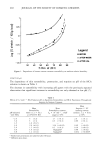
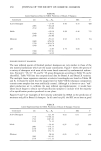
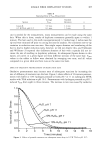
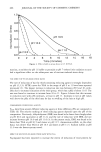
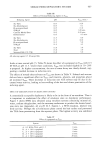
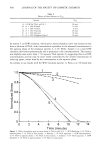
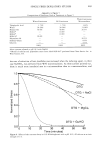
SINGLE FIBER DEPILATORY STUDIES 473 4. Guanidinium salts 5. Increased TGA concentration The rate of TGA-induced stress decay was decreased by the addition of high concentra- tions of n-propanol, triacetin, glycerin, or propylene glycol, and by incorporation of TGA into the water phase of a water-in-oil emulsion. REFERENCES (1) H. A. Yablonski and R. William, A quantitative study of the effect of depilatory solutions upon hair, J. Soc. Cosmet. Chem., 19, 699-706 (1968). (2) T. J. Elliot, Use of a laboratory model to evaluate the factors influencing the performance of depila- tories, J. Soc. Cosmet. Chem., 25, 367-377 (1974). (3) R. R. Wickerr, Kinetic studies of hair reduction using a single fiber technique,d. Soc. Cosmet. Chem., 34, 301-316 (1983). (4) R. R. Wickerr and B. G. Barman, Factors affecting the kinetics ofdisulfide bond reduction in hair,.]. Soc. Cosmet. Chem., 36, 75-86 (1985). (5) K. W. Herrman, Hair kerarin reaction, penetration, and swelling in mercaptan solutions, Trans. Faraday Soc., 59, 1663 (1963). (6) Y. K. Kamath, C. J. Dansizer, and H. D. Weigmann, Weftability of keratin fiber surfaces, J. Soc. Cosmet. Chem., 28, 273-284 (1977). (7) J. A. Maclaren, The extent of reduction of wool proteins by thiols, Aust. J. Chem., 15, 824 (1962). (8) R. Barry, in Cosmetics.' Science and Technology, Vol. 2, Balsam and Sagarin, Eds., Ch. 18, pp. 39-65 (1972). (9) J. L. Parra, J. J. Garcia Dominguez, F. Cornelles, J. Sanchez, S. Solans, C. Pelejero, and F. Balaguer, Use of microemulsions as vehicles for nucleophilic reagents in cosmetic formulations, lnt. d. Cosmet. Sd., 7, 127-141 (1985).

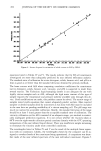
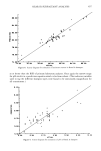
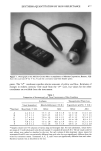
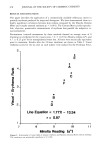
j. Soc. Cosmet. Chem., 37, 475-479 (November/December 1986) Quantitation of erythema in a soap chamber test using the Minolta Chroma (Reflectance) Meter: Comparison of instrumental results with visual assessments STEPHEN W. BABULAK, LINDA D. RHEIN, DIANA D. SCALA, F. ANTHONY SIMION, and GARY L. GROVE, Colgate-Palmolive Company, 909 River Road, Piscataway, NJ 08854 (S.B., L.D.R., D.S., F.A.S.), and Skin Study Center, 340I Market Street, Philadelphia, PA 19104 (G.L.G.). Received June 9, I986. Synopsis Current methods for quantifying erythema in clinical irritation tests rely on subjective, visual scoring by trained evaluators. We demonstrate herein the usefulness and reliability of a commercially available reflec- tance meter for objectively quantifying this parameter in a clinical test using soaps and detergent products. This portable reflectance instrument, called the Minolta Chroma Meter, was used to quantify erythema on the forearms in a soap chamber patch test situation. The instrumental readings for six bar products were compared with two other assessments--visual scores of erythema and transepidermal water loss. The rela- tive irritancy of six soap/detergent bars was determined. All three assessments lead to the same conclusion that two of the bars were significantly milder than four others. The correlation coefficient for visually scored erythema compared with Minolta redness readings was r = 0.97, thus confirming the sensitivity and reliability of the technique for this class of compounds. This instrument is small and contains a flexible probe which conveniently permits reading of multiple sites. Results show this reflectance instrument provides a reliable, noninvasive tool for objective assessment of erythema in patch tests. BACKGROUND Erythema in skin is produced when exposure to irritants such as detergent products, allergens, or UV light elicits infiltration of blood cells close to the skin surface. Oxy- haemoglobin gives the skin this red color. This is a major factor used in the assessment of a detergent product's irritation potential. Traditionally, erythema has been assessed visually by trained observers using predetermined arbitrary scales. However, these mea- surements are highly subjective and can be influenced by the background color of the subject's skin. Additionally, the visual assessments may not be consistent between studies. Skin color can be instrumentally measured using reflectance techniques which will de- fine color by using the standardized tristimulus system recommended by CIE (1) or by determining a reflectance spectrum. Analysis on the basis of skin color has been dis- cussed in detail by others (2,3). Instrumental measurements of erythema would result in more objective, reproducible, and quantitative data than visual scoring. However, 475
Purchased for the exclusive use of nofirst nolast (unknown)
From: SCC Media Library & Resource Center (library.scconline.org)