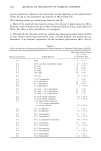
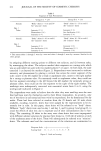
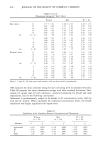
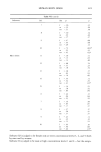
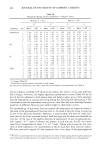
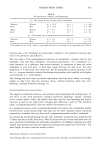
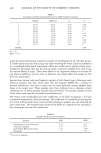
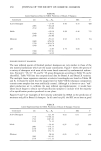
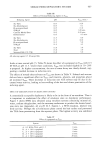
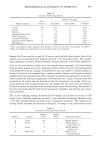
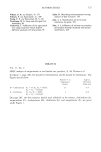
448 JOURNAL OF THE SOCIETY OF COSMETIC CHEMISTS Table I Calculation of Pooled Standard Deviation for CEM Volatility Computer Sample Duplicate d d 2 1 30.42 30.61 0.19 0.04 2 31.01 31.45 0.44 0.19 3 30.05 30.40 0.35 0.12 4 29.60 29.65 0.05 0 5 30.70 31.16 0.46 0.21 6 31.56 31.40 0.16 0.03 7 30.52 30.57 0.05 0 8 30.45 30.70 0.25 0.06 9 29.88 30.05 0.17 0.03 10 29.35 29.34 0.01 0 TOTAL 0.68 N = 10. PSD = 0.17. using the above-determined maximum number of wavelengths for all 700 data points. A combo search was also done using only those wavelengths which could be transferred to a wavelength filter-based instrument. Often the combo search required fewer wave- lengths for robustness than did the step-up search. Indicator variables were used to tag the various Brand X types. These were added to the regression analysis to account for any physical difference such as color or fragrance that might affect the sample set but were not quantitated. Spectra from various color and fragrance variants of both brand types of shampoo were stored as separate data files. From these files the program PICKS (8), a method of spectral subtraction, was used to select the ten most spectrally unique samples from those in the larger pool. These samples were then combined into a shampoo variety calibration set on which primary analyses were performed. Ten random samples of each of the above were used for the prediction/validation set. The results were wavelengths and their coefficients in the form of equation 1 for each constituent measured by chemical analysis. The coefficient of correlation (r) relating the fit of near infrared predictions versus primary laboratory analyses was also obtained for each constituent. The standard error of prediction (SEP) on a sample set not included in the training set was used for verification. Table II Standard Deviations of Lab Analyses Analysis PSD RSD Potentiometric Active Titration 0.31 0.21 Volatility Computer 0.17 0.31 Karl Fischer Moisture Titration 2.79 3.00 Ultraviolet -* 0.01 Not run in duplicate.

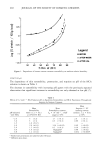
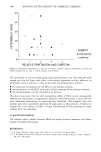
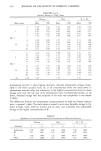
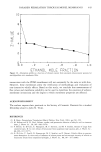
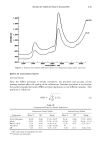
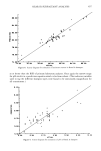
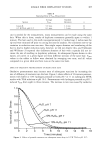
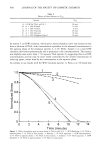
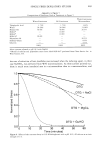
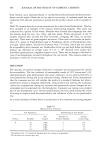
NEAR IR SURFACTANT ANALYSIS 449 i.800. i.600' i.400' u i.aOO- m i.000- ß 800- ß 600 ß 400 ß •oo NATER ALS • ' | ' | ' | ' • ' I ' I ' i•00 t400 t600 t800 •000 •00 •400 NAVELEN6TH Figure 2. Typical nearin•ared reflectancespectra •rammonium ]aurylsulGte and water. RESULTS AND DISCUSSION RAW MATERIALS Since the NIRA technique is strictly correlative, the precision and accuracy of the primary analyses affect the quality of the calibrations. Standard procedure is to calculate the pooled standard deviation (PSD) on blind duplicates on ten different samples. This quantity is defined as = •/i•d,2/2n .=
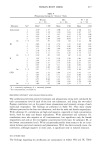
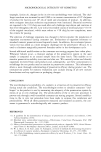
PSD (2) Table III Compositional Data for Anionic Surfactants Ammonium Lauryl Sulfate Sodium Lauryl Sulfate Constituent Mean % SD Range Mean % SD Range Active Detergent 28.99 0.68 27.45-29.97 29.36 0.88 27.91-30.81 Solids 30.61 0.85 27.84-32.16 30.98 1.20 29.01-33.24 Benzoic Acid 0.35 0.04 0.28-0.45 0.35 0.07 0.25-0.57 Viscosity* 21.58 6.11 11.00-32.00 ** pH 5.01 0.11 4.81-5.25 5.38 0.17 5.06-5.83 * All terms must be multiplied by 100. ** Viscosity not measured.
Purchased for the exclusive use of nofirst nolast (unknown)
From: SCC Media Library & Resource Center (library.scconline.org)