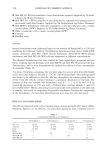
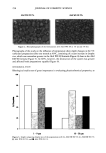
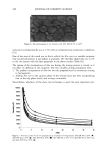
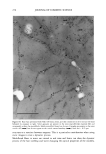
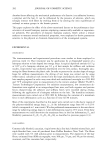
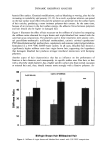
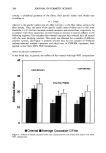
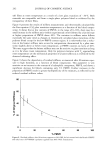
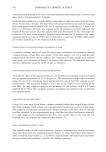
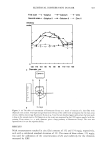
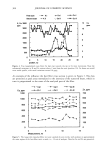
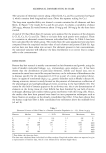
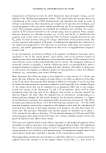
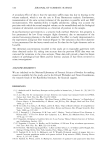
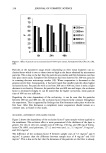
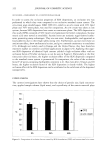
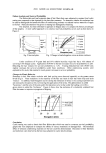
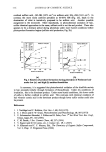
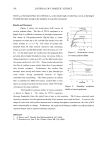
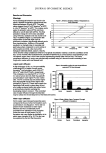
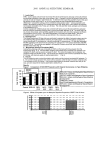
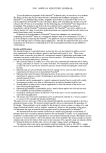
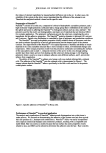
DYNAMIC HAIRSPRAY ANALYSIS 287 keratin fiber surface. Chemical modifications, such as bleaching or waving, alter hair by increasing its wettability and porosity (11,12). As a result, a polymer solution can spread on the hair surface more effectively and the polymer can penetrate into the surface layers of hair cuticles, producing a more intimate polymer-hair contact. At the same time, because of an increase in the hair surface energy, the adhesive forces between polymers and hair should also be higher in damaged hair. Figure 4 illustrates the effect of hair structure on the stiffness of a hairset by comparing the stiffness ratios obtained for virgin brown and triple-bleached hair treated with the same hairspray compositions. The polymers used in these treatments were anionic co(vi- nyl pyrrolidone-methacrylic acid-lauryl methacrylate), cationic co(vinyl caprolactam/ PVP/dimethylaminoethyl methacrylate, copolymer), and nonionic polyvinylpyrrolidone, formulated in a 55% VOC EtOH-water system. In all cases, bleached hair showed a significantly higher stiffness ratio than virgin brown hair, supporting the hypothesis that damaged, bleached hair produces stronger interfacial interactions with hairspray polymers. Another aspect of hair characteristics that has an influence on the performance of fixatives is hair diameter, and consequently, its specific surface area. Fine hair, or hair with a relatively small diameter, has a higher specific surface area than normal caucasian or oriental hair and, thus, should interact more strongly with a fixative polymer. As- 6O 5O o 40 •) 30 • 20 10 Co(VP-MA-LM) Co(VCL-VP-DMEMA) PVP BVirgin Brown Hair B Bleached Hair Figure 4. Stiffness of virgin brown and bleached hair treated with 55% VOC compositions.

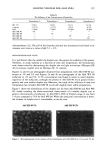
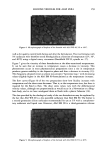
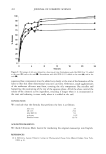
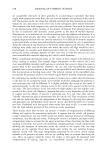
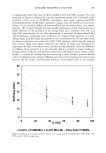
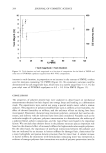
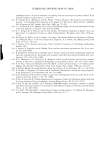
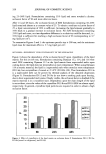
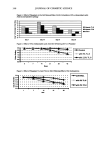
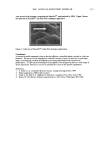
288 JOURNAL OF COSMETIC SCIENCE suming a cylindrical geometry of the fibers, their specific surface area should vary according to •r = 2/(rp) where •r is the specific surface area of a fiber (cm2/g), r is the fiber radius, and p is the fiber density. Thus, the ratios of the specific surface areas of fibers used in this work should be 2:1.4:1 for fine caucasian, normal caucasian, and oriental hair, respectively. In accordance with these arguments, we have found an increase in hairset stiffness in the following sequence: fine caucasian hairnormal caucasian hairoriental hair, all treated with the same hairspray solution. This result was obtained for a number of different polymer systems, and Figure 5 presents selected data for two samples of VA/butyl maleate/isobornyl acrylate copolymer and ethyl ester of PVM/MA copolymer, both applied to hair from 100% VOC formulations. EFFECT OF SOLVENT COMPOSITION It was found that, in general, the stiffness of hair treated with high-VOC compositions 4O 3O 2O 10 Co(VA-BM-IA)(1) I Ethyl Ester PVMIMA _ I ! Co(VA-BM-IA)(2) L B Oriental B Average Caucasian E! Fine Figure 5. Stiffness of normal caucasian brown, fine caucasian brown, and oriental hair treated with 100% VOC compositions.
Purchased for the exclusive use of nofirst nolast (unknown)
From: SCC Media Library & Resource Center (library.scconline.org)