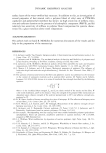
DYNAMIC HAIRSPRAY ANALYSIS 295 surface layers of the water-swollen hair structure. In addition to this, an investigation of several properties of hair treated with a polymer blend of ethyl ester of PVM/MA copolymer and poly(methylvinylether) has shown: (a) high sensitivity of stiffness reten- tion and tackiness duration to the presence of a hydrophilic component (PMVE), and (b) relatively low sensitivity of stiffness to polymer blend composition for systems charac- terized by a glass transition above room temperature. ACKNOWLEDGMENTS The authors wish to thank R. McMullen for numerous discussions of the results and for help in the preparation of the manuscript. REFERENCES (1) J. Jachowicz and K. Yao, Dynamic hairspray analysis. I. Instrumentation and preliminary results,•/. Soc. Cosmet, Chem., 47, 73 (1996). (2) J. Jachowicz and R. McMullen, The mechanical analysis of elasticity and flexibility of polymers used as hair fixatives, Proceedings of the IFSCC Conference, Santiago de Chile, May 1999. (3) J. Jachowicz and R. McMullen, Mechanical analysis of hair fiber assemblies by static and relaxation measurements, XXI IFSCC International Congress, Berlin, September 11-14, 2000, pp. 287-292. (4) J. Martin, J. F. Johnson, and A.R. Cooper, Mechanical properties of polymers: The influence of molecular weight and molecular weight distribution,J, Macrotool. Sci, Revs. Macrotool. Chem., C8(1), 57 (1972). (5) The question of interactions between the fibers and polymeric matrix was addressed in the literature in the context of composite materials such as polymer fiber systems. M. Nardin and J. Schultz, Langmuir, 12, 4238 (1996), discuss it in terms of interfacial shear strength described by the following equation: where x is the interfacial shear strength, E,, and Ej are el•tic toodull of the matrix and the fiber, W is the work of adhesion, and 8 is the distance. Thus, the strength of the polymer-fiber interactions are dependent upon cohesive strength of the polymer (proportional to E•,5) and adhesive strength pro- portional to W. (6) R. W. Rance, Studies of factors controlling the action of hairsprays. II. The adhesion of hairspray resins to hair fibers,J, Soc. Cosmet, Chem., 25, 297 (1974). (7) R. R. Wickerr, J. A. Sramek, and C. M. Trobaugh, Measurement of the adhesive strength of hair- hairspray junctions,J. Soc. Cosmet, Chem., 43, 169 (1992). (8) J. Jachowicz and C. Ramireddy, Cationic polymers, US Patent 5,149,752 J. Jachowicz and C. Ramireddy, Conditioners based on cationic polymers, US Patent 5,147,635. (9) For example, "Shrinkproofing wool by treating with water soluble hardenable polymer (polycarbam- oylsulphonates, Bunte salt polymers, amphoteric polymers) in aqueous medium," FR 2,434,888, assigned to IWS Nominee Ltd. (10) L.J. Wolfram, Wool modification by deposition of reactive polymers, AppL PoOm, Syrup,, 18, 523, (1971). (11) Y.K. Kamath, C.J. Dansizer, and H. D. Weigmann, Wettability of keratin fiber surfaces, J, Soc. Cosmet. Chem., 28, 273 (1977). (12) Y. K. Kamath, C. J. Dansizer and H. D. Weigmann, Wetting behavior of human hair fibers,J. AppL PoOm. SN,, 22, 2295 (1978). (13) Enoc/opedia ofPoOmer Sciene and Engineering, H. Mark, N. Bikales, Ch. Overberger, G. Menges, and J. Kroschwitz, Eds. 0ohn Wiley & Sons, New York, 1987), Vol. 7, p. 534.

j. Cosmet. Sci., 52, 297-311 (September/October)2001 Evaluation of a new X-ray fluorescent analysis technique for the creation of a Nordic hair database: Elemental distributions within the root and the virDin seDment of hair fibers B. STOCKLASSA, M. ARANSAY-VITORES, G. NILSSON, C. KARLSSON, D. WIEGLEB, and B. FORSLIND, Cox Analytical Systems AB, Gothenburg (B.S.), National Laboratory of Forensic Science, Linkb}Oing (M.A.-V., G.N, C.K.), and EDRG, Department of Medical Biophysics, Karolinska Institute, Stockholm (D. W., B.F.), Sweden. Accepted for p•blication May 31, 2001. Synopsis A new, non-destructive X-ray fluorescence technique for quantitative estimation of elemental content in biological tissues has been developed. Technical and instrumental characteristics of the ITRAX X-ray spectrometer have been evaluated in relation to the properties of biological samples, i.e., human hair fibers. Thus, attenuation variations of the fluorescent X-rays in the hair bulk mass were demonstrated by analysis of sulfur, calcium, and zinc in a virgin part near the root of one hair fiber with elliptical cross section. By rotation of the hair fiber and successive analyses made of the same part of the hair fiber, the results showed that concentrations of elements varied as functions of the diameter of the analyzed hair volume. Other sources of errors are also discussed. The ITRAX instrument allows for precise, fast, non-destructive, simultaneous, quantitative recording of the detected elements and trace elements down to levels of 1 ppm (l•g/g). It was used for assessment of normal values of physiologically important elements present in hair in a cohort of normal, healthy Swedish, Caucasian individuals. The database constructed from data retrieved from a conceivably homogenous ethnic set of individuals represents, to our knowledge, the first of its kind. INTRODUCTION In recent years an increasing interest in hair research has evolved, partly as a result of the introduction of pharmaceutical agents (minoxidil, finasteride) promoting hair growth in certain individuals with inherited androgenic alopecia (AnA). In addition, the "green wave" of dietary consciousness has resulted in a layman's interest in trace elements and their proposed beneficial properties to the status of health. Assessing the content of trace elements in hairs allegedly reflecting the health of an individual has become a particular mercantile niche. A great number of commercial laboratories have appeared that provide 297
Purchased for the exclusive use of nofirst nolast (unknown)
From: SCC Media Library & Resource Center (library.scconline.org)