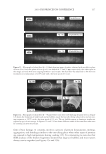
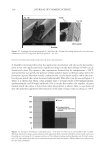
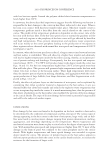
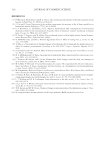
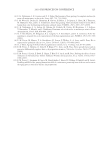
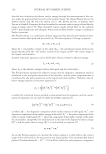
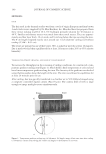
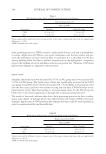
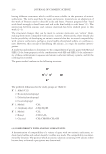
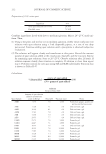
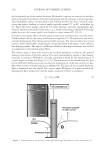
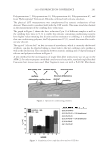
JOURNAL OF COSMETIC SCIENCE 128 describe the calculation of polymer surface energy through the measurement of the con- tact angle, by applying theories such as the Zisman theory, the Owens/Wendt theory, the Fowkes theory, and the Van Oss theory (2,6,7). Mr. Brown and his co-workers from Procter & Gamble Company disclosed a method to measure surface energy of hair fi ber by using an image device (8). They measured contact angles of hair fi ber in two solvents (99%+ pure hexadecane and ultrapure water) and calculated surface energy according to Fowkes equations. The Fowkes theory is a combinaton of three equations that describe the interfacial inter- actions between the liquid and the solid (2,6). The fi rst equation is Young’s equation: s = s + sL cosq S SL (1) where σs = total surface energy of the solid, σSL = the interfacial tension between the liquid and the solid, σL = the surface tension of the liquid, and θ = the contact angle at the liquid/ solid interface. Another important equation used in the Fowkes theory is Dupre's adhesion energy: = s + s - sSL SL S L I (2) where ISL is the adhesive energy between the liquid and the solid surface. The Fowkes theory separates the adhesive energy into the dispersive component which is attributed to the non-polar interaction of the interface, and the polar component that is contributed by the polar interaction at the liquid and solid interface. Therefore, the ad- hesive energy equation (2) becomes equation (3): ( ) ( )1/2 ª º = s s + s s « » 1/2 2 D D P SL L S L S I (3) in which the interfacial tension variable is eliminated from the equation, and the combi- nation of equations (1), (2), and (3) yields the Fowkes equation (4): ( ) ( )1/2 ( )/2 q s s + s s = s +1 1/2 cos D D P L S L S L (4) in which, s D L = the dispersive component of the surface tension of the liquid, s D S = the dispersive component of the surface energy of the solid, sLP = the polar component of the surface tension of the liquid, s P S = the polar component of the surface energy of the solid, the total surface energy (σS) of a solid material is the sum of the dispersive surface energy (s D S ), and the polar surface energy (s P S ), is as described in equation (5): s = s + sS D P S S (5) To use the Fowkes equation to calculate the surface energy of a solid surface, the contact angle of the solid needs to be measured in tow liquid probes. One recommended liquid probe is Diiodomethane (σL = σLD = 50.8 mN/m), which has only dispersive component

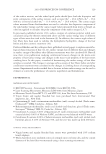
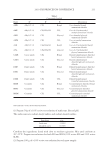
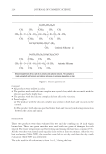
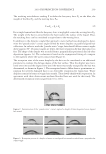
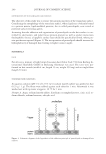
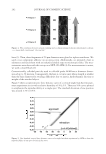
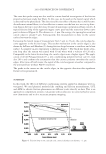
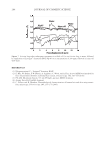
2010 TRI/PRINCETON CONFERENCE 129 of the surface tension, and the other liquid probe should have both the dispersive and polar components of the surface tension, such as water (σLP = 46.4 mN/m, σLD = 26.4 mN/m), or benzyl alcohol (σLP = 11.4 mN/m, σLD = 28.6 mN/m). The contact angle values measured from diiodomethane are used to calculate the dispersive component of the solid surface energy, and the contact angle values measured from water or benzyl al- cohol are applied to calculate the polar component of the surface energy (2,6,7). In previously published articles (2,6), surface energies of common polymer solids were calculated using the theories mentioned above and the surface energy data of different types of hair were also cited in the literature (9). In addition, the contact angle values of hair fi bers have been used to validate the hydrophobic/hydrophilic change of the hair before and after cosmetic treatment (10). Professor Bhushan and his colleagues have published several papers to explore nanotribo- logical characterization of hair (11,12), surface energy data of different hairs and changes in surface energy of hair fi bers after different treatments were also circulated (8). But till now, there is no publication studying correlations between changes in the micro-scale property of hair-surface energy and changes in the macro-scale property of the hair tresses combing force. In this paper, a method of determining the surface energy of hair fi ber samples is revealed. The changes in average surface energy of hair fi bers before and after conditioner treatment were correlated to the changes in combing forces of corresponding tresses. Experimental results verifi ed that a decrease in hair surface energy can be used to evaluate or screen the performance of cosmetic ingredients and formulations. EXPERIMENTAL MATERIALS AND INSTRUMENTS K • RŰSS Processor - Tensiometer K100MK2, from KRŰSS, USA Laser Scanning Micrometer, Mitutoyo LSM-5000, from Mitutoyo, Japan • Miniature Tensile Tester MTT-175 and MTT-160, from Dia-Stron Instruments, UK • Virgin brown and regular bleached hair were purchased from International Hair • Importers, Inc., New York. Quaternium-91 (and) cetrimonium methosulfate (and) cetearyl alcohol (Trade name: • CrodazosoftTM DBQ, Croda Inc., Edison, NJ) Behentrimonium methosulfate (and) cetyl alcohol (and) butylene glycol (Trade name: • IncroquatTM Behenyl TMS-50, Croda Inc., Edison, NJ) Conditioner-A contains 6.00% of Quaternium-91 (and) cetrimonium methosulfate (and) • cetearyl alcohol, 0.80% of Neolone CAPG, and the rest was balanced with DI-water. Conditioner-B contains 6.00% of behentrimonium methosulfate (and) cetyl alcohol (and) • butylene glycol, 0.10% of Neolone 950, and the rest was made up with DI-water. CONTACT ANGLE MEASUREMENT Virgin brown and regular bleached hair tresses were prewashed with 10% sodium • lauryl sulphate. Thirty hair fi bers were randomly selected, crimped onto two brass tabs, and the central • diameter of the hair fi ber was measured using a laser scanning micrometer.
Purchased for the exclusive use of nofirst nolast (unknown)
From: SCC Media Library & Resource Center (library.scconline.org)