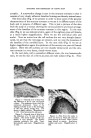
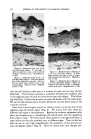
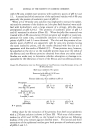
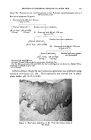
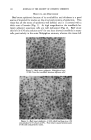
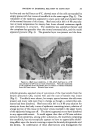
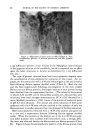
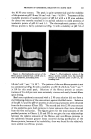
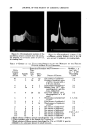
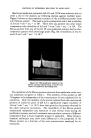
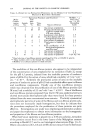
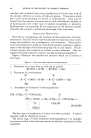
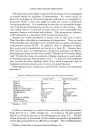
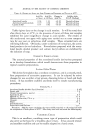
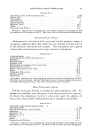
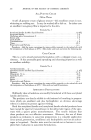
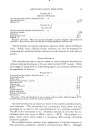
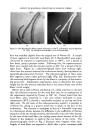
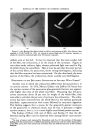
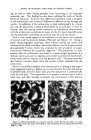
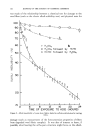
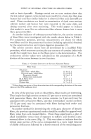
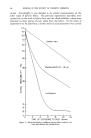
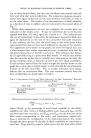
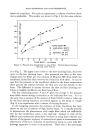
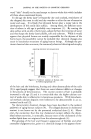
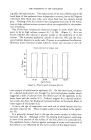
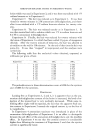
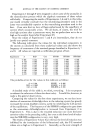
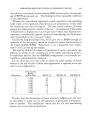
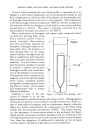
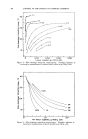
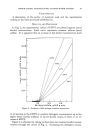
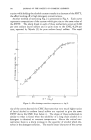
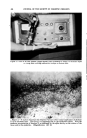
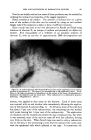
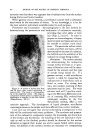
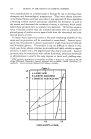
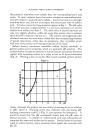
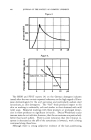
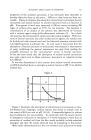
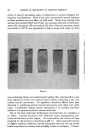
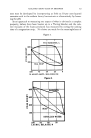
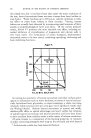
368 JOURNAL OF THE SOCIETY OF COSMETIC CHEMISTS represents the alkali-insoluble portion of the untreated fibers that is, if Fortho plus Fp,r, is 0.921, the alkali insolubility of the untreated wool is 92.1%. For kid mohair and human hair, the data are fitted using only one exponential term an "ortho" term for kid mohair and a "para" term for human hair. The data obtained so far for B. A. fleece wool show great scatter, and it is unlikely that this scatter is due to sampling problems. It is clear that the B. A. fleece wool is intermediate in behavior between human hair (para) and kid mohair (ortho) in this sense, then, it shows the behavior of an ortho-para type of fiber. Unfortunately, it is also equally clear that there is little probability that the data may be sensibly fitted by the sum of two exponential terms, as was done with the 64's wool. Another indication of ortho-para character is the tendency shown by a fiber to curl after it has been exposed to a•lkali. This tendency is consider- ably enhanced by first treating the fiber with acid. This was done for each of the four fiber types and their curling tendency in alkali was observed both before and after treatment with acid. In the case of the 64's wool, there was a slight curling tendency in alkali after twenty minutes exposure. After eight hours in boiling sulfuric acid, the same alkali exposure caused a much more pron6unced curling. The B. A. fleece wool showed little of such curling tendency either before or after acid exposure. In addition, observations made of treated fibers under polarized light were confusing, because there were apparently some strain effects in the B. A. fibers whether or not they had been treated with acid. The effect of such strains in the fibers was to render quite ambiguous any observations with polarized light. Mohair showed little tendency to curl in alkali with or without previous acid exposure. After a treatment with acid for four hours, the fibers, except for scale outlines, appeared to be extremely "porous" to the alkaline solution. After twenty minutes in alkali, wh-en these same fibers were viewed under polarized light, they were observed to have lost essentially all their birefringence. This behavior is to be expected, if the fibers were ortho ones. Human hairs behaved like mohair in their curling behavior, but, after sixteen hours in acid followed by twenty minutes in alkali, they still exhibited a large birefringence. This is another indication that human hair is a para fiber. SUMMA RY As described earlier, four criteria have been used for determining the structure of the cortices of keratin fibers. They are: dye staining, alkali solubility after exposure to acid, tendency to curl in alkali and cystine content. By any of these four standards, the 64's wool shows ortho-para dif-

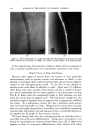
EFFECT OF BILATERAL STRUCTURE ON KERATIN FIBERS 369 ferentiation. Based on cystine content and alkali solubility, the B. A. fleece wool appears to show ortho-para differentiation. However, the B. A. fleece wool does not indicate such differentiation by either dye staining or tendency to curl in alkali. A possible explanation for this apparent anomaly is that each cortical cell or spindle cell of a keratin fiber is either ortho or para in nature. In the 64's wool the ortho spindle cells appear to be concentrated on one side of the fiber and the para spindle cells on the other, leading to ortho-para differentiation. In the B. A. fleece wool it may be that the ortho and para spindle cells are so inter- mingled across the whole fiber cross section that no effective fiber asym- merry is observed. This might explain the lack of dye staining differentia- tion and the lack of a curling tendency in alkali, as well as the much lower crimp level. Both kid mohair and human hair appear to be rather straight- forward in their behavior kid mohair appears to be "pure" ortho and human hair appears to be "pure" para. ?lcknowledgments: The work reported herein was carried out at Textile Research Institute as part of the Wool Research Project, under the spon- sorship of the International Wool Secretariat and a group of American wool manufacturers. Thanks are due A. B. Coe and Miss D. F. O'Reilly for the photomicrography. REFERENCES (1) Bell, P. H., )e. Arm. Chem. Soc., 76, 5565 (1954). (:2) Dusenbury, J. H., and Coe, A. B., Textile Research )e., 25, 354 (1955). (3) Dusenbury, J. H., Mercer. E. H., and Wakelin, J. H., Ibid., 24, 890 (19.54). (4) Freney, M. R., Nature, 160, 799(1947). (5) Golden, R. L., Whitwell, J. C., and Mercer, E. H., Textile Research St., 25, 334 (1955). (6) Harris, M., private communication. (7) Horio, M., and Kondo, T., Textile Research )e., 23, 373 (1953). (8) Mercer, E. H., Ibid., 23, 388 (1953). (9) Mercer, E. H., Golden, R. L., and Jeffries, E. B., Ibid., 24, 615 (1954). (10) Ohara, K., Melliand Textilber., 19, 407 (1938). (11) Ohara, K., Ibid., 20, 3:26 (1939). DIGEST OF DISCUSSION After the paper was presented on September 24, 1954, questions were asked by the audience. What follows is not a verbatim transcript, but rather an attempt to set down the gist of both questions and answers. QuEsxIoN: Could the kinky nature of negroid hair be attributed to its having an ortho-para differentiation? ztnswer: We really don't know. Some very preliminary work was done by Mercer to answer this question when he was at Textile Research Institute. He came to the tentative conclusion that kinky human hair might have an ortho-para character. The problem is complicated by the great amount of pigmentation found in most negroid hair, if preferential dyeing behavior is to be used as an experimental tool. A really complete investigation of all the ortho-para aspects would require a large amount
Purchased for the exclusive use of nofirst nolast (unknown)
From: SCC Media Library & Resource Center (library.scconline.org)