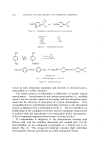
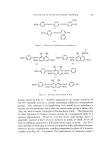
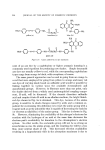
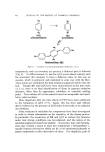
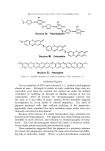
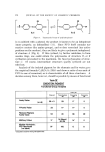
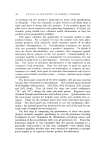
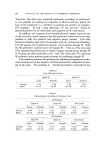
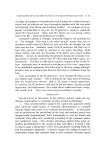
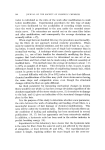
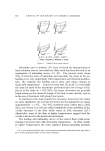
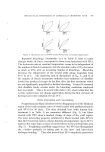
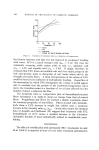
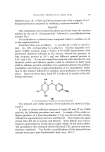
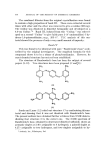
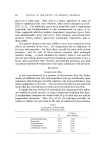
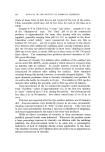
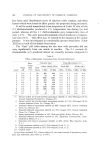
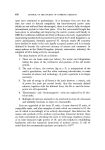
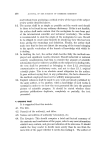
358 JOURNAL OF THE SOCIETY OF COSMETIC CHEMISTS SO•H HO•S-••N•N---•-NH2 0 0 --CCH2CH2C-- yellow (a) insulator (c) blue (b) H2N. 0 0 0 HO•S ••0 green (d) Figure 10. Color additivity in dye synthesis nent of an azo dye by a naphthalene or higher aromatic homolog is a commonly used expedient for producing new shades. Simple benzenoid azo dyes are usually yellow to red, while the corresponding naphthalene types range from orange to black, with exceptions, of course. The same general approaches can be used in going from an orange to a red that were employed for going from yellow to orange and many red azo dyes of varying shade based on sulfanilic acid would be possible by linking together in various ways the available chromophoric and auxochromic groups. However, to illustrate more than one point, only the shades derived from a widely used aminonaphthol coupling compo- nent, H-acid, will be discussed. If the chemist diazotizes sulfanilic acid and couples it into H-acid in an alkaline medium, the bright bluish- red dye shown in Fig. 9a is obtained. This dye, because of the amino group, is sensitive to shade changes caused by acids and a common ex- pedient for overcoming this deficiency is to react the amino group with a reagent such as acetic anhydride that is capable of decreasing the basicity (or electron availability) of the amino group. This dye is shown in Fig. 9b. However, eliminating the availability of the nitrogen's electrons for reaction with the hydrogen of an acid at the same time decreases the electron pair's availability for donation to the chromophore's electron system. In other words, the acetamido group will not be as strong an auxochrome as was the amino group, and the resulting dye will be a less blue, more neutral shade of red. This decreased electron availability resulting in a hypsochromic shift in the absorption maximum is due to

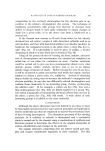
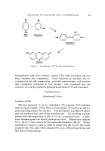
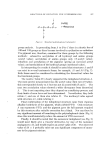
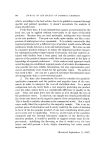
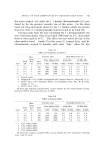
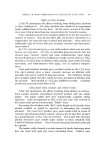
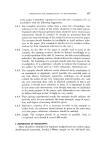
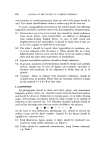
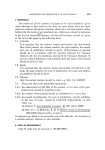
RATIONALE OF DYES SYNTHESIS PROGRAM 359 competition by the carbonyl chromophore for the electron pair in op- position to the primary chromophoric dye system. The technique of modifying auxochromes with groups that increase or decrease their ability to deepen shade is used quite commonly to obtain changes of shade for a given color, as in the above case from a bluish-red to a neutral red. If the chemist now returns to H-acid (from which he has already obtained two red colors), couples it with diazotized sulfanilic acid in an acid medium, and then with diazotized aniline in an alkaline medium, he lengthens the conjugated system to the point where a deep blue dye re- sults (Fig. 9c). If p-nitroaniline is used in place of aniline, a further deepening of shade to a blue-black dye is obtained (Fig. 9d). Using all the general devices of varying the kind, number, and posi- tion of chromophores and auxochromes, the chemist has completed an initial line of azo colors for evaluation on wool. Further variations could be carried out to give azo dyes encompassing almost every color desired--greens, violets, scarlets, browns, and so on, in an almost infinite range of nuances of shade. Before leaving the area of azo dyes, it will be of interest to point out another tool which the organic chemist employs to obtain a given color, viz., additivity. Instead of obtaining deeper shades by seeing ways to increase the molecule's conjugation and electron mobility, he can take two differently colored chromophores and combine them chemically by an insulating group, thereby synthesizing the additive color. If, for example, a yellow azo dye (Fig. 10a) and a blue anthraquinone dye (Fig. 10b) are linked together by a group (Fig. 10c) which is incapable of transmitting electronic effects from one dye to the other, a green dye (Fig. 10d) will result. A wide choice of such insulating groups is available to the dyes synthesist. CONCLUSIONS Although the above discussion has been limited to azo dyes, it must be thoroughly stressed that the same general principles and approaches used to synthesize azo dyes are employed no matter what structural class of dyes is being investigated. The absorption spectrum of the starting molecule, be it colorless or colored, is determined and a systematic study is carried out by the chemist using a combination of synthesis and literature perusal to determine the effects on the original absorption of various substitutions and changes in the molecule. The organic structures comprising dyes are indeed varied and com- plex and require considerable ingenuity in their synthesis. For this
Purchased for the exclusive use of nofirst nolast (unknown)
From: SCC Media Library & Resource Center (library.scconline.org)