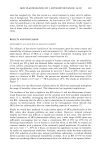
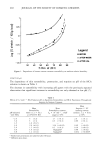
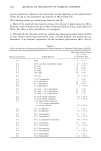
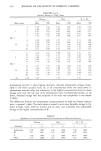
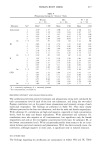
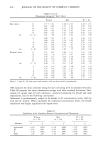
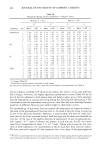
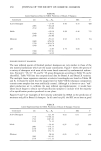
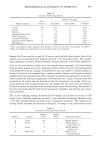
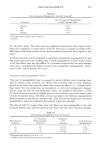
HUMAN BODY ODOR 423 Table VIilb Concentration, Perceived Intensity, and Sex Attribution--"Body" Shirts Women Men Women's shirts Mean + SD n Mean + SD n Mean + SD n Mean + SD n Shirt 1 2.00 1.00 11 2.00 1.00 3 2.33 .65 12 2.67 1.53 3 2 2.60 1.34 5 2.89 1.36 9 2.88 .64 8 3.14 1.86 7 3 5.33 2.08 3 5.64 1.36 11 5.50 1.4l 8 6.29 .95 7 4 2.11 .78 9 1.80 .45 5 1.80 .84 5 2.80 1.48 10 5 3.00 1.63 10 3.00 1.16 4 3.82 1.66 11 2.50 1.29 4 16 3.00 1.68 13 3.50 2.12 2 3.22 1.30 9 3.50 2.26 6 17 3.50 1.65 10 4.60 1.34 5 2.71 .95 7 4.63 1.77 8 18 3.67 .52 6 3.33 2.00 9 3.13 2.30 8 2.86 1.22 7 19 3.00 1.34 11 3.25 1.89 4 3.10 1.29 10 3.60 2.07 5 20 2.11 1.05 9 3.17 1.60 6 2.22 1.20 9 3.50 2.51 6 Men's shirts Shirt 1 3.00 1.41 5 3.44 1.42 9 3.13 1.36 8 3.43 1.51 7 2 3.78 1.30 9 4.00 1.41 5 3.60 1.14 5 3.60 1.71 10 3 4.00 0 2 5.08 1.62 12 2.00 0 1 5.07 1.49 14 4 3.50 .71 2 5.39 1.37 12 4.60 1.14 5 5.20 1.62 10 5 5.00 2.83 2 3.25 1.49 12 4.50 1.73 4 4.36 2.01 11 16 1.20 1.10 5 2.60 1.58 10 2.25 1.17 8 1.71 .76 7 17 3.40 1.14 5 5.00 1.63 10 3.40 1.67 5 4.00 1.63 10 18 1.00 1.00 3 2.92 1.24 12 2.57 .98 7 2.38 1.06 8 19 2.25 1.28 8 2.86 1.35 9 2.43 1.62 7 2.88 1.64 8 20 3.00 .02 4 3.55 2.02 11 3.71 1.80 7 3.25 1.83 8 Shirts 6 15, both men's and women's, had not been rated for sex attribution. intensity goes with male attribution) holds for female but not significantly for male respondents. DISCUSSION CONCENTRATION AND PERCEIVED INTENSITY The decrease of perceived intensity with increasing dilution is amazingly slight. With substance II, where it is most pronounced, it amounts to 1.92 scale points on a 9-point scale for a dilution factor of 256. With androstenol and cyclopentadecanolide, a dilu- tion factor of 2401 leads to a decrease in perceived intensity of only 1.25 and 0.79 scale points respectively (Table III). In the face of such slight responses to major dilution steps, one may be led to wonder whether the respondents really smell something or whether many of them were just guessing--a doubt which is particularly pertinent in view of published reports about the high incidence of anosmia to androstenol (8), in view, moreover, of the observation, commonly known to perfumers, that many people are very insensitive to macrocyclic musks, and in view of the massive task demanded of

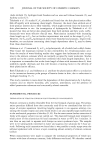
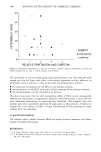
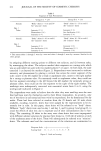
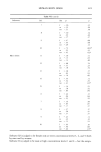
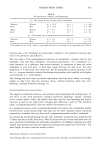
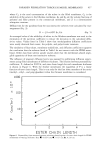
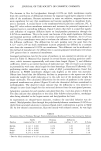
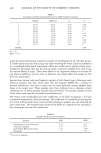
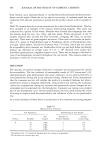
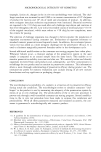
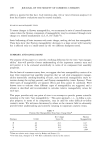
424 JOURNAL OF THE SOCIETY OF COSMETIC CHEMISTS Table IX Pleasantness Rating and Sex Attribution--"Solution" Shirts Substance Sol. 2 Women (n = 29) Men (n = 30) •3 C•3 • C• Mean • mSD n Mean _+SD n Mean mSD n Mean _+SD Androstenol 1 3.44 1.19 16 2.44 1.42 13 3.05 1.40 19 2.85 1,01 2 3.42 1.27 20 2.19 1.65 9 3.43 0.62 17 2.67 1.33 3 3.84 0.84 19 3.23 1.61 10 3.54 1.03 18 3.22 0.98 4 3.96 1.03 17 4.14 1.13 12 3.37 0.89 18 3.47 1.00 5 3.93 1.02 20 3.93 1.30 9 3.56 0.94 18 3.67 0.71 III 1 3.10 1.48 13 2,65 1.33 16 2.81 1.35 12 2.78 1.15 2 3.11 1.36 12 2.80 1.31 17 2.84 0.89 15 2.73 1.28 3 3.37 0.90 21 3.67 1.30 8 3.52 1.08 22 3.83 0.64 4 3.87 1.21 21 3.54 0.96 8 3.63 1.20 17 3.03 0.67 5 3.78 1.14 21 3.58 1.10 8 3.79 1.20 21 3.59 1.19 II 1 2.29 1.56 7 q.41 1.49 22 2.97 1.75 11 1.60 1.26 2 3.22 1,44 6 1.74 1.26 23 2.87 1.43 13 1.86 1.42 3 3.30 1.41 11 2.17 1.18 18 3.20 1.69 17 2.13 1.25 4 3.28 1.28 17 2.78 1.02 12 3.72 1.18 19 2.06 1.33 5 3.22 1.13 18 3.21 0.97 11 3.11 1.07 21 2.78 0.82 CPD 1 3.82 1.49 24 4.93 0,49 5 4.10 1.30 23 3.14 1.27 2 4.04 1.25 24 4.07 1.12 5 3.70 1.09 20 3.73 1.20 3 3.96 1.19 24 3.47 0.51 5 3.88 0.86 22 3.29 1.03 4 3.58 0.95 20 3.48 1.03 9 3.53 1.34 19 3.27 1.31 5 3.95 1.14 20 3.70 0.95 9 3.54 1.13 19 3.94 0.84 1 12 12 12 18 15 8 13 9 19 17 13 11 9 7 10 8 11 11 •,2 Compare Table III. 3 Attributed to female wearer attributed to male wearer. No values were obtained for the "body" shirts due to the design of the experiment (see Table I). the test subjects: smelling 30 T-shirts in one session, five times in a row, may well have led to fatigue. However, the highly significant group trend z-scores (Table IV) for all four of the test substances, both among male and female judges, give us firm assurance that the respondents as a group were not guessing but reporting real observations.* The consideration that the respondents were given no clues that they were smelling the same materials in different dilutions gives added weight to these high z-scores. The methodology of this study does not warrant the assignment of numerical values to the slope of the psychophysical function (that is, the slope of the plot of log I versus log C) nor to the detection threshold. However, it may be sat•ly said that the study indi- cates that for all of the materials studied, both the slope and the detection threshold are very low. In the case of the highest dilutions of androstenol, II and cyclopentadecano- lide, approx. 10 -9 mole of odorant was present at each arm pit for III, the lowest tested level corresponded to about 5 x 10 -9 mole. Taking into account the low vola- tility of these substances, the concentration in the air must have been very low indeed. We have previously argued (9) that materials with a low slope of the psychophysical * We have no explanation for the curious finding that the mean intensity rating for the highest dilution of both androstenol and III (solution 5) is higher than for solution 4. The differences are non-significant.
Purchased for the exclusive use of nofirst nolast (unknown)
From: SCC Media Library & Resource Center (library.scconline.org)