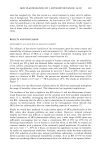
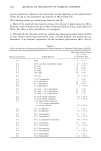
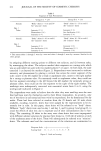
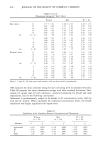
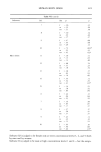
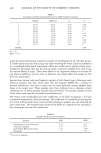
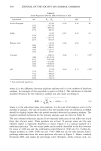
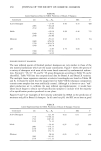
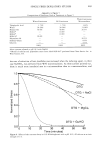
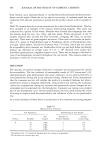
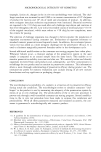
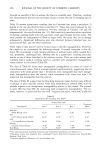
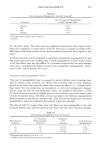
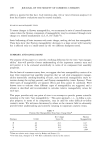
HUMAN BODY ODOR 425 Table X Sex Attribution, Intensity, and Pleasantness x2--One sample test for intensity and sex attribution "Solution" Women X 2 = 12.8 df = 1 p .00l shirts Men X 2 = 12.8 df = 1 p .001 "Body" Women X 2 = 5.0 df = 1 p .05 shirts Men X 2 = 1.8 df = 1 p .20 x2--One sample test for pleasantness and sex attribution* "Solution" Women X 2 = 5.0 df = 1 p .05 shirts Men X 2 = 5.0 df = 1 p .05 * An analysis for the "body" shirts is not possible here due to the design of the experiment (see Table I). function and a low threshold are particularly valuable to the perfumer, because they tend to be persistent and diffusive. The low slope of the psychophysical function of androstenol, coupled with its low threshold, may well have biological, evolutionary significance. As a metabolite of a male hormone, as a substance that occurs naturally in excretions of man and other mammals, it may well have, or have had, signal function for man (1,2). For such substances, it is obviously very useful that they be perceptible at great dilutions in the air (i.e., at great distances) without becoming overpowering when smelled at far higher concentrations (i.e., from nearby). The finding that both male and female respondents rated the men's shirts, on average, higher in odor level than the women's shirts, without knowing what they were smelling, confirms Schleidt's findings (5). CONCENTRATION AND PLEASANTNESS The negative correlation between concentration and pleasantness for androstenone, II, and III is in line with perfumers' common experience regarding "animal" odorants (civet, natural musk, indol, and others): that they must be used sparingly and lead to rejection if used at too high levels (compare also references 2 and 4). The synthetic musk, cyclopentadecanolide, does not exhibit this behavior at all. In a qualitative sense as well, cyclopentadecanolide was found to be considerably further removed from actual human body odor than are the other odorants tested numerous respondents remarked that the shirts with cyclopentadecanolide smelled "perfumed." An interesting incidental finding was the wide variability in pleasantness ratings for the T-shirts that had actually been worn. Both for shirts worn by women and those worn by men, and both with female and with male respondents, the difference between the shirt judged most pleasant and the one judged least pleasant was significant (Table XI)--but more highly for men's than for women's shirts. PERCEIVED INTENSITY AND PLEASANTNESS The finding that the correlations between perceived intensity and pleasantness (Table

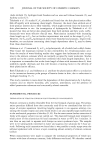
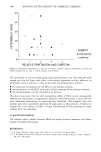
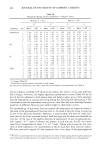
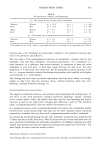
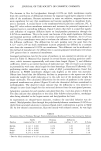
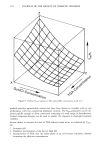
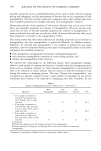
426 JOURNAL OF THE SOCIETY OF COSMETIC CHEMISTS Table XI Comparison of Mean Pleasantness Rating for Most Pleasant and Least Pleasant T-shirt (Wilcoxon matched pairs signed ranks test) Most Pleasant Rating Least Pleasant Rating Female Respondents Mean q- SD Mean q- SD z p (2-tailed) I Women's shirts Shirt 12 4.44 .78 Shirt 13 3.46 1.13 2.48 .013 Men's shirts 15 4.06 1.15 14 1.69 1.02 3.30 .001 II Women's shirts 10 3.90 1.58 7 3.21 1.91 1.57 .117 Men's shirts 9 4.14 1.46 7 2.68 1.56 2.94 .003 Male Respondents I Women's shirts 12 (.75 1.67 14 4.03 1.00 2.07 .038 Men's shirts 15 4.4l 1.49 11 2.40 1.03 3.35 .001 II Women's shirts 10 4.22 1.24 7 3.53 1.27 2.51 .012 Men's shirts 9 4.24 .97 7 3.16 1.20 2.54 .011 VII) are, on the whole, less consistent and lower than between concentration and pleas- antness (Table VI) may seem surprising at first sight. It must be born in mind, how- ever, that Table VII records the relationship between intensity perception and pleasant- ness perception at a given concentration /eve/.' it takes into account only the intensity differences due to subjective factors, not those due to the objective factor, concentra- tion. This is true also for the "overall" correlations for solutions 1-5. The different correlation patterns are curious: for substance II one can say, at all con- centration levels studied, that "the more strongly one perceives it, the more unpleasant one finds it." It is simply an odor that nearly everybody considers inherently un- pleasant. With androstenol and substance III, there appears to be, for many people, a most pleasant level that is low but higher than 0. With male respondents, the correla- tions between intensity and pleasantness are not significant at any concentration level with female respondents, they are significant and negative only at the two highest concentration levels. (We have no reasonable explanation for the significant negative correlation, with women, at the lowest concentration level of III.) The finding (Table V) that for these two substances the relationship between concentration and pleasantness shows a far clearer trend at higher concentrations (solutions 1-3) than at lower concen- trations (solutions 3-5) is in line with this interpretation. With cyclopentadecanolide there is no consistent pattern linking pleasantness ratings to perceived intensity at a given concentration (Table VII), nor pleasantness to concentra- tion (Table V). Here, the interpretation "some like it strong" appears appropriate. It must be remembered, for this and all other findings of this test, that the odors were smelled on T-shirts in a context in which they were judged "as body odors." Different relationships between intensity and pleasantness might well have resulted had they been smelled on smelling blotters or in perfume bottles as aromatic chemicals or as perfumes. With the T-shirts actually worn, a pattern is apparent that is also present with andros- tenol and III: the negative correlation between perceived intensity and pleasantness, that is, the feeling that "strong is unpleasant," is stronger with female than with male respondents. This is particularly pronounced with the shirts worn by males where all shirts give, among female respondents, negative correlations (see Table VII). This
Purchased for the exclusive use of nofirst nolast (unknown)
From: SCC Media Library & Resource Center (library.scconline.org)