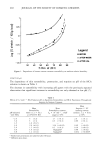
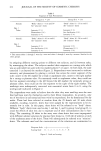
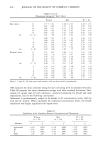
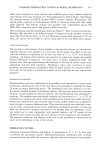
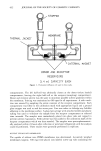
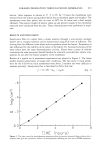
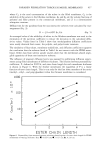
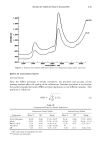
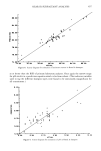
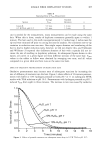
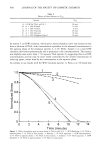
PARABEN PERMEATION THROUGH MODEL MEMBRANES 433 solvent. After exposure to solvent at 37 - 0.2øC for 72 hours the membranes were removed from the solvent and quickly blotted dry on absorbent paper and weighed. The membranes were then placed into an oven at 60øC for 24 hours and a final weight obtained. The percent weight of solvent taken up and percent weight of the membrane extracted were calculated from the data. These determinations were performed in tripli- cate. RESULTS AND DISCUSSION Steady-state flux of a solute from a donor solution through a non-reactive isotropic barrier into a receptor solution can be characterized using Fick's law of diffusion. The driving force for diffusion is the solute activity gradient across the barrier. Permeation is also influenced by the mobility of the solute in the barrier (9). Saturated solutions of the same solute have the same thermodynamic activity. Fluxes from a series of vehicles containing the same permeant should therefore be identical, provided that vehicle com- ponents do not alter the barrier property of the membrane. Results of a typical set of permeation experiments are plotted in Figure 2. The linear profile denotes achievement of steady-state conditions. The lag times to reach steady- state for the 0.0254-cm thick membranes were about 2 minutes and were difficult to measure precisely. Steady-state flux is described by Fick's first law: J - D' PC' (CD- C•t)/h (Eq. 1) .8 ¸ • 4 0.0 0 2 4 8 T ME (hours) Figure 2. The time course for methylparaben permeation from an aqueous saturated donor solution into a receptor sink Q is the cumulative amount of methylparaben diffusing per unit area of PDMS membrane.

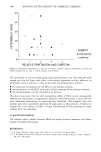
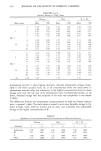
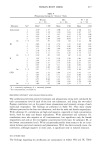
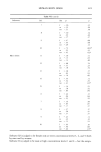
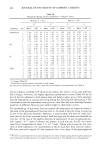
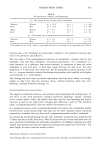
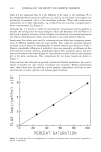
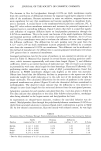
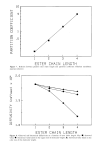
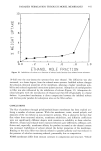
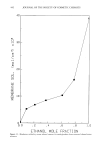
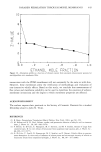
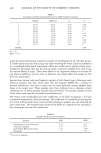
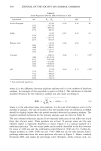
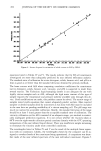
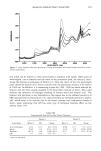
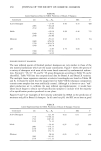
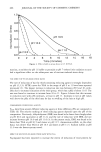
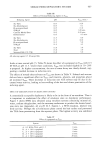
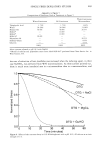
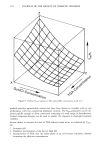
434 JOURNAL OF THE SOCIETY OF COSMETIC CHEMISTS where J is the steady-state flux, D is the diffusivity of the solute in the membrane, PC is the membrane/vehicle partition coefficient, C o and C R are the donor and receptor con- centrations of permeant, and h is the membrane thickness. When sink conditions are maintained, as in these experiments, CR is effectively zero and flux is proportional to donor concentration, Co (Figure 3). Although Eq. 1 is written in terms of concentration, the permeant activity gradient is actually the driving force for mass transport. Flynn and Roseman (10) and Most (11) had noted a negative deviation in flux at higher concentrations of p-aminoacetophenone and ethyl p-aminobenzoate which was attributed to non-ideal solution behavior. Steady-state flux values were used for evaluating solvent effects and comparing perme- ation of different parabens from the same vehicle. Flux values for saturated solutions (constant activity source) of methylparaben in various solvents are collected in Table I. Despite considerable differences in solubility, there was essentially no difference in flux from solution in water, glycerin, polyethylene glycol 400, propylene glycol, and mix- tures of the polyols with water (Figure 4). Less extensive studies with the other parabens led to the same conclusions. Flux comparisons for two donor liquids are shown in Figure 5. From partition data obtained on specially synthesized fillerless membranes, the concen- tration of paraben per unit volume of polymer was calculated. Within experimental error, these values were the same for a given paraben, independent of solvent for satu- rated systems in water, glycols, and aqueous glycol mixtures. z 0 0 20 40 60 80 100 PERCENT SATURAT I ON Figure 3. Steady-state flux of methylparaben as a function of aqueous donor concentration expressed as a percent of saturation.
Purchased for the exclusive use of nofirst nolast (unknown)
From: SCC Media Library & Resource Center (library.scconline.org)