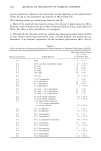
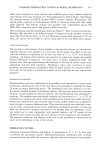
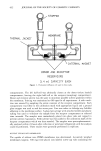
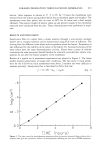
400 JOURNAL OF THE SOCIETY OF COSMETIC CHEMISTS test solution was expressed as the mean ratio (+ two standard errors) of extensibility after test solution treatment to extensibility after treatment with water only. PENETRATION MEASUREMENTS A penetration cell similar to many described in the literature (12) was constructed. The skin layer (2 cm 2 human stratum corneum) was held vertically between glass flanges, thus separating two glass compartments, each with an access port at the top outside edge. Each compartment held about 5 ml solution stirred with magnetic coupling at a rate sufficient to ensure that transport through the solution was not a rate-limiting step. In contact with the outside of the stratum corneum was the donor solution of penerrant, while in contact with the inside was the acceptor solvent, water. The cell was main- tained at a temperature of 30øC, close to that of the skin surface in vivo. Prior to each penetration measurement, the integrity of the stratum corneum was checked by measuring its DC resistance. Isotonic saline was introduced into both chambers. Each side was electrically connected via agar/KC1 bridges to KC1 solution containing calomel electrodes and thence to a high impedance resistance meter. Any membrane whose resistance was below about 40 Kf• was probably faulty and was re- jected. Both compartments were carefully washed out with water before introducing donor and acceptor solutions. The donor solute was radiolabelled and small aliquots were removed at 30-min intervals from the acceptor solution for liquid scintillation counting. Sampling was normally discontinued at 7 hours except in cases of slower penetration rates which were sampled for up to 30 hours. Results were calculated as total amount of solute that had penetrated per 1 cm 2 of skin at a given time from an essentially constant concentration of donor solution (since quantity of solute penetrating total quantity of donor solute). Plotted data showed a gradually increasing amount of penetrating solute tending to a steady-state rate from which the steady-state flux J can be determined. From Fick's first law of diffusion (12), KDAC J - d -- kpAC where K = skin-water partition coefficient D = diffusion coefficient AC = concentration difference across the membrane d = thickness of membrane kp KD - permeability constant kp was calculated for HCA in aqueous solution as a function of solution pH and in the presence of a number of penetration enhancers and structurally related materials. Each study of dependence on one parameter was made, when possible, using skin from one subject to avoid problems of inter-subject variation. All penetration measurements were carried out in duplicate. SORPTION MEASUREMENTS Eight discs of 5 mm diameter were cut from separated human stratum corneum and

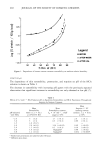
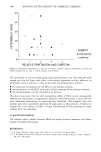
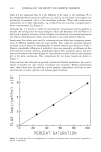
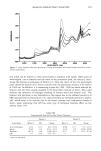
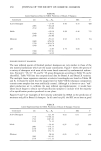
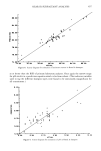
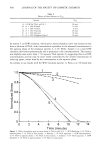
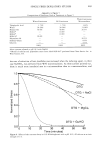
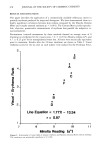
SKIN PLASTICISATION BY 2-HYDROXYOCTANOIC ACID 401 each disc weighed dry. One disc served as a control exposed to water only for subtrac- tion of background. The remainder were separately exposed to 1 ml aliquots of donor solution, radiolabelled as for penetration, for four hours at 30øC. This time was suffi- cient for equilibrium to be achieved. Each sample was then removed, briefly rinsed in water, blotted dry, and solubilised prior to liquid scintillation counting. Specific sorp- tion of donor solute was calculated for each group of seven as a mean ___ two standard errors. RESULTS AND DISCUSSION EXTENSIBILITY AS A FUNCTION OF RELATIVE HUMIDITY The influence of the relative humidity of the environment upon the water content and extensibility of stratum corneum is well documented (13). We wished to investigate the plasticisation efficacy of HCA at a range of relative humidities including those low values at which conventional moisturisers cannot function (6). This study was carried out using one sample of human corneum only. Its extensibility (% stretch per 100 g load) was measured before treatment, as the relative humidity (RH) of the cabinet containing the apparatus was changed in steps. Sufficient time was al- lowed for equilibration of the corneum with each new RH. Temperature was main- tained at 20øC. The sample was immersed in water for 3 hours at 20øC, blotted, and allowed to equilibrate with the cabinet environment before extensibility was measured again as a function of RH. Finally, the process was repeated after immersion of the sample for 3 hours in 0.15 mol 1-• HCA solution at 20øC. The results are presented in Figure 1. It is evident that the effectiveness of plasticisation by HCA was maintained throughout the range of humidity values used. This observation has important implications. The incidence of dry skin is higher at low RH values (1) and the effectiveness of tradi- tional (humectant type) moisturisers will be minimal with little available atmospheric water. It is, therefore, encouraging that the HCA plasticisation effect persists even at low RH, indicating that the effect is direct plasticisation of corneum rather than plasti- cisation via moisturisation. This is borne out by investigations which indicate that HCA does not substantially alter the water-binding capacity of corneum (7). Ideally we would have preferred to study further aspects of HCA plasticisation at low RH, where skin dryness problems are most evident. However, isolated corneum samples are brittle and difficult to handle and measure at this value. The above-de- scribed persistence of HCA plasticisation efficacy over a wide range of RH values was sufficiently encouraging that we chose a compromise RH of 65% (at 20øC) for all following measurements. It is of interest to note that when, at this RH, we treated our corneum samples with a solution of the commonly quoted moisturiser (4) sodium lac- tate at 0.2 mol 1- •, 20øC for 3 hours, we obtained no significant increase in extensibil- ity under our experimental conditions. Similarly, treatment under the same conditions with 10% solutions of either urea, sodium pyrrolidone carboxylate, or sodium chloride failed to produce any substantial extensibility increases. So at an RH of 65% we would expect no interfering effects of moisturisation from the additives to be reported below.
Purchased for the exclusive use of nofirst nolast (unknown)
From: SCC Media Library & Resource Center (library.scconline.org)