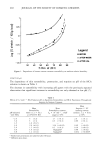
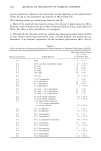
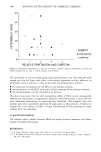
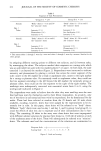
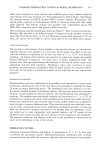
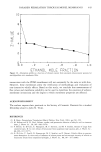
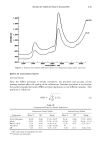
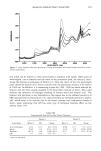
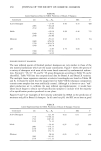
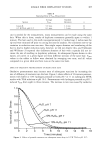
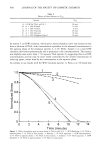
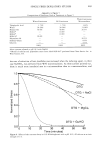
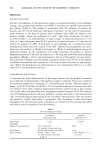
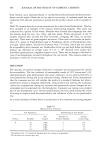
470 JOURNAL OF THE SOCIETY OF COSMETIC CHEMISTS this may account for the difference in results. We did not investigate W/O microemul- sions. THE EFFECT OF GUANIDINE SALTS ON REDUCTION KINETICS Guanidine salts are known to accelerate the kinetics of hair reduction (8). Figure 6 shows the effect of guanidine hydrochloride (GUHC1), NaCI, and MgC12 at ionic strengths of 1.0 on reduction kinetics using 2,4-dithioglutaric acid (DTG). This dithio-diacid reduces hair very slowly in the absence of salt, probably because its bulk and high negative charge density cause it to diffuse into hair slowly. The addition of NaC1 or MgC12 leads to some increase in reduction rate, but GuHC1 causes a much greater increase at the same ionic strength. This effect is most probably due to a large increase in the rate of diffusion of DTG into the hair as a result of hair swelling induced by GuHC1. The effect of several guanidinium salts on SFTK results with thioglycolate at pH 11.5 are shown in Figure 7. All of the salts reduced T95 % to less than half its original value. Differences between the anions are small and are probably not significant. The major swelling effect seems to come from the guanidinium cation. CENTRAL COMPOSITE STUDY An efficient way to determine effects of multiple parameters is to perform an experi- 1.0 0.8 0.6 0.4 0.2 1-No Salt 2-W/1M GuHCI 3-W/0.5M Su2CO3 4-W/0.5M Su2SO4 5-W/1M GuSCN 4 -"•\\ ,k•" • '" 2 4 6 8 Time (minutes) 0 I 0 10 12 14 Figure 7. Effects of guanidine salts on stress decay in 0.5 M TGA at pH 11.5. 1. No salt. 2. 1.0 M GuHC1. 3. 0.5 M Gu2CO 3. 4. 0.5 M Gu2SO 4. 5. 1.0 M GuSCN.

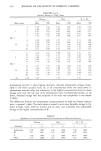
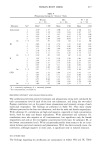
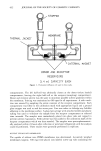
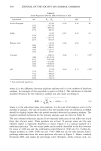
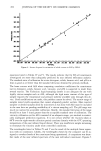
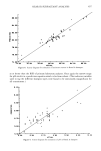
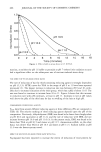
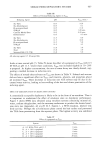
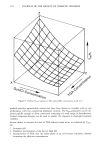
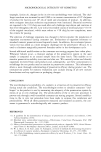
SINGLE FIBER DEPILATORY STUDIES 47 1 Active Range 0.25-0.75M TGA pH Range 9.5-11.5 GuHCI Range 0-2.0M T95% = 67.45 4- HF- 39.47x [TGA] - 29.59 X [GuHCI] -4.44XPH 4- 5.77 X [TGA] 2 4- 2.81 X [GuHCI] 2 4- 6.00 X [TGA] X [GuHCI] 4- 2.0 X [TGA] X pH 4- 1.64 X pHX [GuHCI] for Hair:C/= 1 HF - 0 for Hair½2 HF -- 0.11 r 2 = .955 Only one residual time (Actual-Predicted) was greater than one min. Figure 8. Central composite response equation. ment in a central composite design format, which allows the construction of a regres- sion equation to predict the response to any set of conditions. From this regression equation may be obtained the single variables and variable interactions which statisti- cally significantly influence hair tensile weakening. Furthermore, by inspection of the equation, the T95 % response can be minimized with respect to all variables or to fewer variables when the remaining ones are fixed at given values. A central composite test of the response of T95 • to calcium thioglycolate concentration from 0.25 to 0.7 5 M, pH from 9.5 to 11.0, and GuHC1 concentration from 0 to 2.0 M was run. The complete response equation is shown in Figure 8. In order to run enough conditions to adequately define the response equation, fifteen 1.5-cm sections from each of two hairs were used. This results in the small hair-to-hair correction factor, HF. The fit to the model was excellent, with no measured time being different from the pre- dicted time by more than 1 minute. Figure 9 illustrates the calculated response surface for the response of T95 % to thioglycolate and GuHC1 concentration at pH 10.5. The thioglycolate and GuHC1 axes run from 0.25 to 0.75 M and from 0.0 to 2.0 M respec- tively. T95 % ranges from 16.5 to 6.5 minutes. While the equation in Figure 8 is useful for prediction of response within the range of the test, it should be pointed out that the equation cannot be extrapolated outside of the measured range of any of the parameters because bizarre results, such as prediction of negative values for T95 %, may occur. CONCLUSIONS The SFTK method is useful for the laboratory evaluation of depilatory systems. The
Purchased for the exclusive use of nofirst nolast (unknown)
From: SCC Media Library & Resource Center (library.scconline.org)