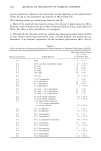
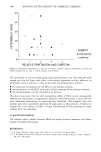
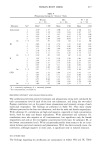
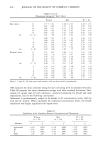
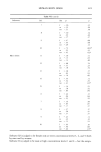
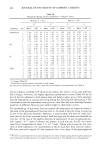
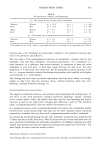
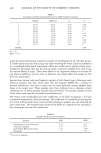
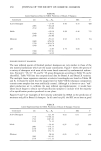
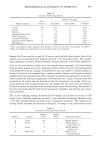
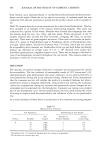
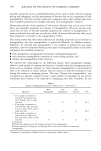
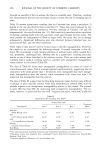
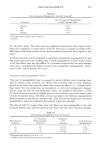
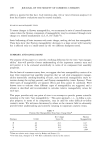
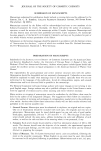
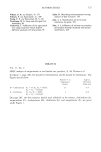
498 JOURNAL OF THE SOCIETY OF COSMETIC CHEMISTS ability is poorest for fine hair. Curl retention data (14) or twist retention analysis (14) from hair fixative evaluations may be treated similarly. FLYAWAY MANAGEABILITY TESTS To assess changes in flyaway manageability, we recommend a ratio of control/treatment values where the flyaway component of manageability may be estimated through static charge or a related measurement (2,6,15,16) (Table V). Static ballooning of hairs increases with static charge, making the hair less manageable. These data show that flyaway manageability decreases to a large extent with humidity but is affected only to a small extent by the two different shampoos tested. SUMMARY AND CONCLUSIONS The purpose of this paper is to provide a working definition for the term "hair manage- ability" that will provide a better understanding of this important cosmetic term and will permit it to be evaluated scientifically in terms of its component hair assembly properties. On the basis of consumer survey data, we suggest that hair manageability consists of at least three important hair assembly properties that we call style arrangement manage- ability (essentially combing/brushing of hair), style retention manageability (style re- tention during the styling process), and flyaway manageability (static flyaway). These three types of manageability are separate effects and they cannot be combined. Well known tests to evaluate these different types of manageability are suggested and a scheme is described and recommended to calculate relative manageability values for each type. This paper provides only one point of view in an attempt to provide greater scientific meaning to the term "hair manageability." This same approach, i.e., to define a com- plex property in terms of its components, may be used for other difficult-to-define cosmetic terms. We welcome discussions by others in the cosmetic field to ultimately provide better understanding and scientific meaning to important cosmetic terms. Table V Flyaway Hair Manageability From Static Charge Data # Rel. Charge Flyaway Shampoo % RH Units (X) Manageability B 40 20.3 0.47 C 40 19.4 0.50 B 70 10.2 0.94 C 70 9.6 1.00 • Data are relative static charge units by Barber and Posner (15). For these data, shampoo C at 70% RH is arbitrarily selected as the control.

HAIR MANAGEABILITY 499 ACKNOWLEDGEMENTS Appreciation is expressed to Mss Barbara Chapinski and Eileen Schmidt for many helpful discussions and advice during the course of this work. REFERENCES (1) C. R. Robbins and G. V. Scott, Prediction of hair assembly characteristics from single fiber proper- ties, J. Soc. Cosmet. Chem., 29, 783-792 (1978). (2) J. Jachowicz, G. Wis-Surel, and M. L. Garcia, Relationship between triboelectric charging and surface modifications of human hair, J. Soc. Cosmet. Chem., 36, 189-212 (1985). (3) P.S. Hough, J. E. Huey, and W. S. Tolgyesi, Hair body, J. Soc. Cosmet. Chem., 27, 571-578 (1976). (4) C. R. Robbins and C. Reich, Prediction of hair assembly characteristics from single fiber properties. Part II. The relationship of fiber curvature, stiffness, and diameter to combing behavior, J. Soc. Cosmet. Chem., 37, 141-159, (1986). (5) C. R. Robbins, Methods to evaluate friction on hair, 3rdAnnual Hair Science Sympodum, Syburg, W. Germany (November 1984). (6) C. Mills, V. C. Ester, and H. Henkin, Measurement of static charge on hair,J. Soc. Cosmet. Chem., 7, 466-475 (1956). (7) M. L. Garcia and J. Diaz, Combability measurements on human hair, J. Soc. Cosmet. Chem., 27, 379-398 (1976). (8) W. Newman, G. L. Cohen, and C. Hayes, A quantitative characterization of combing force, J. Soc. Cosmet. Chem., 24, 773-782 (1973). (9) D. Bauer, J. P. Beck, C. Monnais, and C. Vayssie, Contribution to the quantification of the condi- tioning effects of hair dyes, Int. J. ofCosmet. Sci., 5, 113-129 (1983). (10) C. R. Hicks, Fundamental Concepts in the Design ofExperzments, 2nd ed. (Holt, Rinehart, and Winston, 1973), lop. 86-103. (11) W. J. Conover, Practical Nonparametric Statistics, 2nd ed. (John Wiley & Sons, 1980), pp. 299- 308. (12) C. R. Robbins, Chemical and Physical Behavior of Human Hair, (Van Nostrand Reinhold Co., New York, 1979), p. 201. (13) N. E. Yin, R. H. Kissinger, W. S. Tolgyesi, and E. M. Cottington, The effect of fiber diameter on the cosmetic aspects of hair, J. Soc. Cosmet. Chem., 28, 139-150 (1977). (14) S. H. Ganslaw and F. T. Koehler, Evaluation of hair fixatives--a new technique utilizing torsional measurements,J. Soc. Cosmet. Chem., 29, 65-78 (1978). (15) R. G. Barber and A.M. Posner, A method for studying the static electricity produced on hair by combing, J. Soc. Cosmet. Chem., 10, 236-246 (1959). (16) A. C. Lunn and R. E. Evans, The electrostatic properties of human hair, J. Soc. Cosmet. Chem., 28, 549-570 (1977).
Purchased for the exclusive use of nofirst nolast (unknown)
From: SCC Media Library & Resource Center (library.scconline.org)